

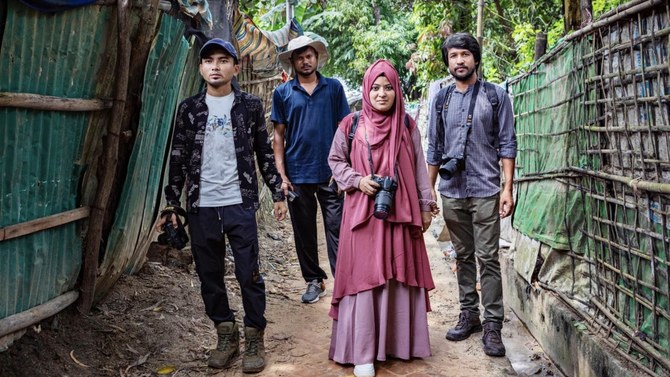

DHAKA: Four Rohingya refugees have won the 2023 Nansen Refugee Award in the Asia and Pacific category for using audiovisual art to document their experiences of statelessness and living in camps in Bangladesh.
The UNHCR Nansen Refugee Award was established in 1954 to recognize individuals or groups for their work helping displaced and stateless people. It is named after Fridtjof Nansen, a Norwegian scientist and diplomat who became the first high commissioner for refugees at the League of Nations in 1921.
Rohingya refugees Abdullah Habib, Sahat Zia Hero, Salim Khan and Shahida Win, who have been documenting the life of Rohingya with their smartphones and cameras, were awarded the prestigious UN prize for “portraying the lives of their fellow refugees truthfully and with empathy,” the UNHCR said in a statement on Thursday.
The winners, all in their 20s and early 30s, are living in squalid and overcrowded camps in Cox’s Bazar in Bangladesh’s southeast.
The coastal district, which has for decades given shelter to Rohingya fleeing violence in neighboring Myanmar, has become the world’s largest refugee settlement with the arrival of hundreds of thousands of them following the 2017 Myanmarese military crackdown.
Their return to Myanmar has been on the agenda for years, but a UN-backed repatriation process has not taken off until now, despite pressure from Bangladesh amid dwindling financial support to host the large community.
“As I am documenting and telling the story of the Rohingya refugees, I find every story painful ... I see their dreams and hopes shattered,” one of the awardees, photographer and documentary filmmaker Habib, told Arab News.
“The young children and newborn babies, I see them prisoners by birth.”
Storytelling is for him a way to save his community from being forgotten.
“I want to keep reminding people around the world about our struggle life and to make them feel empathy for us, to see our resilience and strength,” he said.
“We are very concerned that people around the world will forget us easily if we don’t keep sharing our stories.”
Khan, another awardee, who works as an emergency preparedness trainer, has spent his whole life in Cox’s Bazar.
“I understand the people’s suffering and agony in this camp life very well. I know the pain of refugee life ... I believe in making a change with my photos,” he said.
“The aim of my photography is documenting ... I want to enlighten the next generation about our lives, and I want to make people from other communities aware of our everyday struggle and challenges.”

In this photo by Salim Khan, one of the winners of the 2023 Nansen Refugee Award, Rohingya women are seen carrying firewood at a camp in Cox’s Bazar, Bangladesh. (Salim Khan)
Hero, a community volunteer and researcher at the International Organization for Migration, has been involved in photography since 2015, when he was living in Myanmar’s Rakhine State.
He was initially a sports photographer before he arrived in Cox’s Bazar with his family in 2017.
“Children in the camp have no future and access to formal education. There are huge health crises here ... If anyone from a family gets any major disease like cancer, they can’t get treatment here, and they can’t afford treatment outside,” he said.
“I want to show to the world that our situation is very bad here. We have been suffering in the camps for the past six years. Our lives and hopes have been destroyed. If the world and international community forget us, it will be a great loss for world humanity. We don’t want to be treated as a forgotten community. The world should recognize us as human beings.”
Win, the only woman among the four winners, shares the same hope for the impact of her work. She also wants her photography to serve as a means to empower other women.
“In our community, girls are not allowed to go out of home. Despite this, I used to go out to learn the stories of our people ... I wanted to make the international community know that we are also able to do storytelling,” she told Arab News.
“The world doesn’t know about the struggle of women in the camps ... If we don’t tell our stories, people will not know the actual situation. Since many media don’t come here, we have to tell these stories ourselves.”


