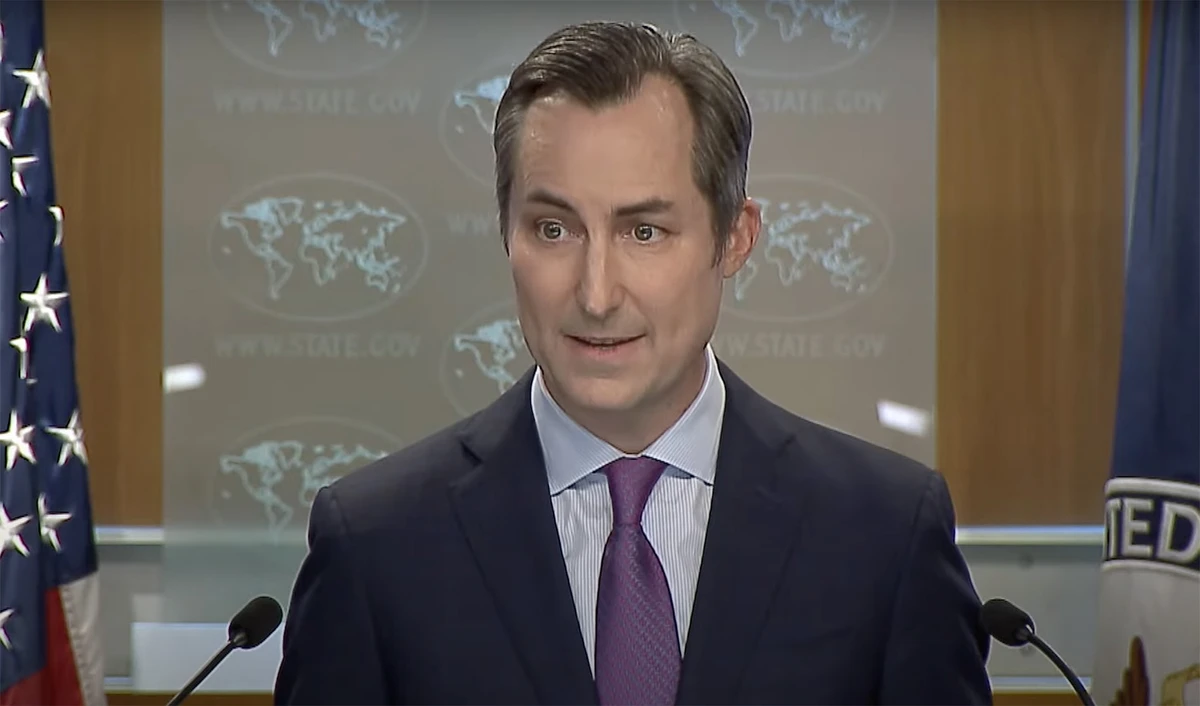
ISLAMABAD: A senior State Department official denied any American role in bringing Pakistani leaders to power on Monday, saying the administration in Washington had always pursued a policy of engagement toward the South Asian country and worked with all governments over a wide spectrum of issues.
The statement comes only a few weeks ahead of the general elections in Pakistan, which are scheduled to be held by the election commission on Feb. 8.
The deep-rooted suspicion among Pakistanis toward the United States regarding political manipulation has intensified following last year’s ouster of former prime minister Imran Khan, who publicly accused the Biden administration of orchestrating his downfall. American officials have repeatedly denied the allegation but found it difficult to dispel the public perception in Pakistan.
The recent decision of Khan’s political rival, Nawaz Sharif, to end his four-year self-exile in London and return to Pakistan to lead his party’s election campaign, despite a conviction on graft charges from an accountability court, has further fueled suspicions among some about potential political manipulation before the national polls.
“The United States does not play any role in choosing the leaders of Pakistan,” State Department Spokesperson Matthew Miller said during his media briefing in Washington. “We engage with the leadership shown by – or the leadership decided by the Pakistani people, and we will continue to engage with the Government of Pakistan on all [the important] issues.”
Miller was asked why the United States had not condemned Sharif’s return to the country to carry out political activities despite being convicted by a local accountability court.
The State Department official also responded to a question about mounting tensions between Pakistan and Afghanistan in recent weeks, encouraging both countries to resolve their issues diplomatically.
“It’s something that we have been engaged on,” he added. “We’ve detailed the substance of some of those specific engagements over the past few weeks, and we will continue to do so.”
Pakistani officials have accused the government in Kabul of not doing enough to end cross-border militancy after a string of deadly attacks which they blamed on the proscribed Tehreek-e-Taliban Pakistan (TTP) network.
The TTP leadership is said to be based in Afghanistan.
Pakistan has also started deporting unregistered foreigners, mostly Afghans, since November while citing security reasons.
US denies political meddling in Pakistan amid rising suspicions ahead of general elections
https://arab.news/2egfj
US denies political meddling in Pakistan amid rising suspicions ahead of general elections
- State Department says Washington works with all Pakistani administrations over a wide spectrum of issues
- Matthew Miller also urges Pakistan and Afghanistan to find diplomatic solutions to their mounting tensions
Pakistan urges equal application of international law, flags Indus treaty at UN debate
- Pakistani envoy says silence over violations of international law are fueling conflicts from South Asia to Gaza
- He urges the UN secretary-general to use the Charter’s preventive tools more proactively to help avert conflicts
ISLAMABAD: Pakistan’s UN ambassador on Monday called for equal application of international law in resolving global conflicts, warning that India’s decision to hold the 1960 Indus Waters Treaty in abeyance and the unresolved dispute over Kashmir continued to threaten stability in South Asia.
Speaking at an open debate of the UN Security Council on “Leadership for Peace,” Ambassador Asim Iftikhar Ahmad said selective enforcement of international law and silence in the face of violations were fueling conflicts worldwide, undermining confidence in multilateral institutions.
His remarks come months after a brief but intense military escalation between India and Pakistan in May, following a gun attack on tourists in Indian-administered Kashmir. India blamed the attack on Pakistan, a charge Islamabad denied while calling for a transparent international probe.
The attack triggered a military standoff between the two South Asian nuclear neighbors and prompted New Delhi to suspend the World Bank-brokered Indus Waters Treaty, a move Pakistan says has no basis in international law and has described as “an act of war.”
“India’s unilateral suspension of the Indus Waters Treaty — a rare and enduring example of successful diplomacy — is yet another blatant breach of international obligations that undermines regional stability and endangers the lives and livelihoods of millions,” Ahmad told the council.
He said Jammu and Kashmir remained one of the oldest unresolved disputes on the Security Council’s agenda and required a just settlement in line with UN resolutions and the wishes of the Kashmiri people, a position India has long rejected.
Ahmad broadened his remarks to global conflicts, citing Gaza, Ukraine, Sudan and other crises, and said peace could not be sustained through “selective application of international law” or by sidelining the United Nations when violations occur.
The Pakistani envoy also referred to the Pact for the Future, a political declaration adopted by UN member states this year aimed at strengthening multilateral cooperation, accelerating progress toward the 2030 development goals and reforming global governance institutions.
While welcoming the pact, Ahmad warned that words alone would not deliver peace, pointing to widening development financing gaps, rising debt distress and climate shocks that he said were reversing development gains across much of the Global South.
He called for a stronger and more proactive role for the UN Secretary-General, including earlier use of preventive tools under the UN Charter, and urged the Security Council to demonstrate credibility through consistency, conflict prevention and greater respect for international court rulings.
“No nation can secure peace alone,” Ahmad said. “It is a collective endeavor, requiring leadership, cooperation and genuine multilateralism.”