

Pakistan commerce minister on high-level China visit to improve balance of trade

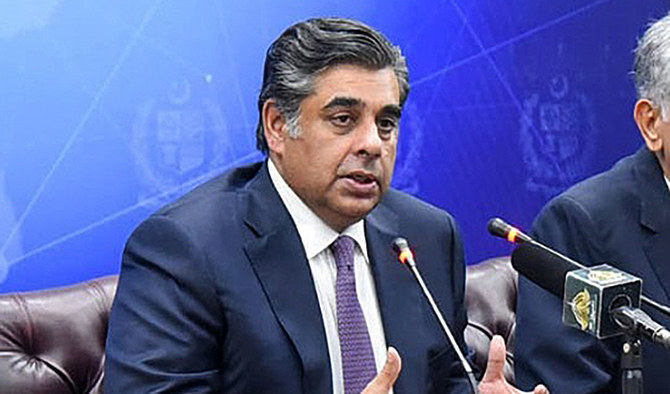
In this file photo, taken on September 8, 2023, Pakistan’s interim commerce minister Dr. Gohar Ejaz speaks during a joint press conference. (APP/File)
Short Url
Updated 11 December 2023
Follow

Pakistan commerce minister on high-level China visit to improve balance of trade

  • In 2022, Pakistan’s exports to China were recorded at US$2.53 billion, with agricultural exports catching the pace
  • China’s exports to Pakistan stood at $23.09 billion during 2022, according to UN’s COMTRADE database

KARACHI: Pakistani Minister of Commerce Dr. Gohar Ejaz is leading a high-level delegation to China to discuss economic ties, with a focus on improving the balance of trade between the two nations.

China is a major ally and investor, particularly in the China Pakistan Economic Corridor, a flagship project under China’s Belt and Road Initiative with more than $65 billion pledged for road, rail, agricultural and other infrastructure developments.

China is Pakistan’s largest trading partner and biggest source of foreign direct investment. In 2022, Pakistan’s exports to China were recorded at US$2.53 billion while China’s exports to Pakistan stood at $23.09 billion, according to the United Nations COMTRADE database.

“The delegation, led by Minister Dr. Gohar Ejaz, is engaged in discussions with Chinese counterparts aimed at improving the Sino-Pak trade relations and identifying avenues for collaborative ventures,” the minister’s office said in a statement.

“With a focus on improving the trade balance with China as part of the Minister’s vision to upon the momentum generated during Prime Minister [Anwaar-ul-Haq] Kakar’s visit, the delegation is actively exploring opportunities to enhance economic cooperation.”

On Monday, Ejaz met with Zhang Xinmin, Chairman of the China Chamber of Commerce for Import and Export of Textiles (CCCT), “to bolster textile trade between Pakistan and China, with a particular emphasis on addressing trade imbalances.”

Discussions included strategies for accessing new markets in China to promote Pakistani exports and facilitate smoother trade transactions.

The Pakistani minister also met with Luan Richeng, President of the COFCO Group, a key player in China’s food processing sector. 

“This meeting forms a pivotal part of Pakistan’s strategy to augment non-textile exports, leveraging the strength of COFCO Group’s position as China’s largest food processor, manufacturer, and trader,” Pakistan’s commerce ministry said. 

The delegation also held a series of business-to-business (B2B) meetings, providing a platform for Pakistani and Chinese businessmen to engage in discussions to fortify trade relations.


Pakistan could double economic size to $1 trillion by 2035 if reforms accelerate — planning minister

Updated 5 sec ago
Follow

Pakistan could double economic size to $1 trillion by 2035 if reforms accelerate — planning minister

  • Ahsan Iqbal says remittances from nine million overseas Pakistanis almost equal exports from 240 million at home
  • The minister cites exports, artificial intelligence, climate resilience and governance overhaul as pillars of expansion

ISLAMABAD: Pakistan could more than double the size of its economy to $1 trillion by 2035 if it accelerates structural reforms and strengthens governance, Planning Minister Ahsan Iqbal said on Wednesday, setting out an ambitious growth target for the next decade.

Addressing the Pakistan Governance Forum 2026 in Islamabad, Iqbal said the country faced a strategic choice between maintaining its traditional growth trajectory or pursuing deeper reforms aimed at faster expansion. According to the International Monetary Fund (IMF), Pakistan’s economy was estimated at $410.5 billion in 2025.

“If Pakistan continues to grow at its traditional pace, the economy will reach $600 billion by 2035,” Iqbal said, according to an official statement. “However, with national cohesion, positive synergy and accelerated reforms, Pakistan can achieve the milestone of a $1 trillion economy.”

The minister maintained achieving the higher target would depend on leadership capacity, institutional effectiveness and coordinated efforts between the federal and provincial governments.

He said the government had stabilized the economy over the past two years through governance reforms and corrective measures, steering it away from what he described as the “brink of bankruptcy.” He added that international financial institutions were now citing Pakistan’s recovery as a case study.

Iqbal outlined the government’s “Five Es” framework — Exports, E-Pakistan, Environment and Climate Change, Energy and Infrastructure, and Equity and Empowerment — as the pillars of long-term growth.

He said the strategy aimed to push exports beyond $100 billion, promote technology and artificial intelligence, address climate risks, improve energy efficiency and invest in human capital.

The minister acknowledged structural challenges including a 2.55 percent annual population growth rate, 40 percent child stunting, 25 million out-of-school children and a tax-to-GDP ratio of around 10 percent, describing them as urgent governance issues.

He noted that about nine million overseas Pakistanis contribute roughly $40 billion in annual remittances, while exports from a domestic population of 240 million stand at a similar level, highlighting what he called a significant performance gap.

Iqbal urged political stakeholders to prioritize economic development over confrontation, calling for what he termed an “economic long march” driven by national unity and policy continuity.