Lebanon border clashes intensify despite peace efforts

1 / 2
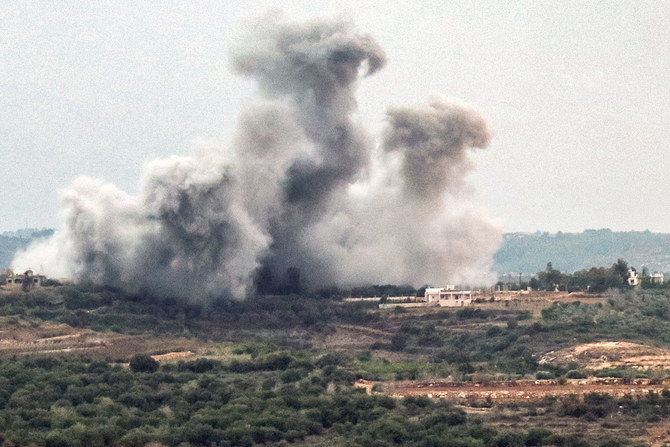
Smoke billows after Israeli bombardment on the outskirts of the village of Tayr Harfa close to the Israeli border in south Lebanon on December 9, 2023. (AFP)
2 / 2
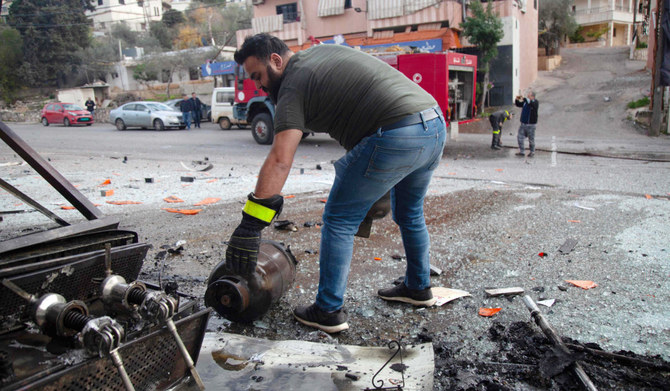
Emergency service members work at the site of Israeli shelling which hit a supermarket and a coffee shop in the southern Lebanese village of Adaysseh near the border with Israel on December 8, 2023, amid ongoing cross-border tensions as fighting continues with Hamas militants in the southern Gaza Strip. (AFP)
Short Url
Updated 09 December 2023
Follow

Lebanon border clashes intensify despite peace efforts

  • Supreme Islamic Council condemns Israeli targeting of villages, farms
  • French delegation leads talks in Tel Aviv, Beirut in bid to restore calm

BEIRUT: Confrontations between Hezbollah militants and the Israeli army intensified on Saturday as talks continued in an effort to end the conflict on Lebanon’s southern border.

The Supreme Islamic Council, which includes Sunni figures in Lebanon, expressed concern about Israeli targeting of villages, towns, and farms in southern areas of the country.

The council met in Dar Al-Fatwa, chaired by the Grand Mufti of Lebanon, Sheikh Abdul Latif Derian.
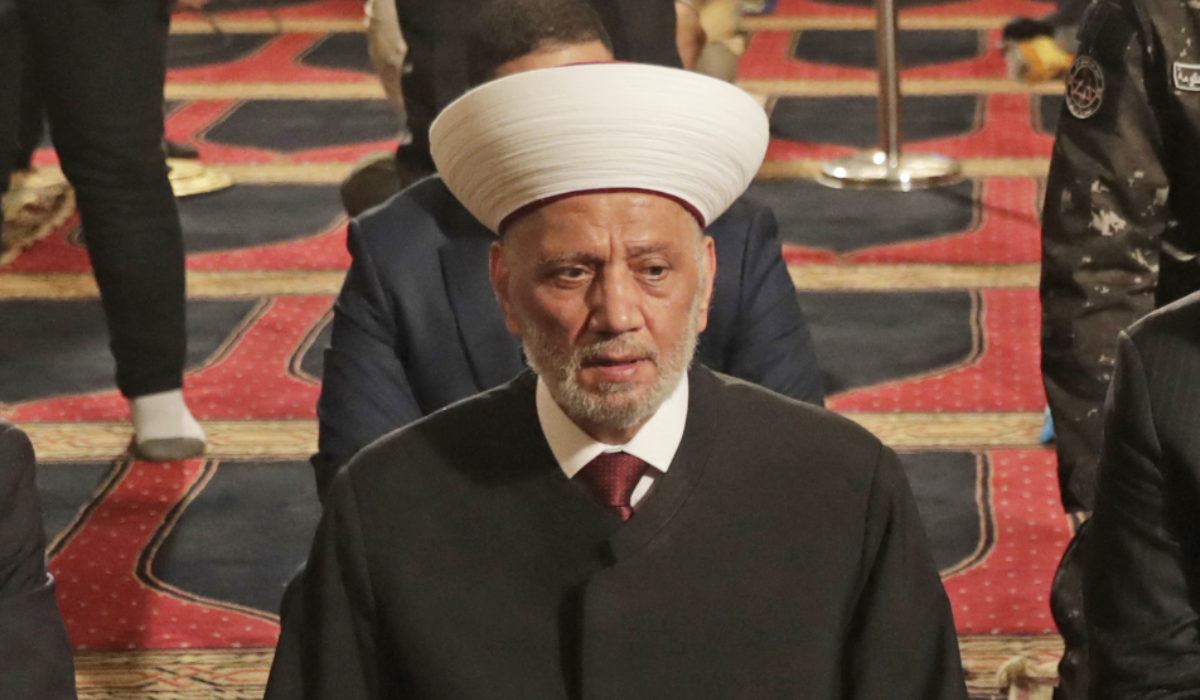


Sheikh Abdul Latif Derian. (AFP file photo)

In a statement, the council said that Israeli officials should be considered “perpetrators of war crimes and mass crimes against humanity, and subjected to international justice, to prevent the occurrence of these crimes elsewhere in the world.”

The statement came as a French delegation met with Lebanese leaders and security officials for a second day in a bid to settle the conflict.

The delegation visited Tel Aviv ahead of the talks, which seek to restore calm along the Blue Line as part of a commitment to implement UN Resolution 1701.

Speaking after the meeting, Lebanese Foreign Minister Abdallah Bou Habib said he notified the visiting French delegation of acts of Israeli aggression stretching back to 2006 and involving more than 30,000 violations of Lebanon’s sovereignty.

He called for the demarcation of the land border and an Israeli withdrawal from occupied Lebanese regions.

Bou Habib reiterated that Lebanese airspace should not be used to attack Syria, and highlighted the importance of supporting the Lebanese army in implementing the UN resolution.

The delegation from France’s Ministry of Europe and Foreign Affairs is led by Frederic Mondoloni, director-general for political and security affairs, and includes Alice Rufo, director-general of external relations and strategy at the French Ministry of Armed Forces.

Israel stepped up its shelling of southern border villages on Saturday.

Homeowners and facility owners captured footage of the widespread destruction of property, with some houses in Odaisseh and Aita Al-Shaab leveled.

Some of the villages are believed to have been targeted preemptively by Israel in order to thwart possible attacks by Hezbollah.

After a night of Israeli shelling, Hezbollah resumed its strikes on Israeli military sites.

Hezbollah said it targeted Israeli soldiers near Metula “with appropriate weapons, causing direct hits.”

The militant group also renewed its shelling of areas in Ramyah, and said it struck an Israeli bunker, killing and wounding those inside.

It also targeted an Israeli army site in Ras Naqoura.

The killing of several fighters in the past 48 hours has lifted Hezbollah’s death toll to 95 since the beginning of its involvement in hostilities on Oct. 8.

Media reports said that three militants died when their car was targeted by an Israeli drone in Quneitra, Syria.

The Israeli army escalated its attacks on Lebanon, shelling Mount Labouneh with heavy artillery, according to a security source.

For the second time in recent days the Israeli army also targeted Lebanese army facilities.

Israeli shelling targeted an army hospital in Ain Ebel, according to the Lebanese Army Command, while an army site in Jidar, near Rmeish, was hit by two phosphorus shells, injuring two soldiers.

Three soldiers were injured when Israeli rockets struck the Intelligence and Naval Forces Center in Ras Al-Naqoura.

Israeli artillery also targeted the outskirts of the Kfarchouba village and the Zebdine outpost, with rockets being fired every 15 minutes.

Israeli army spokesman Avichay Adraee said that fighter jets hit a series of Hezbollah targets inside Lebanon, including the party’s operational headquarters.


Survival in Gaza ‘on the edge,’ living conditions ‘brutal’ despite easing of hunger, UN officials warn

Updated 5 sec ago
Follow

Survival in Gaza ‘on the edge,’ living conditions ‘brutal’ despite easing of hunger, UN officials warn

  • ‘The situation remains extremely precarious … Having an entire population living on the brink is just not acceptable,’ says UNICEF deputy executive director
  • ‘Hundreds of thousands of people are shivering in fabric tents that don’t keep the heat in or the rain out,’ adds World Food Programme deputy executive director

NEW YORK CITY: Survival in Gaza remains “on the edge” and the conditions there are “extremely brutal,” senior UN officials said on Monday, despite some easing of the situation compared with last year.

They warned that the entire population of the battered enclave is living on the brink, in what they described as an unacceptable situation. Urgent decisions are needed to ensure humanitarian access remains open, and to prevent fragile gains from being reversed they added.

“The situation remains extremely precarious, with survival at the edge,” the deputy executive director of UNICEF, Ted Chaiban, told reporters after returning from a visit to Gaza and the West Bank.

“Having an entire population living on the brink is just not acceptable.”

Carl Skau, the World Food Programme’s deputy executive director, who accompanied Chaiban on the visit, said the living conditions for hundreds of thousands of displaced people were “just brutal,” with families sheltering in flimsy tents or heavily damaged buildings in Gaza as winter storms batter the territory.

“Hundreds of thousands of people are shivering in fabric tents that don’t keep the heat in or the rain out,” Skau said.

“I met a woman, who had given birth just 10 days earlier, sitting on a wet mattress in a cold tent on the beach. It was absolutely brutal.”

Both officials said the situation had improved compared with a year ago, when Gaza was on the brink of famine, but stressed that the gains were fragile and could easily be reversed.

“The ceasefire has allowed us to rein in famine,” Skau said. “Most people I spoke to were eating at least once a day. But there is still a very long way to go. The situation is extremely fragile.”

Chaiban said that more aid and commercial goods were entering Gaza and the availability of food had improved, but he warned that the humanitarian crisis remained deadly, for children in particular.

“More than 100 children have been reported killed since the ceasefire,” he said, adding that about 100,000 youngsters are still acutely malnourished and require long-term care.

About 1.3 million people, many of them children, still lack proper shelter, Chaiban added, as families continue to live in flimsy tents or bombed-out buildings, exposed to heavy rain, strong winds and freezing temperatures.

At least 10 children reportedly have died of hypothermia since winter began.

“It really is miserable in those tents,” Chaiban said.

Skau said hundreds of thousands of people remain displaced, unable to return to homes that had been reduced to rubble, and struggling to survive with little protection from the elements.

“I spoke to a woman who had lost her husband, most of her relatives and her home,” he said. “She was left with four children and absolutely nothing.”

Both officials highlighted moments of resilience amid the devastation, including children who had returned to learning and families who were attempting to rebuild fragments of normal life, but said such signs of hope should not obscure the sheer scale of the ongoing suffering.

“The gains we’ve made can easily be reversed,” Skau said. “So much more needs to be done now.”

Both of the officials said further progress would depend on the continuation of the ceasefire agreement and predictable humanitarian access, including the opening and sustained operation of multiple border crossings, and routes into and within Gaza. Aid workers need safe conditions in which to operate at scale, they added.

Shelter remains the most urgent need as winter storms continue; Skau said the immediate priority was to “flood the strip with shelter,” while Chaiban said decisions were urgently needed to ensure access for essential supplies and to restore basic services.

The coming weeks will be critical, Chaiban said, adding: “We have a window to change the trajectory for children in Gaza. We can’t waste it.”