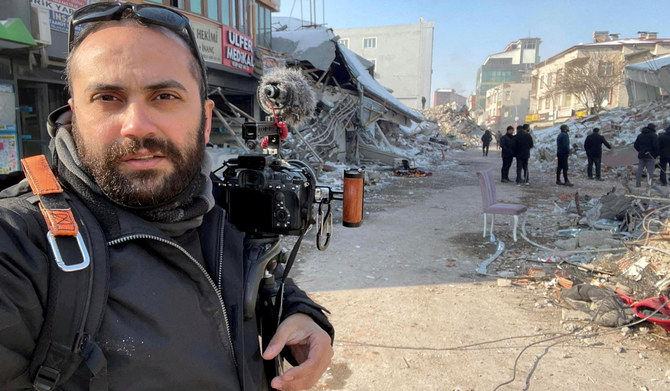
WASHINGTON: Top US diplomat Antony Blinken on Thursday welcomed an Israeli investigation into a strike that killed a journalist and wounded six others on Oct. 13 in southern Lebanon.
“It is important and appropriate that it be fully and thoroughly investigated. My understanding is that Israel has initiated such an investigation and it will be important to see that investigation come to a conclusion and to see the results,” he said when asked about the case at a news conference alongside his British counterpart David Cameron.
An investigation by Agence France-Presse published Thursday into the strike, which killed Reuters journalist Issam Abdallah and wounded six others, including two from AFP, points to a tank shell only used by the Israeli army in the high-tension border region.
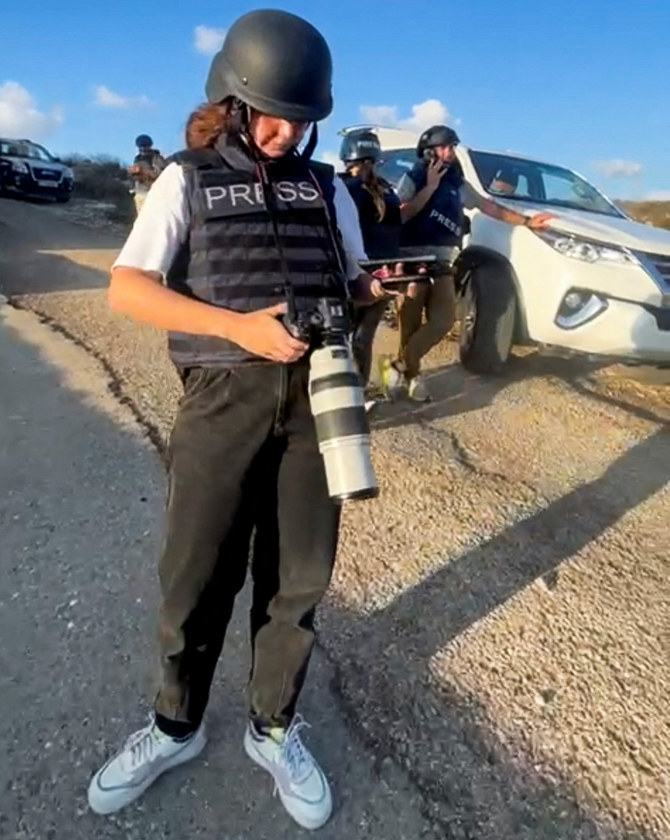
AFP photographer Christina Assi, 28, had a leg amputated and is still in hospital.
Jointly conducted with Airwars, an NGO that investigates attacks on civilians in conflict situations, the investigation found that the attack involved a 120-mm tank shell only used by the Israeli army in this region.
It found that the strikes likely came from the southeast near the Israeli village of Jordeikh where Israeli tanks were operating.
“I have extraordinary admiration for the men and women in your profession who, every day around the world, in the most dangerous places in the world, are trying to bring the facts, the stories to other people,” Blinken said.
Cameron also underscored the important role of journalists, particularly those working in conflict zones.
“It’s absolutely essential that you have independent, impartial, professional journalists covering these conflicts,” he said.
“And it’s an incredibly difficult job, incredibly brave job and my condolences from me and everyone in the UK for that loss of life.”
Amnesty International said on Thursday that Israeli strikes that killed Abdallah were likely to have been a direct attack on civilians and must be investigated as a war crime.
Human Rights Watch (HRW), in a separate report, said the two Israeli strikes were “an apparently deliberate attack on civilians and thus a war crime”, saying those responsible must be held to account.
A Reuters investigation published on Thursday found an Israeli tank crew killed Abdallah and wounded the six other journalists by firing two shells in quick succession from Israel while the group were filming cross-border shelling from a distance.
An Israeli government spokesperson denied Israeli forces targeted non-combatants.
“We do not target civilians,” spokesperson Eylon Levy said in a televised briefing, when asked about reports from Reuters, AFP, Amnesty International and HRW. “We’ve been doing everything possible to get civilians out of harm’s way.”
The Israel prime minister’s office did not respond to questions from Reuters on Thursday seeking comment on the reports by HRW and Amnesty International.
The group of seven reporters from AFP, Al Jazeera and Reuters were all wearing blue flak jackets and helmets, most with “PRESS” written on them in white letters.
They were on a hilltop in an open area with no tree cover nor other buildings to obscure the reporters from nearby Israeli military outposts. Drones had been buzzing overhead and an Israeli helicopter patrolling.
Directly targeting civilians is forbidden under the laws of armed conflict, such as the 1949 Geneva Conventions, which all U.N. member states have ratified.
Amnesty said its investigation uncovered “chilling evidence pointing to an attack on a group of international journalists who were carrying out their work by reporting on hostilities”.
HRW said that evidence indicated the Israeli army “knew or should have known that the group of people they were firing on were civilians”.
Commenting on the findings of the Reuters investigation, a spokesperson for the German foreign ministry said: “The protection of journalists must be guaranteed at all times. Incidents in which journalists are injured or killed must be fully investigated. This also applies in this case.”
Neither Israel nor Lebanon is a signatory to the International Criminal Court, whose 124 member states accept its jurisdiction in the prosecution of war crimes, crimes against humanity and genocide.
Reuters presented the Israel Defense Forces (IDF) with its findings that the tank rounds were fired from within Israel and posed additional detailed questions, including whether Israeli troops knew they were firing upon journalists.
Lieutenant Colonel Richard Hecht, the IDF’s international spokesman, said in response: “We don’t target journalists.” He did not provide further comment.
Lebanon said it would refer the Reuters and AFP reports to the U.N. Security Council to be added to a complaint it has submitted saying Israel has killed civilians during ongoing hostilities between Israel and the Lebanese armed group Hezbollah.
The Israeli prime minister’s office did not respond to a request for comment on Lebanon’s statement.
Lebanese caretaker Prime Minister Najib Mikati, in the government statement issued in response to the reports’ publication, said: “Israeli criminality has no limits”.


![]()
![]()
![]()

Blinken welcomes Israel probe on reporters killed, wounded in Lebanon

Short Url
https://arab.news/4asdz
Blinken welcomes Israel probe on reporters killed, wounded in Lebanon
- Jointly conducted with Airwars, an NGO that investigates attacks on civilians in conflict situations, the investigation found that the attack involved a 120-mm tank shell only used by the Israeli army in this region


Latest updates


Recommended


© 2026 SAUDI RESEARCH & PUBLISHING COMPANY, All Rights Reserved And subject to Terms of Use Agreement.