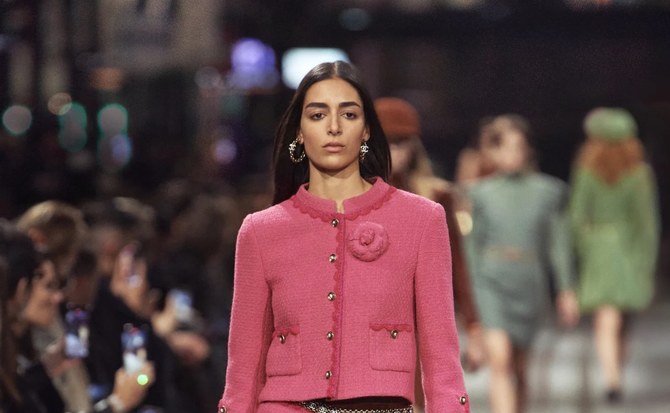
Model Nora Attal walks Chanel’s Manchester show

Nora Attal graced the runway in a pink tweed skirt suit. (Chanel)
Short Url
Updated 09 December 2023
Follow

Model Nora Attal walks Chanel’s Manchester show

DUBAI: Scintillating colors and celebrity flair lit up a gloomy Manchester on Thursday as the British city — famous for its past textile industry — flaunted the latest fashion in a prestigious Chanel show, which British Moroccan model Nora Attal walked.

Lashed by rain and plunged into winter darkness, the city’s gritty industrial heritage was not an obvious choice as the setting for the glitz and glamour of the French luxury group’s Metiers d’Art event.


The blazer was cropped and featured a flower on her chest. (Chanel)

But the show captivated as models strutted down the catwalk sporting dazzling bermuda shorts, mini-skirts and eye-catching outfits under a temporary covering in a city center street.

Attal, 24, graced the runway in a pink tweed skirt suit — a quintessential British classic —with gold buttons. The blazer was cropped and featured a flower on her chest. She wore a gold chain belt on her waist, matching bracelets and black ballerinas to complete the look.


A post shared by CHANEL (@chanelofficial)


Actor Hugh Grant, director Sofia Coppola, local football stars Ruben Dias and Luke Shaw, as well as brand ambassadors Charlotte Casiraghi and Kristen Stewart, were among the celebrities in attendance.

“I loved the rock attitudes, the 60s looks,” British actor Jenna Coleman told AFP.


A post shared by CHANEL (@chanelofficial)


The northern English city was a hub of the 19th century industrial revolution, processing half of the world’s cotton in 1860.

Chanel’s creative director Virginie Viard said Manchester was the starting point for a musical culture that changed the world, inspiring her to bring the show there for its pioneering and creative spirit.

Attal, who has walked the runway for major fashion houses including Tom Ford, Tory Burch, Tiffany & Co., Fendi, Burberry and Valentino, is a Chanel fixture and has walked the runway for the storied brand a number of times over the years.


A post shared by CHANEL (@chanelofficial)

She hit the runway for Chanel in October 2022 at Paris Fashion Week, where she showed off a number of looks as part of the label’s Spring-Summer 2023 showcase. The ensembles were part of a 71-piece collection designed by the fashion house’s creative director, Virginie Viard.

In June this year, she took part in a campaign for Chanel Beauty, in which she posed wearing a pair of black sunglasses. The model was also seen holding a pocket-sized capsule of Chanel hand cream and lying in long green grass with her oversized branded shades.


Mini op-ed: Why emotional wellbeing is not only an individual concern in Arab societies

Updated 03 February 2026
Follow

Mini op-ed: Why emotional wellbeing is not only an individual concern in Arab societies

ABU DHABI: Across much of the world, emotional wellbeing is now being discussed in similar ways with familiar language: self-care, boundaries, resilience.

These terms have helped people speak more openly about stress and mental health, often for the first time. That matters. But the language also carries an assumption, one that is not always questioned. It suggests that healing begins, and largely takes place, within the individual.

In many Arab societies, that idea does not fully apply. The self is rarely experienced in isolation. Identity forms early through family life, shared responsibility, and social roles that extend beyond personal choice.

Sophie Gregoire Trudeau and Nancy Zabaneh. (Supplied) 

Emotions are often managed in relation to others, not apart from them. This difference has practical consequences, particularly as pressure and uncertainty.

Wellbeing is not just something that happens on a mat or during a six-day retreat, it shows itself in daily life, in our relationships, in how we respond under pressure, and in the choices we make when no one is watching.

That observation runs counter to a global trend that treats emotional health as a private task.

Western approaches have introduced useful tools, including emotional vocabulary, self-reflection, and psychological insight. But when these ideas travel without adaptation, they can overlook the social structures that shape behavior in societies where family and community play a central role.

Healing often begins with the individual in the West. In the East, the sense of self is more closely tied to family, community, and spirituality. Both are powerful — wellbeing lives where self-awareness meets belonging.

In the Gulf, fast economic growth, changing work patterns, and constant digital connection have altered how people live and relate to one another. Traditional support systems still play an important role, but they are under pressure.

At the same time, imported wellness language can feel out of place when it prioritizes inward focus over shared responsibility.

In this region, community and compassion belong together and remain a source of balance and meaning. Emotional awareness, in this setting, is less about self-improvement and more about how people treat one another, whether at home, at work, or during moments of stress.

The UAE has begun to reflect this broader view at a policy level. The National Strategy for Wellbeing 2031 frames emotional and mental health as a part of social wellbeing, not simply personal coping.

That emphasis is reinforced by the government’s designation of 2026 as the Year of Family, which places family relationships at the center of social stability and long-term wellbeing.

Together, these initiatives point to the vital role of families, schools, and workplaces, while leaving open the question of how collective responsibility and individual needs should be balanced in practice.

If there is one message, it is that wellbeing begins with connection to ourselves, to each other, and to what we value most.

As emotional awareness becomes a global language, its meaning will continue to shift. The task ahead may not be choosing between individual insight and collective care, but recognizing where each works, where it falls short, and how the two can exist alongside one another.

Nancy Zabaneh is a Dubai-based wellbeing educator and trauma-informed facilitator of Palestinian origin who has lived and worked in the UAE for more than 25 years. Sophie Gregoire Trudeau is a Canadian author and mental health advocate and has a decade of experience in the public eye as Canada’s former first lady. They are writing ahead of the Kayan Wellness Festival in Abu Dhabi.