India drugs regulator orders quality checks on cough syrup ingredient

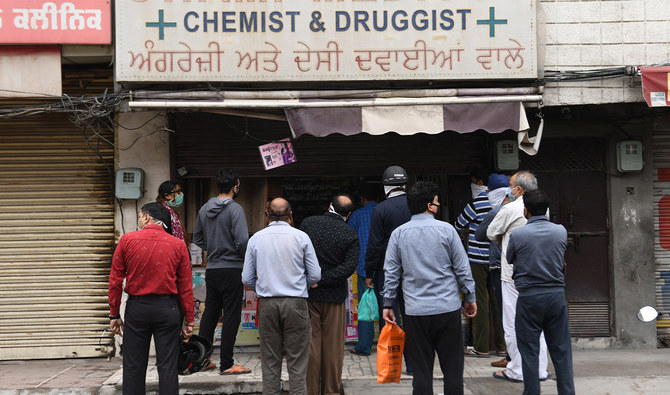
People wait for their turn to buy medicine outside a pharmacy in Amritsar, India on March 28, 2020. (AFP/File)
Short Url
Updated 09 December 2023
Follow

India drugs regulator orders quality checks on cough syrup ingredient

  • Syrups made by three Indian firms have been linked to the deaths of dozens of children in Gambia, Uzbekistan and Cameroon in over a year 
  • Drugmakers have denied allegations their products were responsible for the deaths, which have cast a shadow over quality of Indian exports 

NEW DELHI: India’s drugs regulator has ordered that the source and quality of an ingredient used to make cough syrups be checked and verified as a “top priority,” in the wake of the deaths of at least 141 children globally. 

In one of the world’s worst such waves of poisoning, cough syrups made by three Indian manufacturers have been linked to the deaths of dozens of children in Gambia, Uzbekistan and Cameroon since the middle of last year. 

The drugmakers have denied allegations that their products were responsible for the deaths, which have cast a shadow over the quality of exports from India, often dubbed the “world’s pharmacy” due to its supply of life-saving drugs at low prices. 

In a letter this week, India’s Drug Controller General Rajeev Singh Raghuvanshi directed state and regional authorities to carry out inspections and verify the source and quality of propylene glycol (PG) either produced domestically or imported by cough syrup makers. 

He also directed drugs inspectors to submit a supply chain verification report for PG manufacturers and importers 

The direction was issued to rule out “possible quality issues” related to toxins diethylene glycol (DEG) and ethylene glycol (EG) in cough syrups and the diversion of industrial grade PG, Raghuvanshi said in a letter dated Dec. 6 and seen by Reuters. 

PG is a colorless, viscous liquid that does not react with other substances, making it an ideal solvent for syrupy medicines. Reuters has reported that some Indian drugmakers were buying key ingredients from suppliers who were not licensed to sell pharmaceutical-grade products. 

DEG and EG are used as industrial solvents and antifreeze agents and can be fatal when consumed even in small amounts. 

The syrups linked to the deaths of the children were found to contain high levels of DEG or EG in tests done by the World Health Organization and other authorities. 

Raghuvanshi has requested details including the number of cough syrup batches manufactured across India in 2023, the PG used and whether it was tested before use. 

Raghuvanshi also issued an advisory on Dec. 5 asking all drugmakers to purchase and use only pharmaceutical grade ingredients in their products. 

India has introduced mandatory testing for cough syrup exports since June and stepped up scrutiny of drugmakers, finding a string of deficiencies in recent inspections including poor documentation and a lack of self-assessment. 


’Only a miracle can end this nightmare’: Eritreans fear new Ethiopia war

Updated 6 sec ago
Follow

’Only a miracle can end this nightmare’: Eritreans fear new Ethiopia war

  • Now the fractious Horn of Africa rivals have begun trading barbs and accusations of war-mongering once more
  • It is extremely difficult to gather testimonies from Eritrea, where dissidents often disappear to prison

ADDIS ABABA: Tewolde has fought multiple times for Eritrea, one of the most closed societies on Earth, and is now praying another war is not about to break out with neighboring Ethiopia.
“If the war starts, many people will go to the front and, as before, many children will lose their fathers, mothers will lose their husbands, parents will lose their children,” said Tewolde, who is in his 40s and lives in the Eritrean capital Asmara.
He fought first in the late 1990s during Eritrea’s horrific border war with Ethiopia, and more recently during clashes against rebels in the Ethiopian region of Tigray.
Now the fractious Horn of Africa rivals have begun trading barbs and accusations of war-mongering once more.
“We’ve already experienced this (before) and we know the losses are severe,” said Tewolde, who gave a false name to protect his identity in a country regularly described by rights groups as the North Korea of Africa.
It is extremely difficult to gather testimonies from Eritrea, where dissidents often disappear to prison. To obtain a few words from Tewolde, AFP had to pass questions and answers through an intermediary.

- ‘Incessant aggression’ -

Eritrea, a country of around 3.5 million, has been ruled by President Isaias Afwerki since independence from Ethiopia in 1993 and ranks near the bottom of every rights indicator.
Civilians are conscripted into the army for life or forced into a national service program that the United Nations has compared to slavery.
Ethiopian Prime Minister Abiy Ahmed won a Nobel Peace Prize in 2019 for signing a long-awaited peace deal with Eritrea shortly after coming to power and, in darkly ironic fashion, the two sides joined forces in the brutal war against the Tigrayans from 2020 to 2022.
Eritrea was not pleased that Ethiopia sued for peace without its input and has accused its landlocked neighbor of planning to seize its port at Assab.
For its part, Ethiopia has lately complained that Eritrea has been “actively preparing” for renewed conflict.
Ethiopian Foreign Minister Gedion Timothewos last month said that “Eritrean aggression and provocation is making further restraint more and more difficult.”

- ‘Fleeing en masse’ -

Mehari, an Eritrean in his 30s, fought in the Tigray war, where his army was accused of horrific war crimes.
“Young people are fleeing en masse to Ethiopia... and to Sudan to avoid a possible war,” he told AFP.
Another Eritrean, Luwan, left the country several years ago and now lives in an east African country, which she did not want to name for fear of reprisals against her family back home.
She says her family are terrified after a relative was summoned to a meeting and told to “prepare herself, her sons and daughters because she was told Abiy will start a war against her and the Eritrean people,” she said.
Some mothers at the meeting “still haven’t been informed about where their children are from the last war in Tigray, but still they are being asked to send their remaining children to the front,” Luwan added.
Eritrean Information Minister Yemane Ghebremeskel did not respond to a request for comment from AFP.
A former independence activist now in exile, researcher Mohamed Kheir Omer, said young people are split between their fear of conflict and of being overrun by Ethiopia, whose wartime atrocities are still in recent memory.
“We are torn between Isaias who does not care about his population, and Abiy who thinks only of his own legacy,” he said.
Luwan said she was desperate.
“Only a miracle can end this nightmare.”