

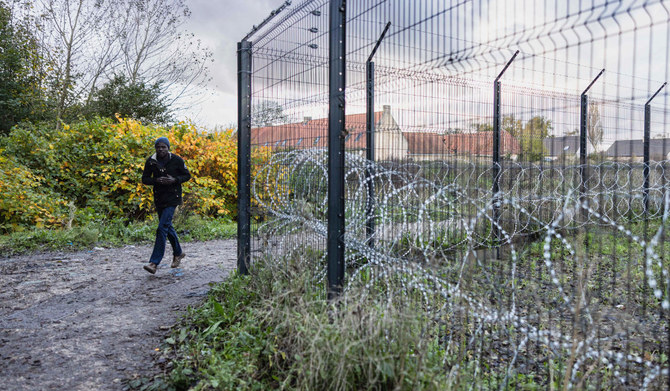


CALAIS, France: On the northern French coast, dozens of migrant teenagers are living in miserable conditions in the forest while waiting to try to cross the Channel in one of the small boats at the center of a heated immigration row in Britain.
British Prime Minister Rishi Sunak is under mounting pressure from his ruling Conservatives to take a tougher stance on the flow of migrants across the Channel ahead of a general election that will be held by January 2025.
Sunak has promised to “stop the boats” but 29,000 people have crossed one of the world’s busiest shipping routes this year in the hope of starting a new life in Britain.
Although the numbers are down on a record 44,000 in 2022, there is little sign that the crossings will stop.
NGOs estimate around 1,000 people are currently living rough in and around Calais, the French port which has for years acted as a beacon for migrants hoping to stow away on trucks crossing the Channel by ferry or through an undersea railway tunnel.
Around 130 are unaccompanied minors, who fled war, conflict or grinding poverty in the hope of making a new beginning in Britain.
Khaled, a 17-year-old migrant from war-torn Sudan who arrived in Calais in early December on the last leg of an odyssey that took him through Libya, Tunisia and Italy, lives alone in a wood, behind a railway track.
His tent is sinking into the mud and his clothes, which are hung on branches, show no sign of drying in the wintry cold.
Every night he tries to climb on the back of a truck bound for Britain — but he’s had no luck so far.
Tighter surveillance in recent years of the rail and ferry terminals, which are fenced off with barbed wire and concrete walls, have pushed growing numbers of migrants to try their luck crossing the Channel.
Since 2018, over 100,000 people have set sail for Britain in crowded inflatable boats or small fishing vessels.
For some, the crossing has proved fatal with the deadliest disaster in November 2021 when 27 migrants drowned.
Khaled said he could not afford the “at least 800-1,000 euros” ($860-$1,080) people smugglers are demanding to take him to Britain by boat.
But Niamatullah, a 17-year-old Afghan who AFP met at a migrant support center in Calais run by the Doctors Without Borders (MSF) charity, is just waiting for the cold snap to pass before he tries his luck.
“Life is hard here, we’re in mud up to our knees and the police keep taking all our belongings,” he complained.
Complaints of police repression have been legion in Calais since 2016 when the authorities bulldozed a sprawling migrant tented camp dubbed the “Jungle” that housed more than 9,000 people at its peak.
Successive French governments have ordered the police to routinely dismantle any new settlements, leaving migrants regularly wandering the streets in search of a place to sleep, including teens.
The only dedicated hostel for unaccompanied minors in the wider Calais region has a maximum capacity of 30.
MSF psychologist Chloe Hannebrouw said the minors were suffering from “huge psychological stress” as well as a deep sense of disillusionment.
“There is a gulf between what they expected in Europe and the conditions they find themselves in, in Calais,” she said.
With no family members to look out for them, NGOs attempt to fill the gap.
In the seaside village of Loon-Plage near Calais, Jeanne Hogard, a social worker for the Red Cross, warns a 16-year-old Sudanese girl of the danger of taking to the sea.
“Do you know the emergency number to call? Do you have a GPS,” she asks rhetorically.
Such warnings fail to make much impact among migrants, many of whom feel their prospects are better in Britain, because they have contacts there and speak the language.
“I’m not afraid. We got this far, we’ll keep going,” Nasser, a Sudanese youth, told AFP.


