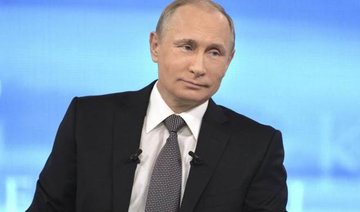
Russia’s Putin says he will run for president again in 2024

Under constitutional reforms Vladimir Putin orchestrated, he is eligible to seek two more six-year terms after his current one expires next year. (AFP)
Short Url
Updated 08 December 2023
Follow

Russia’s Putin says he will run for president again in 2024

  • Russian lawmakers on Thursday set the date of the 2024 presidential election for March 17
  • The March election clears the way for Putin to remain in power at least until 2030

MOSCOW: Russian President Vladimir Putin said on Friday he would run for president again in the 2024 presidential election, a move expected to keep him in power until at least 2030.

Putin, who was handed the presidency by Boris Yeltsin on the last day of 1999, has already served as president for longer than any other ruler of Russia since Josef Stalin, beating even Leonid Brezhnev’s 18-year tenure.

After awarding soldiers who had fought in Ukraine with Russia’s highest military honor, the hero of Russia gold star, Putin was asked by a lieutenant colonel if he would run again, Russian news agencies said.

The Kremlin chief said that he would.

Reuters reported last month that Putin had made the decision to run.

For Putin, the election is a formality: with the support of the state, state media and almost no mainstream public dissent, he is certain to win. Putin turned 71 on Oct. 7.

Opposition politicians cast the election as a fig leaf of democracy that adorns what they see as the corrupt dictatorship of Putin’s Russia.

Supporters of Putin dismiss that analysis, pointing to independent polling which shows he enjoys approval ratings of above 80 percent. They say that Putin has restored order and some of the clout Russia lost during the chaos of the Soviet collapse.

Russian lawmakers on Thursday set the date of the 2024 presidential election for March 17, moving Vladimir Putin closer to a fifth term in office.

The March election clears the way for him to remain in power at least until 2030.


Russia says foreign forces in Ukraine would be ‘legitimate targets’

Updated 03 February 2026
Follow

Russia says foreign forces in Ukraine would be ‘legitimate targets’

  • Moscow has repeatedly said it will not tolerate the presence in Ukraine of troops from Western countries

MOSCOW: Russia would regard the deployment of any foreign military forces or infrastructure in Ukraine as foreign intervention and treat those forces as legitimate ​targets, the Foreign Ministry said on Monday, citing Minister Sergei Lavrov.
The ministry’s comment, one of many it said were in response to questions put to Lavrov, also praised US President Donald Trump’s efforts at working for a resolution of the war and said he understood the fundamental reasons behind the conflict.
“The deployment of ‌military units, facilities, ‌warehouses, and other infrastructure of ‌Western ⁠countries ​in Ukraine ‌is unacceptable to us and will be regarded as foreign intervention posing a direct threat to Russia’s security,” the ministry said on its website.
It said Western countries — which have discussed a possible deployment to Ukraine to help secure any peace deal — had to understand “that all foreign military contingents, including German ⁠ones, if deployed in Ukraine, will become legitimate targets for the Russian ‌Armed Forces.”
The United States has spearheaded ‍efforts to hold talks aimed ‍at ending the conflict in Ukraine and a second three-sided ‍meeting with Russian and Ukrainian representatives is to take place this week in the United Arab Emirates.
The issue of ceding internationally recognized Ukrainian territory to Russia remains a major stumbling block. ​Kyiv rejects Russian calls for it to give up all of its Donbas region, including territory Moscow’s ⁠forces have not captured.
Moscow has repeatedly said it will not tolerate the presence in Ukraine of troops from Western countries.
The ministry said Moscow valued the “purposeful efforts” of the Trump administration in working toward a resolution and understanding Russia’s long-running concerns about NATO’s eastward expansion and its overtures to Ukraine.
It described Trump as “one of the few Western politicians who not only immediately refused to advance meaningless and destructive preconditions for starting a substantive dialogue with Moscow on the ‌Ukrainian crisis, but also publicly spoke about its root causes.”