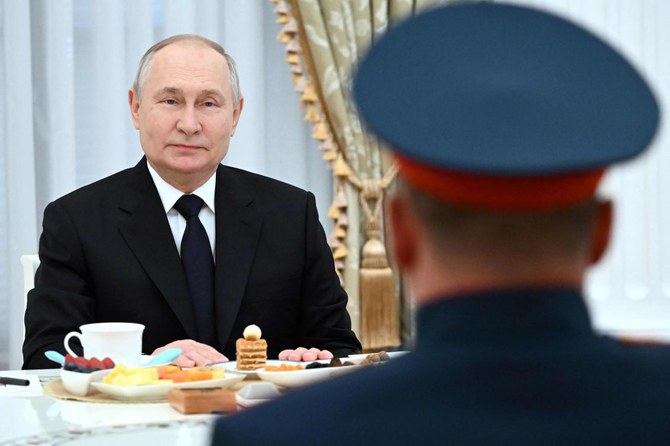

MOSCOW: Russian President Vladimir Putin may soon indicate he will take part in a 2024 presidential election, Kommersant newspaper reported on Tuesday, paving the way for the Kremlin chief to stay in power until 2030.
As part of a conference in November, officials suspect that Putin may announce he will take part in the election in March next year, Kommersant reported, citing unidentified sources close to the presidential administration.
The newspaper, one of Russia’s most respected, said there were, however, other scenarios for what Putin might do at the conference and the final decision rested with him. The Kremlin did not immediately comment.
Putin, who was handed the presidency by Boris Yeltsin on the last day of 1999, has been leader for longer than any other Russian ruler since Josef Stalin, beating even Leonid Brezhnev’s 18-year tenure.
Putin turns 71 on October 7.
While many diplomats, spies and officials have said they expect Putin to stay in power for life, there has yet to be any confirmation of his plans to run in the 2024 presidential vote.
Putin said last month he would make an announcement on his plans only after parliament called the presidential election — due by law to be done in December.
Kremlin spokesman Dmitry Peskov said last month that if Putin decided to run, then no one would be able to compete with him.
While Putin may face no competition for votes, the former KGB spy faces the most serious set of challenges any Kremlin chief has faced since Mikhail Gorbachev grappled with the crumbling Soviet Union nearly four decades ago.
The war in Ukraine has triggered the biggest confrontation with the West since the 1962 Cuban Missile Crisis and the biggest external shock to the Russian economy in decades. Putin faced a failed mutiny by Russia’s most powerful mercenary, Yevgeny Prigozhin, in June.
Prigozhin was killed in a plane crash two months later.
The West casts Putin as a war criminal and a dictator who has led Russia into an imperial-style conflict that has weakened the country and forged Ukrainian statehood while uniting the West and handing NATO a post-Soviet mission of opposing Russia.
Putin, though, presents the war as part of a much bigger struggle with the United States, which the Kremlin elite says aims to cleave Russia apart, grab its natural resources and then turn to settling scores with China.
The former Soviet spies who wield power in Moscow have repeatedly warned of the risk of a Russia-NATO conflict as the West’s post-Cold War dominance wanes, Russia lays to rest the humiliations of the Soviet collapse and China rises to superpower status.
The West says it does not want a NATO-Russia conflict but simply to help Ukraine defeat Russian forces. The Kremlin says the West will never achieve Russia’s defeat in Ukraine.