

The Gaza Strip: Tiny, cramped and as densely populated as London

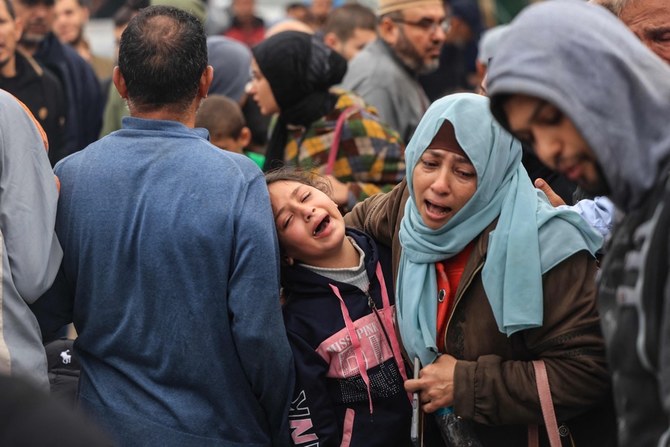
Gaza’s density is even tighter in its urban cores like Gaza City or Khan Younis. (AFP)
Short Url
Updated 06 December 2023
Follow

The Gaza Strip: Tiny, cramped and as densely populated as London

  • Gaza has a population density of about 5,500 per square kilometer

GAZA: The war between Israel and Hamas has seen fierce Israeli bombardment that has flattened broad swaths of the Gaza Strip. Thousands of people have been killed and hundreds of thousands have been displaced.
And all that is happening in a tiny, densely populated coastal enclave.
Gaza is tucked among Israel, Egypt and the Mediterranean Sea. The strip is 25 miles (40 kilometers) long by some 7 miles (11 kilometers) wide. It has 2.3 million people living in an area of 139 square miles (360 square kilometers), according to the CIA Factbook.

That’s about the same land size as Detroit, a city that has a population of 620,000, according to the US Census Bureau. It’s about twice the size of Washington and 3½ times the size of Paris.
Gaza has a population density of about 14,000 people per square mile (5,500 per square kilometer). That’s about the same as London, a city brimming with high-rise buildings, but also many parks. Gaza has few open spaces, especially in its cities, due to lack of planning and urban sprawl.
Gaza’s density is even tighter in its urban cores like Gaza City or Khan Younis, where tens of thousands are packed into cramped neighborhoods and where density rates become more comparable to certain cities in highly populated Asia.
An Israeli-Egyptian blockade, imposed after the Hamas militant group seized power in 2007, has greatly restricted movement in and out of Gaza, adding to the sense of overcrowding.


Israel-backed militia kill two Hamas operatives in Gaza

Updated 16 sec ago
Follow

Israel-backed militia kill two Hamas operatives in Gaza

  • Popular Forces said it had carried out a raid in Rafah, killing two Hamas members who refused to surrender
CAIRO: An Israeli-backed Palestinian militia said on Wednesday it had killed two Hamas operatives in southern Gaza, marking a renewed challenge to Hamas after Israel empowered its rivals in ​areas under Israeli military control.
The armed group, known as the Popular Forces, said in a statement it had carried out a raid in Rafah, killing two Hamas members who refused to surrender and detaining a third. It shared a photo that it said depicted one of the slain men.
Hamas, which brands such groups as “collaborators,” declined to ‌comment on the ‌claim, which Reuters couldn’t independently authenticate. ‌Rafah ⁠sits ​in ‌territory under Israeli control under the terms of an October Israel-Hamas deal.
The Popular Forces, founded by an anti-Hamas armed Bedouin leader, Yasser Abu Shabab, is believed to be the largest group operating in Israel-controlled areas.
Abu Shabab was killed in December in what the group described as a family feud. He was replaced ⁠by his deputy Ghassan Duhine, who vowed no let up in the ‌fight against Hamas. The Popular Forces and ‍others have reported more recruits ‍since the October deal took effect.
The emergence of the ‍groups, though they remain small and localized, has added to pressures on Islamist Hamas and could complicate efforts to stabilize and unify a divided Gaza, shattered by two years of war. The groups ​remain unpopular among the local population, as they operate under Israeli control.
Nearly all of Gaza’s two million ⁠people live in Hamas-held areas, where the group has been reestablishing its grip and where four Hamas sources said it continues to command thousands of men despite suffering heavy blows during the war.
But Israel still holds well over half of Gaza — areas where Hamas’ foes operate beyond its reach. With President Donald Trump’s plan for Gaza moving slowly, there is no immediate prospect of further Israeli withdrawals.
Prime Minister Benjamin Netanyahu acknowledged Israeli backing for anti-Hamas groups in June, saying Israel had “activated” clans. ‌Israel has given little detail since then.
The Popular Forces deny receiving support from Israel.