

One in five children in rich countries lives in poverty: UNICEF

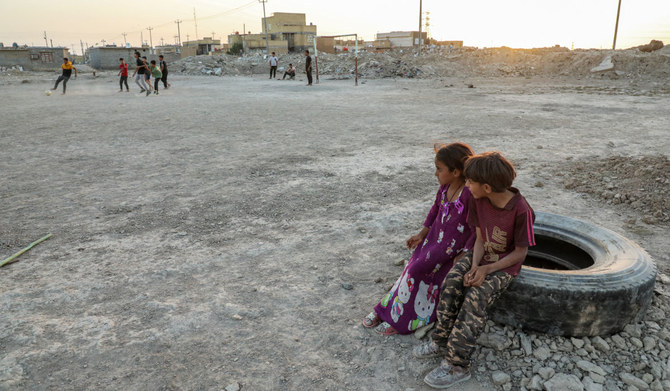
Iraqi children sit in an empoverished area on the edges of Nasiriyah, capital of Dhi Qar province, on September 25, 2023. (AFP)
Short Url
Updated 06 December 2023
Follow

One in five children in rich countries lives in poverty: UNICEF

  • The report called for action to ensure children’s well-being and for political will among the countries surveyed, stressing that a country’s’ wealth did not automatically lift its children out of poverty

UNITED NATIONS, United States: Sixty-nine million children — or more than one in five — live in poverty in the world’s 40 richest countries UNICEF said in a report released Wednesday, blasting Britain and France for their particularly bad standings.
That’s despite a drop in child poverty rates in the periods from 2012 to 2014 and 2019 to 2021, by around 8 percent in the 40 European Union and Organization for Economic Cooperation and Development (OECD) wealthy countries assessed.
“This is equivalent to around 6 million children out of a total child population of 291 million,” said UNICEF Innocenti, the United Nations agency’s research arm.
But at the end of 2021 there were still more than 69 million kids in poverty in those countries.
“For most children this means that they may grow up without enough nutritious food, clothes, school supplies or a warm place to call home,” said Bo Viktor Nylund of UNICEF Innocenti, highlighting the impact of such struggles on young people’s physical and mental health.
The UNICEF figure is based on relative poverty, which is around 60 percent of the national median income, often used in developed countries to establish their own poverty levels.
The report called for action to ensure children’s well-being and for political will among the countries surveyed, stressing that a country’s’ wealth did not automatically lift its children out of poverty.
Since 2012, the biggest setbacks have been seen in some of the richest countries.
Britain saw a 19.6 percent jump in child poverty — or half a million extra children, and France’s rate went up 10.4 percent.
In the United States, the number of poor children has fallen by 6.7 percent, but more than one child in four still lives in relative poverty.
And the poverty rate in 2019-2021 was twice as high as in Denmark, a country with a similar per-capita income.
Underlining the link between child poverty and economic inequality, the report also highlights the greater risk of poverty for children from single-parent families and minority backgrounds.
In the United States, 30 percent of African American children and 29 percent of Native American children live below the national poverty line, compared with only one-in-10 non-Hispanic white children.
In the EU, a child with parents of non-EU nationality is 2.4 times more likely to live in poverty.


UN chief launches first global, independent scientific panel on artificial intelligence

Updated 5 sec ago
Follow

UN chief launches first global, independent scientific panel on artificial intelligence

  • Secretary-General Antonio Guterres nominates 40 experts to serve on body ‘dedicated to helping close the AI knowledge gap and assess the real impacts of AI’
  • It will ‘help the world separate fact from fakes, and science from slop … at a moment when reliable, unbiased understanding of AI has never been more critical,’ he adds

NEW YORK CITY: UN Secretary-General Antonio Guterres on Wednesday formally launched what he described as the only global, independent scientific body focused on artificial intelligence, and submitted his recommendations for the experts to serve on it.

“It will be the first global, fully independent scientific body dedicated to helping close the AI knowledge gap and assess the real impacts of AI across economies and societies,” he told reporters in New York.

“And this could not be more urgent. AI is moving at the speed of light. No country can see the full picture alone.”

The Independent International Scientific Panel on Artificial Intelligence was established by the UN General Assembly through a resolution in August. Guterres said he has now submitted a list of 40 experts from all regions as his proposed candidates for the new body, which was mandated by world leaders under the UN’s Pact for the Future.

The panel is intended to provide authoritative, science-based analysis at a time when AI is developing rapidly and reshaping economies, governance and social life, but regulatory approaches remain fragmented.

Guterres underscored the need for shared understanding among countries to help develop effective safeguards, promote innovation for the common good, and strengthen international cooperation.

The UN said the panel would serve as a global reference point, helping policymakers and the public distinguish between reliable evidence and misinformation, and grounding debates on AI in independent scientific assessment.

The initiative comes amid growing concern over the societal, economic and security risks posed by unchecked technological competition.

“We need shared understandings to build effective guardrails, unlock innovation for the common good, and foster cooperation,” Guterres said.

“The panel will help the world separate fact from fakes, and science from slop. It will provide an authoritative reference point at a moment when reliable, unbiased understanding of AI has never been more critical.”

The proposed members of the panel were selected following an open global call that attracted more than 2,600 applicants, whose expertise spanned fields including machine learning, data governance, public health, cybersecurity, child development and human rights. The chosen candidates are expected to serve in a personal capacity, independent of governments, businesses or other institutions.

The panel will operate on an accelerated timeline, with its first report due in time to inform a Global Dialogue on AI Governance scheduled for July. UN officials said the findings were expected to support international efforts to build common ground on AI governance during a period of heightened geopolitical tensions and technological rivalry.

Guterres framed the initiative as part of a broader push to ensure that AI is shaped collectively, guided by scientific evidence and global solidarity, rather than allowing its development to outpace international cooperation.