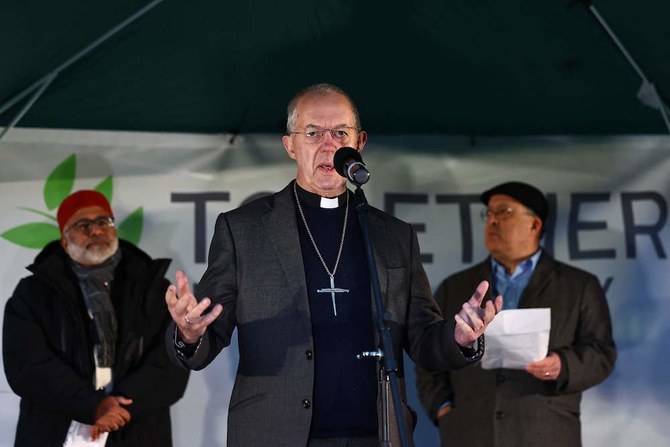
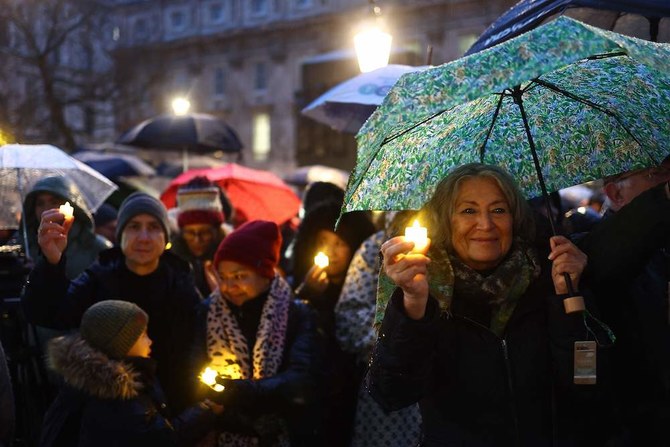
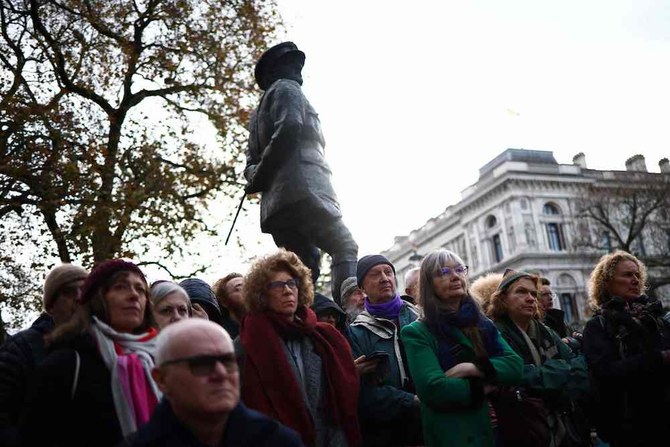
LONDON: A UK interfaith coalition comprising religious, political and civic leaders, as well as grieving relatives of some of those killed in the Israel-Hamas war, held a vigil Sunday in London.
Hundreds gathered mid-afternoon in wet and frigid conditions opposite Prime Minister Rishi Sunak’s Downing Street office and residence to “give a voice to the majority of the public who stand against hate,” organizers said.
The grouping, Together for Humanity, aimed to highlight its nascent movement against rising anti-Semitism and anti-Muslim hate with the event, dubbed “Building Bridges.”
It was spearheaded by Brendan Cox, the widower of murdered British lawmaker Jo Cox, and supported by Archbishop of Canterbury Justin Welby as well as a leading British rabbi, imam and peace activists.
Welby told the crowd it was time to “clean away anti-Semitism and Islamophobia,” both of which have been on the rise in Britain since the war sparked by Hamas’s unprecedented attack.
Hamas militants burst through Gaza’s militarised border into Israel on October 7 and killed about 1,200 people, mostly civilians, while also taking around 240 hostages, according to Israeli authorities.
Israel’s retaliatory military campaign has killed more than 15,500 people in the besieged Palestinian territory, mainly civilians and thousands of them children, according to the Hamas-run health ministry.
“We will not let anti-Semitism, Islamophobia have a role in our streets, our schools, our towns,” Welby added.
Imam Monawar Hussain said “we stand united against all those who seek to sow hatred and division.”
British-Israeli Magen Inon, whose parents were killed in Hamas’s October 7 attack, was also among the speakers.
“Of course I’m angry,” he said.
“What the terrorists really tried to kill is the possibility of people of different backgrounds and faiths to live in peace alongside one another,” Inon added.
“The only possible revenge of my parents is to set aside fear and hate and to be hopeful that a better future is possible.”
Others at the vigil included Palestinian peace activist Hamze Awawde, who lives in Ramallah in the Palestinian Territories and has had relatives injured recently in the conflict.
He spoke of his grandfather, who 50 years ago “chose to fight and sacrifice himself, so his children and grandchildren would have a better future.”
But “50 years on, every year is worse than the last.”
With rain pouring down, those gathered observed a minute’s silence in memory of the victims of the conflict, “whatever their origins.”
Together for Humanity has emerged since Israel began bombing Gaza in response to the October 7 attack, which has prompted a spike in anti-Semitism in Britain.
At least 1,747 incidents were recorded between October 7 and November 29 by the Community Security Trust, whose role is to protect the UK’s Jewish community.
Meanwhile, London and other UK cities have seen large-scale protests on recent weekends in support of Palestinians in Gaza, which have polarized public opinion and been blamed for stoking social divisions.
Ahead of the vigil, Cox, a father of two, said the “loudest and most extreme voices have drowned out the vast majority of the public” when it came to the conflict.
His wife was killed by a Nazi sympathizer days before Britain’s contentious 2016 Brexit referendum, and he subsequently co-founded the Together Coalition charity.


![]()
![]()
![]()
![]()


Religious leaders, victims’ relatives hold UK vigil over Israel-Hamas war

Short Url
https://arab.news/bhrsa
Religious leaders, victims’ relatives hold UK vigil over Israel-Hamas war


ASEAN should adhere to rule of law in face of ‘unilateral actions,’ Philippines’ top diplomat says
- Several ASEAN members have expressed deep concern over the US strike that resulted in the arrest of Venezuelan leader Nicolas Maduro
- Philippines’ top envoy: ‘Across our region, we continue to see tensions at sea, protracted internal conflicts and unresolved border and humanitarian concerns’
CEBU, Philippines: Southeast Asian countries should steadfastly maintain restraint and adhere to international law as acts of aggression across Asia and “unilateral actions” elsewhere in the world threaten the rules-based global order, Manila’s top diplomat said Thursday.
Philippine Foreign Secretary Theresa Lazaro did not provide details of the geopolitical alarm she raised before her counterparts in the 11-nation Association of Southeast Asian Nations who were holding their first major closed-door meetings this year in the Philippines’ central seaside city of Cebu.
Several ASEAN members, however, have expressed deep concern over the secretive US strike that resulted in the arrest of Venezuelan leader Nicolas Maduro on orders from US President Donald Trump. China’s intensifying aggressive stance on Taiwan and in the disputed South China Sea have also troubled the region for years.
Calling out the US and China, among the largest trading and defense partners of ASEAN countries, have been a dilemma and diplomatic tightrope.
“Across our region, we continue to see tensions at sea, protracted internal conflicts and unresolved border and humanitarian concerns,” Lazaro said in her opening speech before ASEAN counterparts.
“At the same time, developments beyond Southeast Asia, including unilateral actions that carry cross-regional implications, continue to affect regional stability and erode multilateral institutions and the rules- based international order,” she said.
“These realities underscore the interim importance of ASEAN’s time-honored principles of restraint, dialogue and adherence to international law in seeking to preserve peace and stability to our peoples.”
The Philippines holds ASEAN’s rotating chair this year, taking what would have been Myanmar’s turn after the country was suspended from chairing the meeting after its army forcibly ousted Aung San Suu Kyi’s democratically elected government in 2021.
Founded in 1967 in the Cold War era, ASEAN has an unwieldy membership of diverse countries that range from vibrant democracies like the Philippines, a longtime treaty ally of Washington, to authoritarian states like Laos and Cambodia, which are close to Beijing.
The regional bloc adopted the theme “Navigating our future, Together” this year but that effort to project unity faced its latest setback last year when deadly fighting erupted between two members, Thailand and Cambodia, over a longtime border conflict.
Aside from discussing the deadly fighting that embroiled Thailand and Cambodia before both forged a US-backed ceasefire last year, the ASEAN foreign ministers will deliberate how to push a five-point peace plan for the war in Myanmar, issued by the regional bloc’s leaders in 2021. The plan demanded, among others, an immediate end to fighting and hostilities, but it has failed to end the violence or foster dialogue among contending parties.
ASEAN foreign ministers are also under pressure to conclude negotiations with China ahead of a self-imposed deadline this year on a so-called “code of conduct” to manage disputes over long-unresolved territorial rifts in the South China Sea. China has expansive claims in the waterway, a key global trade route, that overlap with those of four ASEAN members, the Philippines, Malaysia, Vietnam and Brunei.
Philippine Foreign Secretary Theresa Lazaro did not provide details of the geopolitical alarm she raised before her counterparts in the 11-nation Association of Southeast Asian Nations who were holding their first major closed-door meetings this year in the Philippines’ central seaside city of Cebu.
Several ASEAN members, however, have expressed deep concern over the secretive US strike that resulted in the arrest of Venezuelan leader Nicolas Maduro on orders from US President Donald Trump. China’s intensifying aggressive stance on Taiwan and in the disputed South China Sea have also troubled the region for years.
Calling out the US and China, among the largest trading and defense partners of ASEAN countries, have been a dilemma and diplomatic tightrope.
“Across our region, we continue to see tensions at sea, protracted internal conflicts and unresolved border and humanitarian concerns,” Lazaro said in her opening speech before ASEAN counterparts.
“At the same time, developments beyond Southeast Asia, including unilateral actions that carry cross-regional implications, continue to affect regional stability and erode multilateral institutions and the rules- based international order,” she said.
“These realities underscore the interim importance of ASEAN’s time-honored principles of restraint, dialogue and adherence to international law in seeking to preserve peace and stability to our peoples.”
The Philippines holds ASEAN’s rotating chair this year, taking what would have been Myanmar’s turn after the country was suspended from chairing the meeting after its army forcibly ousted Aung San Suu Kyi’s democratically elected government in 2021.
Founded in 1967 in the Cold War era, ASEAN has an unwieldy membership of diverse countries that range from vibrant democracies like the Philippines, a longtime treaty ally of Washington, to authoritarian states like Laos and Cambodia, which are close to Beijing.
The regional bloc adopted the theme “Navigating our future, Together” this year but that effort to project unity faced its latest setback last year when deadly fighting erupted between two members, Thailand and Cambodia, over a longtime border conflict.
Aside from discussing the deadly fighting that embroiled Thailand and Cambodia before both forged a US-backed ceasefire last year, the ASEAN foreign ministers will deliberate how to push a five-point peace plan for the war in Myanmar, issued by the regional bloc’s leaders in 2021. The plan demanded, among others, an immediate end to fighting and hostilities, but it has failed to end the violence or foster dialogue among contending parties.
ASEAN foreign ministers are also under pressure to conclude negotiations with China ahead of a self-imposed deadline this year on a so-called “code of conduct” to manage disputes over long-unresolved territorial rifts in the South China Sea. China has expansive claims in the waterway, a key global trade route, that overlap with those of four ASEAN members, the Philippines, Malaysia, Vietnam and Brunei.
Latest updates




© 2026 SAUDI RESEARCH & PUBLISHING COMPANY, All Rights Reserved And subject to Terms of Use Agreement.