

Commercial ships hit by missiles in Houthi attack in Red Sea, US warship downs 3 drones

1 / 2
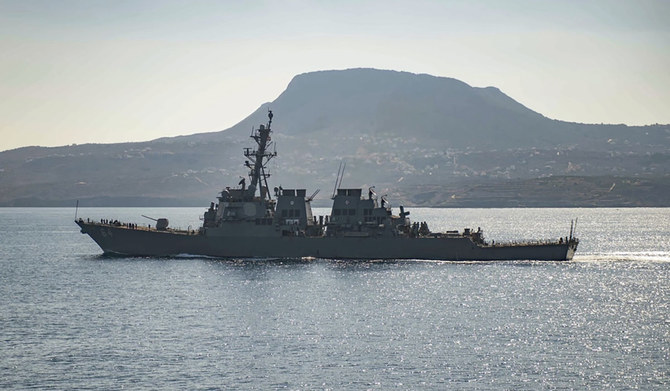
The guided-missile destroyer USS Carney in Souda Bay, Greece. The American warship and multiple commercial ships came under attack Sunday, Dec. 3, 2023 in the Red Sea, the Pentagon said, potentially marking a major escalation in a series of maritime attacks in the Mideast linked to the Israel-Hamas war. (AP)
2 / 2
A picture taken on August 10, 2018 from a military plane shows a ship crossing through the strategic strait of Bab al-Mandab, which separates the Arabian Peninsula from east Africa. (AFP)
Short Url
Updated 04 December 2023
Follow

Commercial ships hit by missiles in Houthi attack in Red Sea, US warship downs 3 drones

  • The Carney detected a missile fired from a Houthi-controlled area of Yemen that landed near the Bahamas-flagged M/V Unity Explorer, while the cargo ship later reported minor damage from another missile from a rebel-held area

DUBAI, United Arab Emirates: Three commercial ships in the Red Sea were struck by ballistic missiles fired from Houthi-controlled Yemen on Sunday and a US warship shot down three drones in self-defense during the hourslong assault, the US military said. Responsibility for the attack was claimed by the Houthi rebels, who are backed by Iran.
The attacks marked an escalation in a series of maritime attacks in the Mideast linked to the Israel-Hamas war, as multiple vessels found themselves in the crosshairs of a single Houthi assault for the first time in the conflict.
In a statement, US Central Command said the attacks “represent a direct threat to international commerce and maritime security. They have jeopardized the lives of international crews representing multiple countries around the world.” It said the three commercial ships and their crews are connected to 14 countries.
According to Central Command, the USS Carney, a Navy destroyer, detected a ballistic missile fired from Houthi-controlled areas of Yemen at the Bahamas-flagged bulk carrier Unity Explorer. The missile hit near the ship. Shortly afterward, the Carney shot down a drone headed its way, although it’s not clear if the destroyer was the target. The drone was also launched from Yemen.
About 30 minutes later, the Unity Explorer was hit by a missile, and while responding to the distress call the Carney shot down another incoming drone. Central Command said the Unity Explorer reported minor damage from the missile.
Two other commercial ships, the Panamanian-flagged bulk carriers Number 9 and Sophie II, were both struck by missiles. The Number 9 reported some damage but no casualties, and the Sophie II reported no significant damage.
While sailing to assist the Sophie II, the Carney shot down another drone heading in its direction. The drones did no damage.
“We also have every reason to believe that these attacks, while launched by the Houthis in Yemen, are fully enabled by Iran,” Central Command said, adding that the US will consider “all appropriate responses.”

The Carney, an Arleigh Burke-class guided-missile destroyer, has already shot down multiple rockets the Houthis have fired toward Israel so far in the war. It hasn’t been damaged in any of the incidents and no injuries have been reported on board.
Houthi military spokesman Brig. Gen. Yahya Saree claimed Sunday’s attacks, saying the first vessel was hit by a missile and the second by a drone while in the Bab el-Mandeb Strait, which links the Red Sea to the Gulf of Aden. Saree did not mention any US warship being involved in the attack.
“The Yemeni armed forces continue to prevent Israeli ships from navigating the Red Sea (and Gulf of Aden) until the Israeli aggression against our steadfast brothers in the Gaza Strip stops,” Saree said. “The Yemeni armed forces renew their warning to all Israeli ships or those associated with Israelis that they will become a legitimate target if they violate what is stated in this statement.”
Saree also identified the first vessel as the Unity Explorer, which is owned by a British firm that includes Dan David Ungar, who lives in Israel, as one of its officers. The Number 9 is linked to Bernhard Schulte Shipmanagement. Managers for the two vessels could not be immediately reached for comment.
Israeli media identified Ungar as being the son of Israeli shipping billionaire Abraham “Rami” Ungar.
The Houthis have launched a series of attacks on vessels in the Red Sea, as well as launching drones and missiles targeting Israel. The US has stopped short of saying its Navy ships were targeted, but has said Houthi drones have headed toward the ships and have been shot down in self defense.
Global shipping had increasingly been targeted as the Israel-Hamas war threatens to become a wider regional conflict — even as a truce briefly halted fighting and Hamas exchanged hostages for Palestinian prisoners held by Israel. However, the collapse of the truce and the resumption of punishing Israeli airstrikes on Gaza and a ground offensive there had raised the risk of the seaborne attacks resuming.
In November, the Houthis seized a vehicle transport ship also linked to Israel in the Red Sea off Yemen. The rebels still hold the vessel near the port city of Hodeida. Missiles also landed near another US warship last week after it assisted a vessel linked to Israel that had briefly been seized by gunmen.
However, the Houthis had not directly targeted the Americans for some time, further raising the stakes in the growing maritime conflict. In 2016, the US launched Tomahawk cruise missiles that destroyed three coastal radar sites in Houthi-controlled territory to retaliate for missiles being fired at US Navy ships at the time.


Washington presses Syria to shift from Chinese telecom systems

Updated 26 February 2026
Follow

Washington presses Syria to shift from Chinese telecom systems

  • Syria is exploring the possibility of procuring Chinese technology
  • It was unclear whether the United States ⁠pledged financial or logistical support to Syria to do so

DAMASCUS: The United States has warned Syria against relying on Chinese technology in its telecommunications sector, arguing it conflicts with US interests and threatens US national security, according to three sources familiar with the matter.
The message was conveyed during an unreported meeting between a US State Department team and Syrian Communications Minister Abdulsalam Haykal in San Francisco on Tuesday. Washington has been coordinating closely with Damascus since 2024, when Syria’s now President Ahmed Al-Sharaa ousted longtime leader Bashar Assad, who had a strategic partnership with China.
Syria is exploring the possibility of procuring Chinese technology to support its telecommunications towers and the infrastructure of local Internet service providers, according to a Syrian businessman involved in the procurement talks.
“The US side asked for clarity on the ministry’s plans regarding Chinese telecom equipment,” said ⁠another source briefed on ⁠the talks.
But Syrian officials said infrastructure development projects were time-critical and that Damascus was seeking greater vendor diversity, the source added.
SYRIAN OFFICIALS CITE US EXPORT CONTROLS AS TELECOMS BARRIER
Syria is open to partnering with US firms but the matter was urgent and export controls and “over-compliance” remained an issue, according to person familiar with the meeting in San Francisco.
A US diplomat familiar with the discussions told Reuters that the US State Department “clearly urged Syrians to use American technology or technology from allied countries in the telecoms sector.”
It was unclear whether the United States ⁠pledged financial or logistical support to Syria to do so.
Responding to Reuters questions, a US State Department spokesperson said: “We urge countries to prioritize national security and privacy over lower-priced equipment and services in all critical infrastructure procurement. If it seems too good to be true, it probably is.”
The spokesperson added that Chinese intelligence and security services “can legally compel Chinese citizens and companies to share sensitive data or grant unauthorized access to their customers’ systems” and promises by Chinese companies to protect customers’ privacy were “entirely inconsistent with China’s own laws and well-established practices.”
China has repeatedly rejected allegations of it using technology for spying purposes.
The Syrian Ministry of telecommunications told Reuters any decisions related to equipment and infrastructure are made “in accordance with national technical and security standards, ensuring data protection and service continuity.”
The ministry said it is also prioritizing the diversification of partnerships and technology sources to ⁠serve the national interest.
Syria’s telecom ⁠infrastructure has relied heavily on Chinese technology due to US sanctions imposed on successive Assad governments over the civil war that grew from a crackdown on anti-government protests in 2011.
Huawei technology accounts for more than 50 percent of the infrastructure of Syriatel and MTN, the country’s only telecom operators, according to a senior source at one of the companies and documents reviewed by Reuters. Huawei did not immediately respond to a request for comment.
Syria is seeking to develop its private telecommunications sector, devastated by 14 years of war, by attracting foreign investment.
In early February, Saudi Arabia’s largest telecom operator, STC, announced it would invest $800 million to “strengthen telecommunications infrastructure and connect Syria regionally and internationally through a fiber-optic network extending over 4,500 kilometers.”
The ministry of telecommunications says that US restrictions “hinder the availability of many American technologies and services in the Syrian market,” emphasizing that it welcomes expanding cooperation with US companies when these restrictions are lifted.
Syria has inadequate telecommunications infrastructure, with network coverage weak outside city centers and connection speeds in many areas barely exceeding a few kilobits per second.