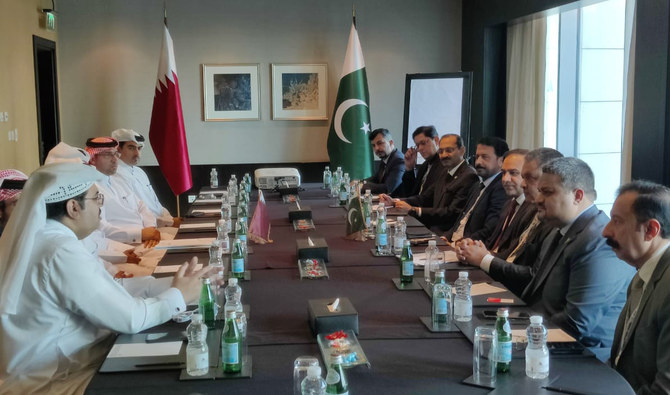

ISLAMABAD: Pakistan’s Caretaker Information Technology Minister Dr. Umar Saif said on Sunday the South Asian country was "well-equipped" to meet Qatar’s expanding IT requirements as he led representatives of 30 leading Pakistani IT companies at meetings with officials of Qatari firms in Doha.
Pakistan's first-ever IT delegation to Qatar arrived in Doha on Saturday for a five-day visit, aiming to attract investment and explore opportunities for Pakistani software houses and freelance developers.
In line with broader trends in the Gulf region, Qatar is actively diversifying its economy and focusing on the technology sector, taking smart city initiatives, launching tech start-ups and hosting technologically advanced events like the FIFA World Cup 2022. The strategic shift includes the adoption of advanced digital technologies, such as AI, cloud computing and cybersecurity, to transition into a knowledge-based economy.
On Sunday, an event titled as 'Pak-Qatar Tech Connect' brought together distinguished speakers from public and private sectors, who stressed the need to enhance collaboration and trade between both countries, according to the Pakistani IT ministry. The event served as a platform for some impactful business-to-business (B2B) interactions.
“Pakistan, a vast country just two hours away, boasts a robust IT infrastructure, a wealth of IT products, services, and a pool of skilled professionals that can undoubtedly cater to Qatar's growing IT needs,” Saif told Arab News from Doha.
The minister said he highlighted Pakistan’s IT potential at the conference in Doha, which included "exciting meetings" with businesses in Qatar to establish collaboration with Pakistani IT firms.
“This time, 30 Pakistani firms are taking part in this conference, but in the near future, Pakistan will be showcasing 300 IT firms in Qatar,” he said. “There is a huge potential for Pakistani companies to expand their business in Qatar.”
Saif expressed hopes that the Pakistan-Qatar IT conference would serve as a catalyst for stronger ties, shared growth and enhanced technological cooperation between the two nations.
“We also had a great meeting with CEO of Qatar Financial Center Yousaf Mohammad Al-Jaida and his team to help establish a process and incentive packages for Pakistani IT companies to expand their businesses to Qatar,” he said.
The visit of the Pakistani delegation is aimed at forging a common, secure platform that enables professionals from both nations to seamlessly share knowledge, expertise and technological advancements, according to the Pakistani IT minister.
Both countries can propel their technological landscapes to new heights by leveraging their technical knowledge.
“This collaboration aims to create a secure technological ecosystem, aligning with Qatar's remarkable strides in automating various business sectors,” he said.
“I extend an invitation to my counterpart Mohammed bin Ali bin Mohammed Al-Mannai to visit Pakistan at his convenience to witness firsthand the technological developments and collaborative potential between our nations.”
He appreciated the role of Qatar Financial Centre and Qatar Free Zone in providing an international platform to Pakistani business houses to set up and launch innovative ventures in Qatar.
Zohaib Khan, chairman of the Pakistan Software Houses Association (P@SHA), said today's primary focus were the B2B interactions, which included participation from top 30 Pakistani IT companies specializing in cybersecurity, digital transformation and various other IT services.
“Qatari companies exhibited significant interest in fintech, cybersecurity, artificial intelligence and digital transformation,” he told Arab News over the phone. “Numerous Pakistani businesses secured promising leads, expected to materialize in the upcoming weeks.”
Khan said collaborations were underway with Qatari firms and several Pakistani entities were considering registration in the Gulf nation.
The upcoming events would be centered around government-to-government (G2G) meetings, which are anticipated to have a highly positive impact on Pakistani IT exports through increased remittances, he added.