

Pakistan nears $1.5 billion deal to supply weapons, jets to Sudan

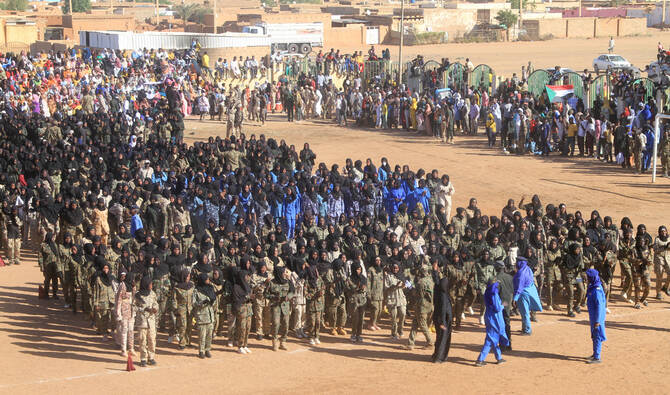
Sudanese soldiers march after completing a training courses, with the aim of supporting the Sudanese regular army in the Ombada locality west of Omdurman, on December 15, 2025, in the capital Khartoum. (AFP/File)
Short Url
Updated 09 January 2026
Follow

Pakistan nears $1.5 billion deal to supply weapons, jets to Sudan

  • Deal may include drones, air defense systems and Karakoram-8 aircraft, with possible JF-17 fighters
  • The sale is expected to bolster Sudan’s army in the ongoing civil war with the Rapid Support Forces

ISLAMABAD: Pakistan is in the final phases of striking a $1.5-billion deal to supply weapons and jets to Sudan, a former top air force official and three sources said, promising a major boost for Sudan’s army, battling the paramilitary Rapid Support Forces.

Their conflict has stoked the world’s worst humanitarian crisis for more than 2-1/2 years, drawing in myriad foreign interests, and threatening to fragment the strategic Red Sea country, a major gold producer.

The deal with Pakistan encompasses 10 Karakoram-8 light attack aircraft, more than 200 drones for scouting and kamikaze attacks, and advanced air defense systems, said two of the three sources with knowledge of the matter, who all sought anonymity.

It was a “done deal,” said Aamir Masood, a retired Pakistani air marshal who continues to be briefed on air force matters.

Besides the Karakoram-8 jets, it includes Super Mushshak training aircraft, and perhaps ‌some coveted JF-17 ‌fighters developed jointly with China and produced in Pakistan, he added, without giving figures ‌or ⁠a delivery ‌schedule.

Pakistan’s military and its defense ministry did not immediately respond to requests for comment.

A spokesman for Sudan’s army did not immediately respond to a message requesting comment.

Assistance from Pakistan, especially drones and jets, could help Sudan’s army regain the air supremacy it had toward the start of its war with the RSF, which has increasingly used drones to gain territory, eroding the army’s position.

PAKISTAN’S DEFENSE AMBITIONS

The deal is another feather in the cap for Pakistan’s growing defense sector, which has drawn growing interest and investment, particularly since its jets were deployed in a conflict with India last year.

Last month, Islamabad struck a weapons deal worth more than $4 billion with the Libyan National Army, officials said, for one of the South Asian nation’s largest arms sales, which includes JF-17 fighter jets and training aircraft.

Pakistan has also held talks with Bangladesh on a defense deal that could includes the Super Mushshak training jets and JF-17s, as ties improve ties with Dhaka.

The government sees Pakistan’s burgeoning industry as a catalyst to secure long-term economic stability.

Pakistan is now in a $7-billion IMF program, following a short-term ‌deal to avert a sovereign default in 2023. It won IMF support after Saudi Arabia and other Gulf allies provided financial and deposit rollovers.


Pakistan drops 8,000 MW power procurement, claims $17 billion savings amid IMF-driven reforms

Updated 11 sec ago
Follow

Pakistan drops 8,000 MW power procurement, claims $17 billion savings amid IMF-driven reforms

  • Government says decision taken “on merit” as it seeks to cut losses, circular debt, ease consumer pressure 
  • Power minister says losses fell from $2.1 billion to $1.4 billion, circular debt dropped by $2.8 billion

ISLAMABAD: Pakistan has abandoned plans to procure around 8,000 megawatts of expensive electricity, the power minister said on Sunday, adding that the decision was taken “purely on merit” and would save about $17 billion.

The power sector has long been a major source of Pakistan’s fiscal stress, driven by surplus generation capacity, costly contracts and mounting circular debt. Reforming electricity pricing, reducing losses and limiting new liabilities are central conditions under an ongoing $7 billion IMF program approved in 2024.

Pakistan has historically contracted more power generation than it consumes, forcing the government to make large capacity payments even for unused electricity. These obligations have contributed to rising tariffs, budgetary pressure and repeated IMF bailouts over the past two decades.

“The government has abandoned the procurement of around 8000 megawatts of expensive electricity purely on merit, which will likely to save 17 billion dollars,” Power Minister Sardar Awais Ahmed Khan Leghari said while addressing a news conference in Islamabad, according to state broadcaster Radio Pakistan.

He said the federal government was also absorbing losses incurred by power distribution companies rather than passing them on to consumers.

The minister said the government’s reform drive was already showing results, with losses reduced from Rs586 billion ($2.1 billion) to Rs393 billion ($1.4 billion), while circular debt declined by Rs780 billion ($2.8 billion) last year. Recoveries, he added, had improved by Rs183 billion ($660 million).

Leghari said electricity tariffs had been reduced by 20 percent at the national level over the past two years and expressed confidence that prices would be aligned with international levels within the next 18 months.

Power sector reform has been one of the most politically sensitive elements of Pakistan’s IMF-backed adjustment program, with higher tariffs and tighter enforcement weighing on households and industry. The government says cutting losses, improving recoveries and avoiding costly new capacity are essential to stabilizing public finances and restoring investor confidence.