


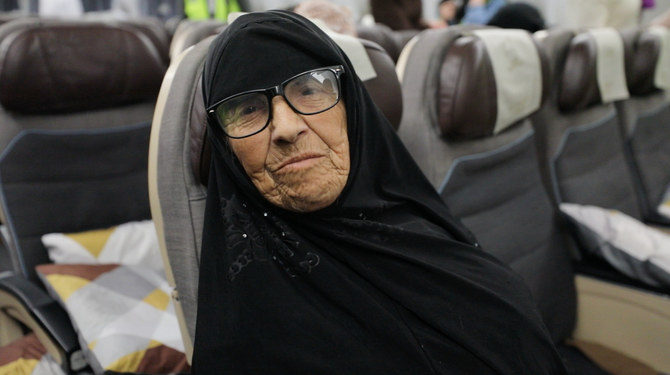

ABU DHABI: “This is my first time on a plane. I have only traveled in my dreams. In Gaza, we can’t dream. We build our homes before they are destroyed all over again. Our dreams are always shattered.”
Abdelrahman Hussam Zyada, 31, was aboard a flight that has become a “flying hospital” for war-stricken Palestinians after once carrying passengers to new destinations or home to see their families.
The comfortable padded seats of Etihad Airways’ Boeing 777 serve as beds for vulnerable elderly cancer patients who have been evacuated from an “apocalyptic” Gaza, via Rafah border, for treatment in the UAE. His mother was among them.
I was part of the Arab News team aboard the fourth UAE mission that left Abu Dhabi on Friday afternoon to airlift 120 injured Palestinian children and cancer patients, along with their companions, from Egypt’s Al-Arish International Airport in a challenging journey that took 14 hours.
My seat in economy class was next to a stretcher installed above a group of folded seats that medics were setting up to provide urgent medical care for the seriously wounded.
Gaza was under intense bombing that day shortly after the truce ended, with airstrikes hitting near the Rafah border where only a few evacuees were lucky to leave.
Our take-off from Abu Dhabi was delayed by almost two hours as UAE officials and medics adjusted their plans based on information they received from Egyptian authorities on the ground.
Landing in Al-Arish at dusk, we left the plane two hours later to welcome patients after officials had back-and-forth negotiations with the Egyptian authorities on the right movement around the highly secured airbase.
The stillness and eerie silence in the vast, dark desert of Al-Arish stood in sharp contrast with the intense bombardment behind Rafah crossing, which was only 55 km away, about a 45-minute trip.
The impact of the brutal war on Gaza unfolded before our eyes as patients began to arrive in Egyptian ambulances.

The passengers shared common features: Eyes framed with intense black circles, thin and exhausted figures, a small plastic bag carrying a few possessions, and a gaze that simultaneously captured a mix of emotions — relief, guilt and hope.
On the tarmac, UAE medics and doctors received the first patient; a seriously injured man, tightly strapped on a stretcher and appearing to be in immense pain, who was transported onto the aircraft via a hydraulic lift after his condition was assessed.
It was a sight that countless hours following the war daily could not have prepared me for.
Soon after, dozens of dazed and weak elderly cancer patients followed on wheelchairs for their turn to board the aircraft.
Receiving them with reassuring smiles and gentle pats on the shoulder, doctors and staff from the Abu Dhabi Department of Health later told us that these patients had had no access to painkillers, proper food or water since the war started on Oct. 7.

“The first thing we do with some cases is give them hydration and painkillers to immediately comfort the pain. We receive many patients who have lived in pain for long weeks,” Jordanian nursing manager, Sabreen Tawalbeh, told me.
This flight received only a few war-related trauma wounds as majority of the adult and young cancer patients boarded the flight unassisted, occasionally smiling in relief and thanking us as they passed through the aisles.
“As much as I am relieved to leave the horror I can’t describe in Gaza, I can’t imagine eating, drinking or sleeping without thinking of my family back home,” said Zyada.
The war, which he calls “hell from a horror film,” has already killed 50 members of his family and levelled the area where they lived to the ground. He has no clue if he will ever see his nine siblings, their children, and his remaining relatives.
After miraculously leaving Gaza, Zyada said he cannot believe he made it out alive.

Amna Hashem Saeed, an elderly Pancreas cancer patient, broke down as she recounted the final moments with her only daughter who could not accompany her after she was denied entry through the Rafah border.
“I am left here to die, mom,” Saeed repeated her daughter’s sentence as the city behind them was collapsing. Saeed’s husband suffered a stroke a few weeks ago and lies without treatment.
“I do not know if I will ever see them again.”
Traumatized and in shock, teenagers who either accompanioned sick elderly family members or were seeking treatment themselves walked down the aisles of the aircraft as if they carried the weight of the world on their shoulders.
A couple of children, too young to comprehend the situation, either played in joy or squirmed in pain.
Sitting in the front row of the plane, three-year-old Karma Al-Khateeb was unable to ignore her pain despite the attempts by her mother Douaa Abu Rahma and a cabin crew member to distract her with a coloring book and crayons. The young leukemia patient had a fever that affected a nerve on her face after her case could not be attended to due to the collapse of hospitals in Gaza.
It took about six hours to carefully get all patients on board and ensure their needs were met before a final headcount was made and the plane left for Abu Dhabi.
“If the evacuation had taken longer and we crossed the maximum number of hours allowed for the cabin crew per shift, we would have had to go to Cairo and change the crew before flying back to Abu Dhabi,” Joe Coughlan, flight medical commander, told me.
Silence quickly took over during the flight to Abu Dhabi after passengers had their first proper meal and rest in nearly two months.
With dreamy eyes and an innocent smile, two-year-old Mohammed, who had no family except his ailing grandmother on the flight, climbed on my lap and played on the plane’s small screen for hours before peacefully falling asleep in my arms.
It was difficult to comprehend that thousands of children like him will go to bed with the possibility that they will not see the next day.
Along with my media colleagues, I left the aircraft, which landed in Abu Dhabi at 5 a.m. the next morning, knowing that the televised images of the war will now strike much deeper.


