

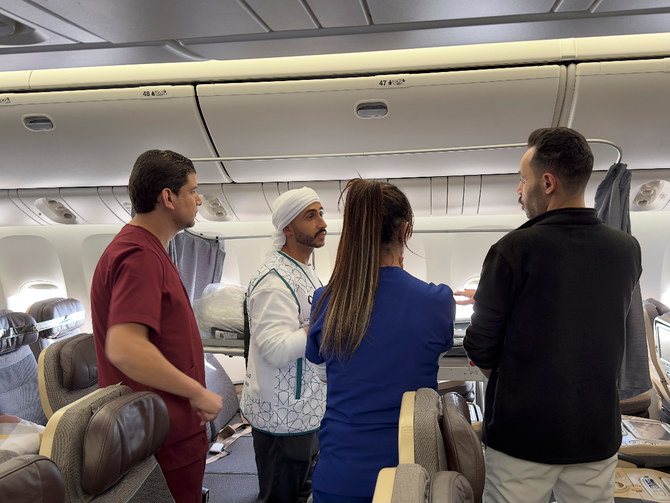

ABU DHABI: Nothing could have prepared Palestinian pediatric nurse Etimad Hassouna for what she saw as she aided injured Palestinian children evacuated from Gaza on a UAE mission.
Hailing from Gaza, Hassouna was among a volunteering team of about 30 medical professionals from the UAE’s Burjeel Hospital, NMC Royal Hospital and Sheikh Khalifa Medical City. The team has worked tirelessly to assist war-stricken patients in unpredictable and challenging evacuation missions that last up to 24 hours.
On an Etihad Airways flight that evacuated 120 injured Palestinians and their families on Friday following intense violence after the truce ended, Hassouna told Arab News that the injuries inflicted on Gazans are “nothing like I have ever seen before” during her 22-year professional experience.
“I saw cases of children with severe burns, injuries and fractures in an intensity I have never witnessed throughout my career in emergency departments, surgery and pediatric wards. Most of the patients coming from under the rubble are disabled for life.”
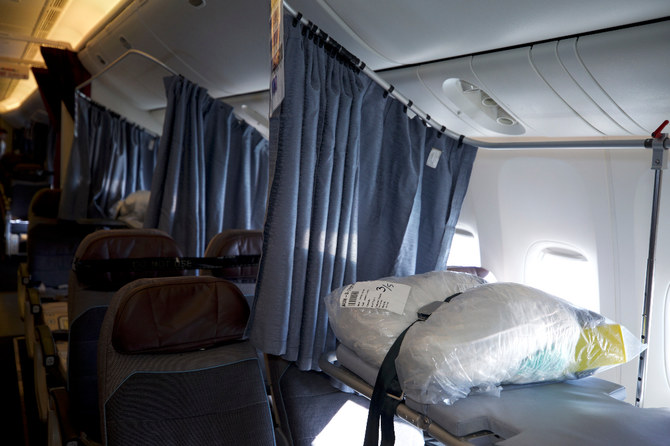
Hassouna works alongside colleagues with a diverse range of expertise to ensure injured evacuees remain in a stable condition on the “flying hospital” from Egypt’s Al-Arish until they land in Abu Dhabi for further treatment.
While the unpredictability of the situation prompts the team to be logistically prepared for all cases and act on the spot, Hassouna said that the extent of the suffering was still difficult to witness.
“It’s a mix of feelings between sadness, to see innocent children suffering on this magnitude, and happiness, to have the opportunity to help rescue them. This small contribution makes me feel I’m giving back, given that we have been feeling rather helpless,” said Hassouna, who left Gaza 30 years ago.

Etimad Hassouna aids injured Palestinian children and cancer patients evacuated from her hometown Gaza. (AN Photo: Mohammed Fawzy)
Asked how she copes with treating severe cases coming from her homeland, she said that “faith and hope” have kept her going. “The reason you go on a mission like this is the same reason you cope, especially when you are helping children.”
Hassouna, whose relatives are displaced in Gaza and living in dire conditions, said: “It hasn’t been easy, but I have to be strong for the women, children and patients.”
Some of Hassouna’s colleagues serving the UAE’s goal to evacuate 2,000 injured Palestinian children and cancer patients have experience working in war zones.
Yet, Sabreen Tawalbeh, a Jordanian nursing manager at Burjeel Medical Center in Abu Dhabi, said the team was witnessing injuries more severe than in any past Gaza conflict.
Although Tawalbeh served as part of a medical team inside Gaza during the 2014 war, she said the burns and injuries on children’s bodies resulting from Israel’s bombardment since Oct. 7 were more acute and violent.
“I received a two-year-old baby whose entire lower body was burned. The children I have dealt with had serious deformities,” said Tawalbeh, who was on her third UAE mission.
More than medical care, patients arriving with extreme shock and trauma require a hope-driven approach.
“It’s important during the evacuation to make them feel safe, given that they are moving to a new place away from the home they have never left, let alone under trauma effects.”

Serving in Gaza war 2014, Sabreen Tawalbeh says children's injuries in the ongoing war are far more severe. (AN Photo: Mohammed Fawzy)
Tawalbeh added: “We need to give them hope that their situation is temporary; that they will return home someday stronger and fully recovered.”
The medical professional, who has tended to war victims in Libya, Afghanistan and Congo, said she will never forget an 11-year-old boy who arrived as a companion to his two cousins, a 7-year-old boy with a fractured skull and a two-year-old baby. The family of the two children had been killed.
“I saw a child become a hero. He was a man who probably never got to live his childhood,” said Tawalbeh. “After serving in this field for so long, I felt I was chosen for this mission, and I love being part of helping people.
Constantly improving missions
UAE doctors and nurses have no knowledge of the cases they will receive beforehand, prompting them to follow a flexible plan throughout the mission. They must be prepared with all types of equipment and a range of specializations.
To increase their future preparedness, the medical staff constantly learn from the challenges of each mission and aim to improve for the next.
During the first evacuation mission, for example, the team faced difficulties moving a patient with a spinal cord injury into the plane due to a lack of equipment to prevent his neck from moving. Another mission received a far higher number of patients than expected.
“Every mission we learn something new,” said Tawalbeh.
Kenneth Charles Dittrich, a consultant emergency physician from SKMC, said that his team comprised anesthetists, respiratory technologists, administrative assistants to help with identifying people, and four nursing staff to prepare for contingencies across all ages groups.
“The evacuated patients go through multiple checks at different borders. During that time, stable people’s condition can change, and to deal with such dynamic medical conditions, we need to constantly be on our feet and serve different roles.”
The staff coordinate with the on-ground medical personnel deployed in Rafah and Al-Arish, as well as Egyptian paramedics, who provide an initial assessment of the patients and give a list of the cases coming on board.
Upon receiving patients, the UAE medics perform reassessments and develop a treatment plan to follow on the flight.
The medics also work in coordination with UAE authorities to distribute the patients to different specialist hospitals across the country.
The Emirati mission includes a range of nationalities, demonstrating their unity in supporting the humanitarian cause.
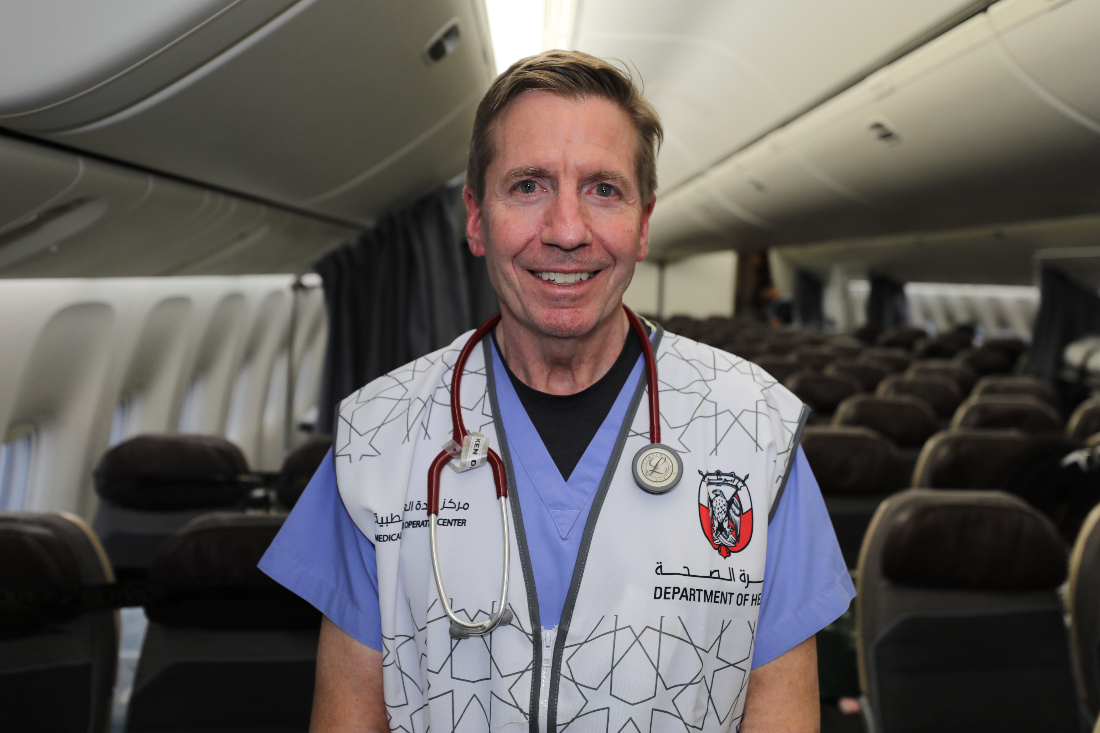
Kenneth Charles Dittrich, emergency specialist, said the key aspect of his work, especially in war zones, is to remain human. (AN Photo: Mohammed Fawzy)
Not a stranger to operating in challenging war zones throughout his 42-year career, Dittrich said that he had learned to make boundaries on the job but would allow himself to process the emotions of stress later.
He added that a key aspect of his work is to “remain human,” adding: “It’s overwhelming to think of people escaping deaths and recognizing what they have left behind.
“The first thing we would do is provide them with nutrition and hydration after long journeys with emotions and stress, and trauma.
“We are in a position to help, and that’s always a positive aspect.”


