



ABU DHABI: At least 120 injured Palestinian children and cancer patients along with their families have been evacuated from Gaza to the UAE for treatment in the first Emirati mission carried out after the week-long truce between Hamas and Israel ended.
However, UAE medical staff, who arrived on a chartered plane at Egypt’s Al-Arish International Airport at 4 p.m. to airlift patients to Abu Dhabi on Friday, said that more Palestinians could have been saved if the truce was extended.
Dr. Maha Barakat, the UAE assistant minister of foreign affairs for health, told Arab News that the renewed bombardment has complicated the evacuation of Palestinians through the Rafah border crossing.
“We would have had more seats on the plane filled with patients if the ceasefire had continued, but it’s just unfortunate,” said Barakat from the tarmac of Abu Dhabi International Airport, where Palestinian patients arrived to safety early Saturday at 5 a.m. following a complex 14-hour evacuation mission.
The Etihad Airways’ Boeing-777 plane, which has transformed into a flying hospital, carried the fourth group of Palestinian patients since the UAE’s evacuation mission started on Nov. 18 with an aim to take in 1,000 injured children and 1,000 cancer patients of all ages for treatment in UAE hospitals.
Arab News was on board the humanitarian mission that took off from Abu Dhabi to Al-Arish airport where patients arrived in Egyptian ambulances from Rafah.
Elderly cancer patients were taken on stretchers and wheelchairs, and delicately transported into the aircraft via hydraulic lifts.
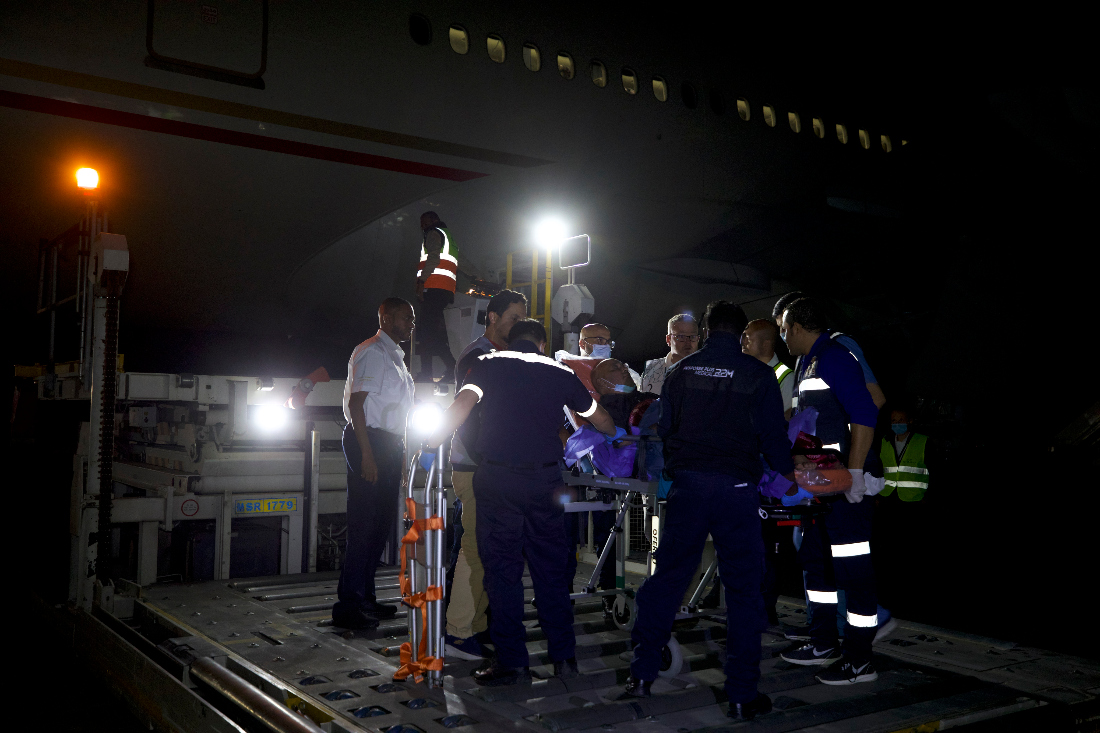
UAE medics assess patients before delicately transporting them into the aircraft via hydraulic lift. (AN Photo: Mohammed Fawzy)
While the first three evacuation flights carried many children with trauma and some with cancer to the UAE, Friday’s flight mainly transported adult and children cancer patients, with only a few cases suffering from trauma injuries.
Weary, sleep-deprived and in pain, many of the patients received painkillers for the first time since the Oct. 7 conflict began, after Israeli bombardment caused a complete collapse of the health system in Gaza and pushed the enclave into a serious humanitarian crisis.
Intense bombing was reported across in Khan Younis and Rafah in the southern Gaza Strip on Friday, killing hundreds shortly after the humanitarian truce collapsed.
Barakat detailed the long journeys that Gazans take to reach the Rafah crossing with Egypt amid the intense bombardment in the war zone. “Patients arriving today would have left Gaza to the Rafah border at 8:30 a.m. without proper food or drink. Some of them waited for security clearance to get through the border to Egypt until 5:30 p.m.
“By the time they arrived in Al-Arish airport, they were exhausted, and many of them were in pain.”
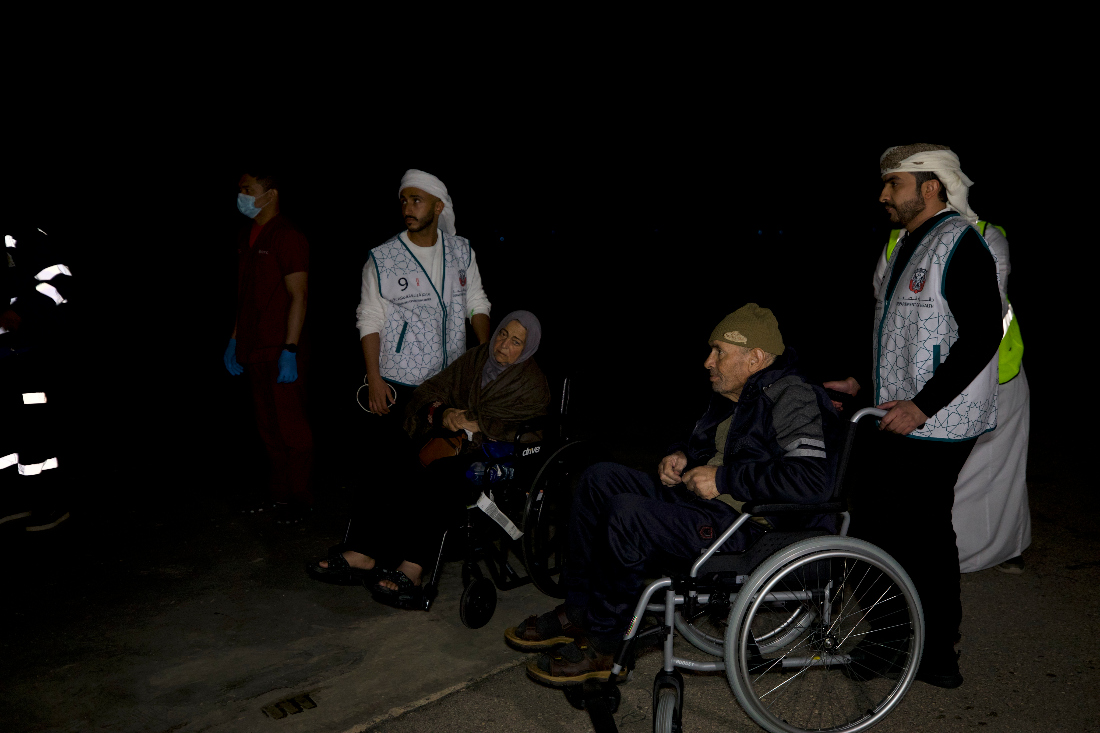
Elderly cancer patients from Gaza arrived to Al-Arish airport where boarded an aircraft to Abu Dhabi for treatment. (AN Photo: Mohammed Fawzy)
At Al-Arish airport, 50 km away from Rafah, Mohammed Abdel-Fattah, a paramedic from the Egyptian Ambulance Authority receiving Gaza patients for evacuation through the border, told Arab News about the intense bombardment at the Rafah crossing on Friday.
“Buildings on the Egyptian side of Rafah were heavily shaking from the bombardment,” he said.
Challenging evacuation process
The UAE has been working with partners like the Egyptian and Palestinian Red Crescents to identify and assess patients who can cross the Rafah border in what Barakat called a “complex and challenging process that takes a long time.”
She added: “Getting information on who can cross Rafah border and when is the most challenging part.”
Asked how people are selected for evacuation, Barakat said that UAE authorities receive a list of patients from the few hospitals still operating inside Gaza. Patients are then asked to head to the Rafah border, where only those who obtain a security clearance from Israeli and Egyptian authorities are allowed to leave Gaza.
A team of about 30 doctors, nurses and medics aided patients on board, liaising with another specialist UAE team on the ground in Egypt’s Al-Arish and Rafah. The ground team carries out preliminary assessments on patients arriving through the border.
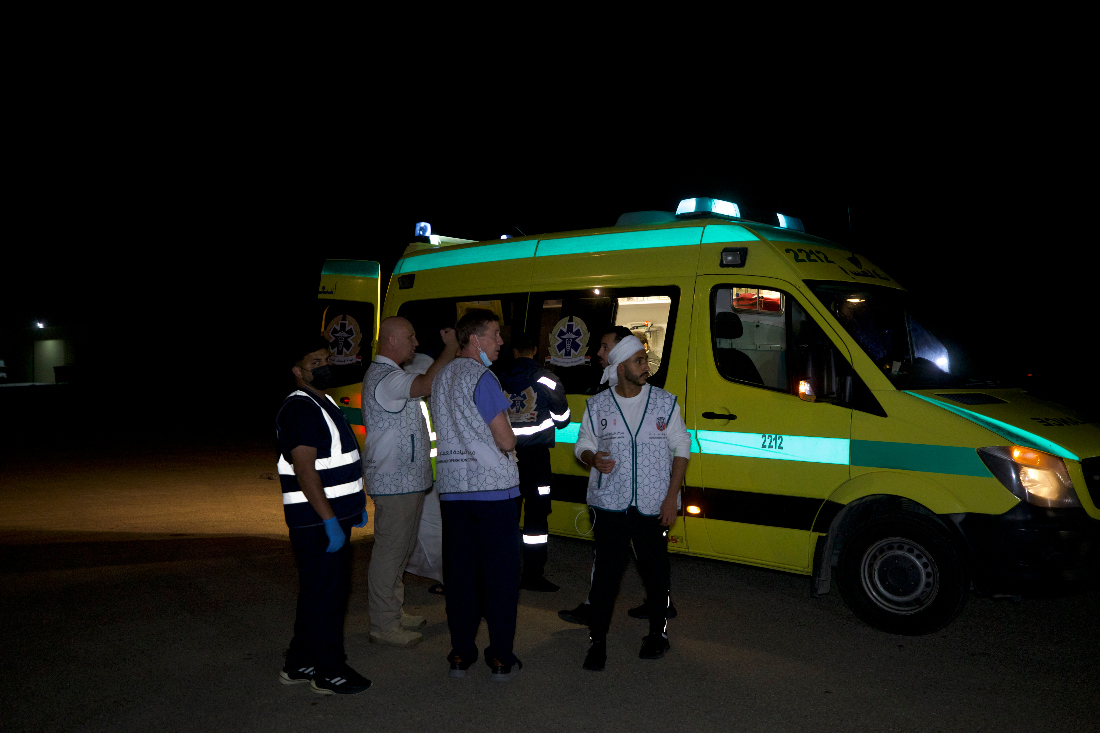
Patients arrived at Al-Arish International Airport on Egyptian ambulances after being evacuated from Gaza via Rafah border. (AN Photo: Mohammed Fawzy)
“I didn’t think we’d survive”
Abdelrahman Hussam Zyada, 31, said he narrowly escaped death twice on his way to Rafah as a companion for his mother, a cancer patient with severe back and knee issues.
“We bid farewell to our relatives on Friday morning before we left for Rafah. By then, the truce had ended, and I asked them to pray for us whether we survive or die. And I don’t know if I will ever see them again,” said Zyada, who has lost more than 50 members of his family since Oct. 7.
Zyada’s planned journey to Rafah was supposed to take 20 to 30 minutes, but intense bombardment blocked several roads, forcing him and his mother to take alternative routes.
“I could not believe we would ever reach the border where we are welcomed by the paramedics and the Egyptian authorities, let alone arrive safely in the UAE,” he said.
His mother was receiving treatment at the Turkish-Palestinian Friendship Hospital, Gaza’s only cancer facility, which was damaged by Israeli strikes. She was referred to a hospital in Ramallah, but lacked the means to travel there due to the intensity of the war in Gaza.
The absence of medical care has seen her condition deteriorate, especially after the family was forced to move when their homes were flattened by airstrikes.
Zyada said his mother would not have stood a chance at survival if she was not evacuated for further treatment. “There are no hospitals or medicines. Nowhere is safe in Gaza.”
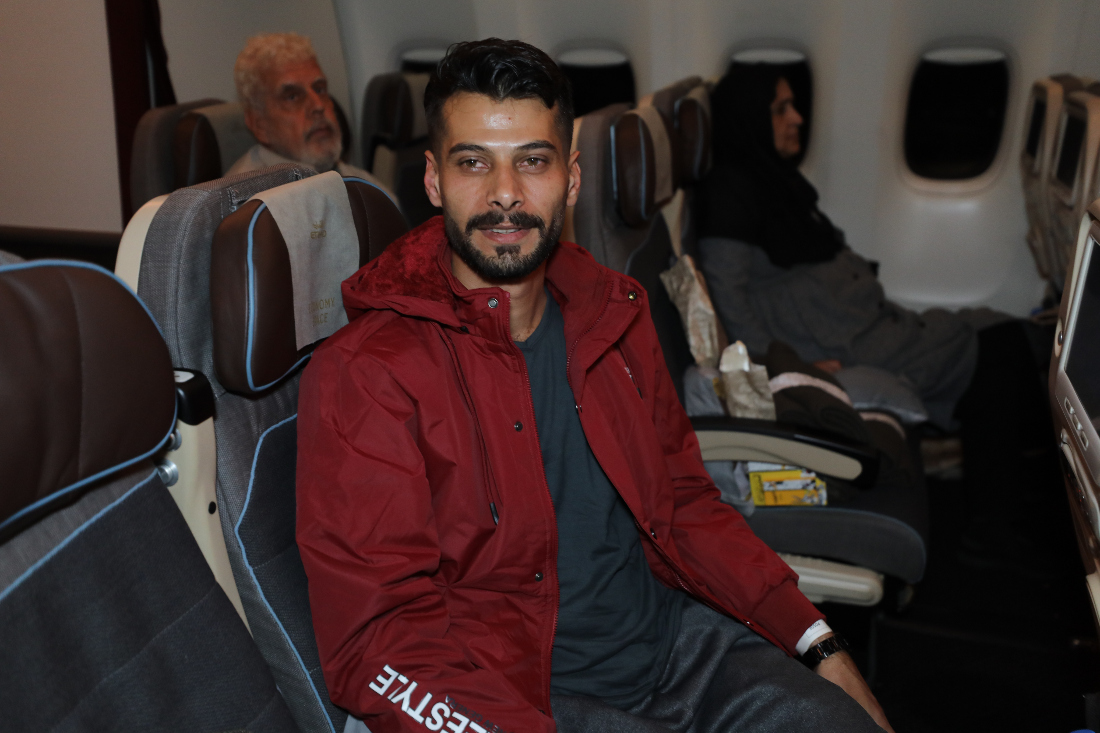
Abdelrahman Hussam Zyada recounted horrifying journey to Rafah border with his mother, a cancer patient evacuated from Gaza. (AN Photo: Mohammed Fawzy)
Amna Hashem Saeed, a pancreatic cancer patient who was also evacuated, had to bid farewell to her only daughter, who could not get through Rafah as her companion.
“My daughter remained at the border because she couldn’t immediately return home due to the intense bombing. Before I departed, she told me she was left with nothing, that she was only left to die,” Saeed recalled as she sobbed.
Saeed herself had previously failed to cross Rafah for treatment in Turkiye seven times due to the security situation. “Every time I headed to the border, I got sent back,” she said.
Her condition deteriorated when she could not receive chemotherapy, which is supposed to be repeated four times in two months. “I had no appetite to eat or sleep. I lost so much weight,” she added.
Saeed’s departure was filled with conflicted feelings. She felt relief over receiving treatment, but sadness for her husband, children and 23 grandchildren left behind in Gaza. “My husband had a stroke and he insisted I go for treatment and find happiness again. But there’s no happiness without them. I can’t imagine how my life would be without them,” she said.


