- Kamala Harris says Israel has a right to defend itself but must respect international, humanitarian law
- King Abdullah stresses the need for the US to play a leading role in pushing for peace in Palestine
GAZA/CAIRO: US Vice President Kamala Harris said too many innocent Palestinians had been killed in Gaza as Israeli war planes and artillery bombarded the enclave on Saturday following the collapse of a truce with Hamas militants.
Speaking in Dubai, Harris said Israel had a right to defend itself, but international and humanitarian law must be respected and “too many innocent Palestinians have been killed.”
“Frankly, the scale of civilian suffering, and the images and videos coming from Gaza, are devastating,” Harris told reporters.
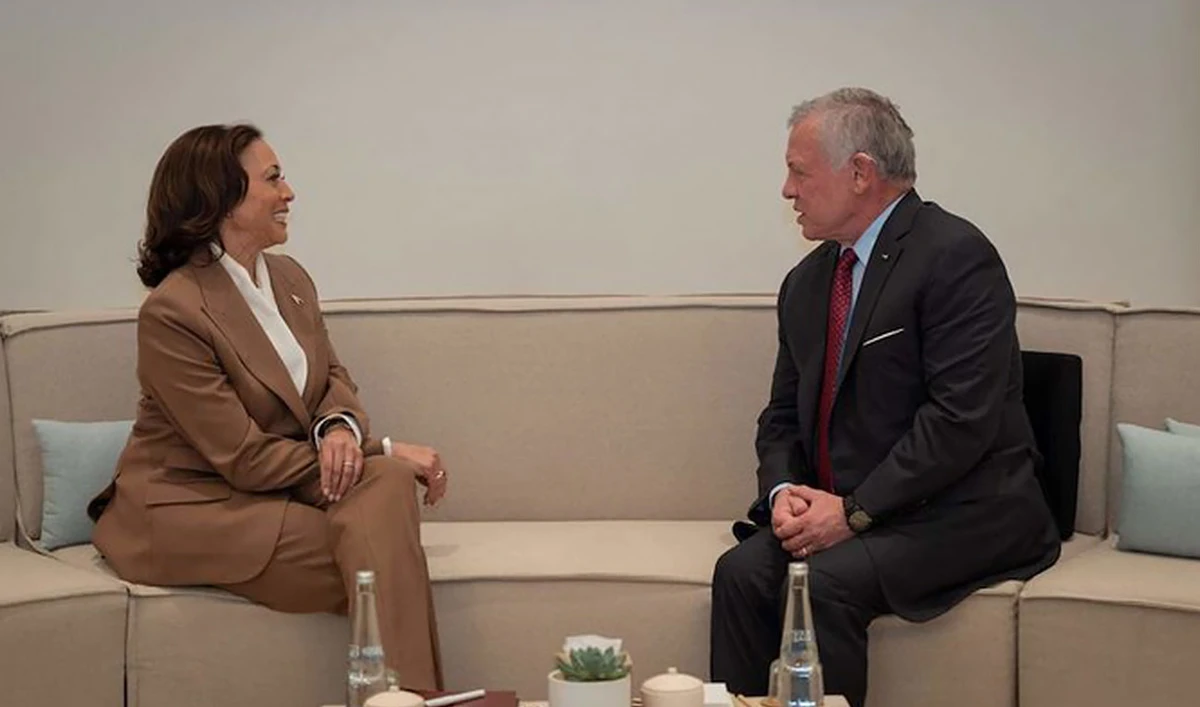
On the sidelines of COP28, Jordan’s King Abdullah II and the US Vice President met in Dubai, reported the Jordan News Agency.
King Abdullah stressed the need for the US to play a leading role in pushing for a political horizon for the Palestinian issue to reach peace on the basis of the two-state solution, during his meeting with Harris.
The King called for an immediate cease-fire in Gaza and protecting civilians, warning of the repercussions of the continued war on international peace and security, including further violence and conflict that could plunge the entire region into a catastrophe.
The two sides reaffirmed their rejection of any attempts of forced displacement of the Palestinians internally or outside Gaza, or attempts to re-occupy any parts of the Strip, reported Petra.
King Abdullah also stressed the importance of maintaining the uninterrupted delivery of sufficient aid, including food, water, fuel, and electricity, without any impediments, warning against the targeting of hospitals and hindering the delivery of medical supplies.
Meanwhile, Harris thanked King Abdullah for his continued leadership in addressing the Israeli-Palestinian conflict and for Jordan’s leadership in providing vital humanitarian assistance to Gaza, including its three airdrops of medical supplies to the field hospital that it has established in Gaza.
She discussed the importance of the recent pause in the fighting between Israel and Hamas, and the Biden-Harris administration’s commitment to supporting efforts to reach a new deal. She also discussed the US ideas for post-conflict planning in Gaza, including efforts on reconstruction, security, and governance.
The US vice president emphasized that these efforts can only succeed if they are pursued in the context of a clear political horizon for the Palestinian people, toward a state of their own led by a revitalized Palestinian Authority and backed by significant support from the international community and the countries of the region.
In a news conference in Tel Aviv, Prime Minister Benjamin Netanyahu said later on Saturday that Israel was continuing to work in coordination with the US and international organizations to define “safe areas” for Gaza civilians.
“This is important because we have no desire to harm the population,” Netanyahu said. “We have a very strong desire to hurt Hamas.”
Harris also sketched out a US vision for post-conflict Gaza, saying the international community must support recovery and Palestinian security forces must be strengthened.
“We want to see a unified Gaza and West Bank under the Palestinian Authority, and Palestinian voices and aspirations must be at the center of this work,” she said, adding that Hamas must no longer run Gaza.
The Western-backed Palestinian Authority governs parts of the occupied West Bank. Hamas seized control of Gaza in 2007 from Palestinian President Mahmoud Abbas’ mainstream Fatah party and has ruled the enclave ever since.
* With Reuters