


Major aftershocks jolt Philippines after magnitude 7.6 quake

1 / 2
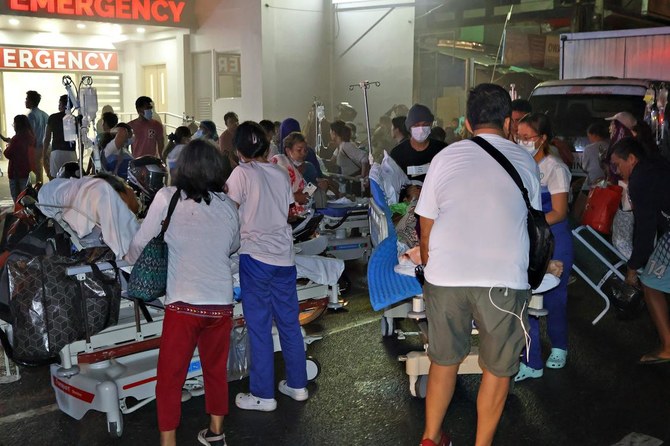
Residents and medical personnel evacuate patients from inside a hospital after a 7.6 earthquake struck Butuan City, in southern island of Mindanao late Dec. 2, 2023. (AFP)
2 / 2
People gather along a street after evacuating from inside buildings after a 7.6 earthquake struck Butuan City, in southern island of Mindanao late Dec. 2, 2023. (AFP)
Short Url
Updated 03 December 2023
Follow

Major aftershocks jolt Philippines after magnitude 7.6 quake

  • The Pacific Tsunami Warning Center initially said that based on the magnitude and location, it expected tsunami waves to hit the southern Philippines
  • In Japan, authorities issued evacuation orders in various parts of Okinawa Prefecture

MANILA: A powerful magnitude 7.6 earthquake struck the southern Philippines on Saturday, the US Geological Survey reported, followed by four major aftershocks that sent residents fleeing from coastal areas amid fears of a tsunami.
The initial quake struck off the coast of the country at a depth of 32 kilometers (20 miles) at 10:37 p.m. local time (1437 GMT) about 21 kilometers northeast of Hinatuan municipality on Mindanao island, the USGS said.
Early on Sunday, over the span of several hours, four powerful aftershocks of magnitudes 6.4, 6.2, 6.1 and 6.0 rumbled through the region, the USGS said.
The initial quake triggered tsunami warnings — which were later downgraded — across the Pacific region and sent residents in northeast Mindanao fleeing buildings, evacuating a hospital and seeking higher ground.
“Destructive tsunami is expected with life threatening wave heights,” the Philippine Institute of Volcanology and Seismology said on X, formerly Twitter.
The Pacific Tsunami Warning Center in Hawaii also issued an alert but later posted that the danger had passed.
“There is no longer a tsunami threat from this earthquake,” it said in a message.
The Philippines seismology institute said in a bulletin at 3:23 am (1923 GMT) local time that the highest waves generated by the seismic activity were .64 meters (25 inches) tall on Mawes Island, but that the tsunami warning had ended.
Small swells were reported as far as Japan’s eastern Pacific coast, where a tsunami warning was also briefly in effect. Palau, a western Pacific archipelago some 900 kilometers (560 miles) off Mindanao, reported no impact.
Hinatuan police Sergeant Joseph Lambo said the quake was “very strong” but that there were no reports of casualties or major property damage.
“Appliances fell off the shelves at the police office and two TV sets were broken. The motorcycles parked outside also tumbled down,” Lambo told AFP.
“Right now we don’t have reports of damage or casualties but people are evacuating because of the tsunami alert.”
Lambo said the 45,000 residents in the municipality had been ordered to leave their homes and many were going on foot or in vehicles to higher ground.
A video posted on social media and verified by AFP showed bottles of drinks and other products falling off shelves in a convenience store as staff fled outside.
Another video, shot by Dennis Orong, showed people screaming as they ran along a street in Lianga, a coastal municipality of Surigao del Sur.
“I was shaking in fear, mainly because of exploding electric poles,” the 26-year-old hairdresser told AFP.
“It was very traumatic.”

Social media reports of a tsunami hitting Lingig municipality, about 35 kilometers south of Hinatuan, were “fake news,” said police Master Sergeant Robert Quesada.
“We’re at low tide,” he said.
“People evacuated away from the coast soon after. We can’t say how many at this point, but pretty much the entire town is along the coast.”
Many people, including Bethanie Valledor, were asleep when the quake struck.
“I felt like the room we’re staying in would be destroyed,” Valledor, 24, told AFP after fleeing the resort where she had been staying, about 20 kilometers southwest of Hinatuan.
“Our place is very near the sea. The resort owner asked us to evacuate immediately. Honestly, I was screaming. I panicked.”
In Butuan City, northwest of Hinatuan, orderlies evacuated patients on gurneys and in wheelchairs from a hospital, their drip and IV bags hanging from support stands.
The quake came nearly two weeks after a 6.7 magnitude quake hit Mindanao, killing at least nine people, shaking buildings and causing part of the ceiling of a shopping mall to collapse.
Quakes are a daily occurrence in the Philippines, which sits along the Pacific “Ring of Fire,” an arc of intense seismic and volcanic activity that stretches from Japan through Southeast Asia and across the Pacific basin.
Most are too weak to be felt by humans, but strong and destructive quakes come at random with no technology available to predict when and where they will happen.


Two high-speed trains derail in Spain, police sources say 21 people killed

Updated 4 min 43 sec ago
Follow

Two high-speed trains derail in Spain, police sources say 21 people killed

  • The accident happened near Adamuz, in Cordoba province. So far, 21 people ​have been confirmed dead by police

MADRID: A high-speed train derailed and smashed into another oncoming train in southern Spain on Sunday, pushing the second train off the tracks in a collision that police sources confirmed to Reuters had killed at least 21 people.
The accident happened near Adamuz, in Cordoba province. So far, 21 people ​have been confirmed dead by police, with state broadcaster Television Espanola adding that 100 people had been injured, 25 seriously. The driver of one of the trains, which was traveling from Madrid to Huelva, was among those who died, the TV station added.
“The Iryo 6189 Malaga — (to Madrid) train has derailed from the track at Adamuz, crashing onto the adjacent track. The (Madrid) to Huelva train which was traveling on the adjacent track has also derailed,” said Adif, which runs the rail network, in a social media post.
Adif said the accident happened at 6:40 p.m. (1740 GMT), about 10 minutes after the Iryo train left Cordoba heading toward Madrid.
Iryo is a private rail operator, majority-owned by Italian state-controlled railway group Ferrovie dello Stato. The train involved was a Freccia 1000 train which was traveling between ‌Malaga and Madrid, ‌a spokesperson for Ferrovie dello Stato said.
The company said in a statement that it ‌deeply ⁠regretted what ​had happened ‌and had activated all emergency protocols to work closely with the relevant authorities to manage the situation.
The second train was operated by Renfe, which also did not respond to a request for comment.
Adif has suspended all rail services between Madrid and Andalusia.

HORRIFIC SCENE
The Iryo train had more than 300 passengers on board, while the Renfe train had around 100.
Paco Carmona, Cordoba fire chief, told TVE the first train heading to Madrid from Malaga had been evacuated.
The other train’s carriages were badly damaged, he said, with twisted metal and seats. “There are still people trapped. We don’t know how many people have died and the operation is concentrating on getting people out of areas which are very narrow,” he ⁠said. “We have to remove the bodies to reach anyone who is still alive. It is proving to be a complicated task.”
Transport Minister Oscar Puente said he was following events ‌from rail operator Adif’s headquarters in Madrid.
“The latest information is very serious,” ‍he posted on X. “The impact was terrible, causing the first two ‍carriages of the Renfe train to be thrown off the track. The number of victims cannot be confirmed at this time. ‍The most important thing now is to help the victims.”
The mayor of Adamuz, Rafael Moreno, told El Pais newspaper that he had been among the first to arrive at the scene of the accident alongside the local police and saw what he believed to be a badly lacerated body several meters from the accident site.
“The scene is horrific,” he said. “I don’t think they were on the same track, but it’s not clear. Now ​the mayors and residents of the area are focused on helping the passengers.”

CALLS FOR MEDICS
Images on local television showed a reception center set up for passengers in the town of Adamuz, population 5,000, with locals coming ⁠and going with food and blankets amid nighttime temperatures of around 42 degrees Fahrenheit (6 degrees Celsius).
A woman named Carmen posted on X that she had been on board the Iryo train to Madrid. “Ten minutes after departing (from Cordoba) the train started to shake a lot, and it derailed from coach 6 behind us. The lights went out.”
Footage posted by another Iryo train passenger, also on X, showed an Iryo staffer in a fluorescent jacket instructing passengers to remain in their seats in the darkened carriages, and those with first aid training to keep watch over fellow passengers. He also urged people to maintain mobile phone batteries to be able to use their torches when they disembarked.
Salvador Jimenez, a journalist for RTVE who was on board the Iryo train, shared images showing the nose of the rear carriage of the train lying on its side, with evacuated passengers sitting on the side of the carriage facing upwards.
Jimenez told TVE by phone from beside the stricken trains that passengers had used emergency hammers to smash the windows and climb out, and they had seen two people taken ‌out of the overturned carriages on stretchers.
“There’s a certain uncertainty about when we’ll get to Madrid, where we’ll spend the night, we’ve had no message from the train company yet,” he said. “It’s very cold but here we are.”