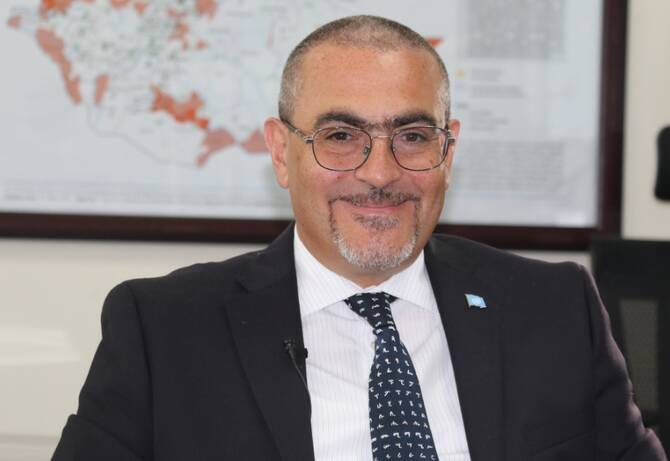
NEW YORK CITY: The fragile ceasefire in Gaza could unravel amid sweeping humanitarian shortfalls, continuing Israeli military operations and mounting restrictions on aid access, a senior UN official told the Security Council on Wednesday.
At the same time, violence and settlement expansions in the occupied West Bank are accelerating, Ramiz Alakhbarov, the UN’s deputy special coordinator for the Middle East peace process, added.
He acknowledged some improvements on the ground in Gaza, noting that deliveries of aid via Egypt, Jordan, Israel, the occupied West Bank and Cyprus had helped to increase supply volumes and improve nutrition, but he stressed that “more must be done.”
Most people in Gaza continue to be dependent on humanitarian assistance, with displaced families exposed to worsening winter conditions, he added, yet aid agencies are still unable to operate at scale despite the halt in major hostilities.
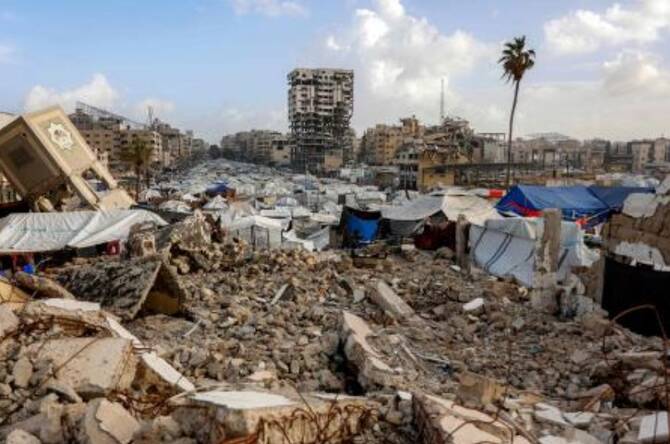
“Nearly the entire population in Gaza remains in need of humanitarian assistance,” Alakhbarov said, warning that heavy rain and cold temperatures have compounded the suffering of about 1.5 million displaced Palestinians who are living in inadequate shelters.
Restrictions on the delivery of construction materials and technical expertise have left emergency shelter sites unable to meet even minimal international standards, he warned as he described families struggling overnight to prevent tents collapsing from the wind and rain.
Humanitarian operations remain hampered by insecurity, customs delays, limited routes into Gaza, and Israeli restrictions on which organizations are allowed bring supplies into the territory, Alakhbarov told the council.
Aid entering Gaza from Jordan accounts for just 9 percent of assistance processed since Oct. 10, he said. He described the current volumes of aid “only a fraction” of what had previously been achieved.
Severe entry restrictions continue to be imposed on critical items such as mobile homes, fuel, rescue equipment and medical supplies, he added, which is endangering displaced people in general and patients in need of health care. Meanwhile, access to public infrastructure and agricultural land remains limited, and repeated displacements of the population continue amid ongoing demolitions.
Despite the ceasefire agreement in October last year, Israeli military operations have not fully ceased, Alakhbarov said, with airstrikes, shelling and gunfire continuing across Gaza.
Armed exchanges between Israeli forces and Palestinian militants also persist, he added, and attacks occur daily near or beyond the so-called “yellow line” that separates the parts of Gaza under Israeli control from the areas to which the Palestinian population is restricted.
“Hundreds of Palestinians have been killed since the ceasefire began, including many women and children,” Alakhbarov told council members.
He also raised the alarm over Israel’s decision to suspend or review the registration of dozens of international nongovernmental organizations, warning that banning them would significantly undermine humanitarian response efforts across the territory. He urged Israel to immediately reverse the move.
Turning to the situation in the occupied West Bank, Alakhbarov said negative trends were “entrenched daily,” citing in particular intensified Israeli military operations, settlement expansions, settler violence, demolitions and large-scale arrests.
Israeli forces conducted expanded raids in cities including Jenin, Nablus, Hebron and Ramallah in late December and early January, he said, frequently involving live fire and raising serious concerns about the use of lethal force.
Palestinians, including minors, have been killed during the operations, and large-scale arrests, including the detention of children, have been reported alongside allegations of ill-treatment of prisoners and deaths in custody.
Palestinian attacks against Israelis have also continued, Alakhbarov noted, including deadly ramming and stabbing incidents in northern Israel in late December.
At the same time, settler violence has intensified, he said, forcing entire Palestinian communities to flee. Repeated attacks led to the displacement of people from Khirbet Yanun in Nablus governorate in December, followed this month by the forcible removal of about 80 households from Ras Ein Al-Auja in the Jordan Valley.
Demolitions and land seizures across the northern West Bank, evictions in East Jerusalem, and the destruction of parts of refugee camps have exacerbated territorial fragmentation, he said.
Meanwhile settlement expansions have been “rapid and relentless.” Israeli authorities have issued tenders for more than 4,700 housing units in Area C — which covers more than 60 percent of the West Bank — including thousands of units in the sensitive E1 zone east of Jerusalem, a move Alakhbarov warned could sever the geographic connection between the northern and southern West Bank.
He also condemned what he described as the escalating Israeli campaign against UNRWA, the UN’s agency for Palestinian refugees, including legislation to seize its compounds and cut utilities, raids on its health facilities, and the demolition of its headquarters in East Jerusalem.
“These acts are flagrant violations of international law,” Alakhbarov said. He urged Israeli authorities to comply with an International Court of Justice advisory opinion requiring them to facilitate, not obstruct, UNRWA operations.
Meanwhile, Israel continues to withhold Palestinian clearance revenues, which are taxes collected by Israel on behalf of the Palestinian Authority on goods imported into Gaza and the West Bank. The amount withheld now totals nearly $2.5 billion, Alakhbarov said, and Israel’s refusal to hand it over is pushing the authority deeper into fiscal crisis, forcing cuts to public services and reduced salary payments to workers.
Unless these Israeli policies are urgently addressed, he warned, the cumulative effects might not only undermine prospects for a two-state solution but also jeopardize progress toward implementation the next phase of the Gaza ceasefire agreement.

Gaza ceasefire fragile, UN warns, amid Israeli airstrikes, aid obstacles and spiraling West Bank violence
Short Url
https://arab.news/jhr58
Gaza ceasefire fragile, UN warns, amid Israeli airstrikes, aid obstacles and spiraling West Bank violence
- Most Gazans remain dependent on humanitarian assistance as winter weather worsens, yet aid agencies still unable to operate at scale, senior UN official tells Security Council
- He warns of ‘entrenched’ negative trends in West Bank, including intensified Israeli military action, settlement expansions, settler violence, demolitions and large-scale arrests
Gaza teen’s chances of walking again depends on Rafah reopening
- Rimas Abu Lehia was wounded five months ago when Israeli troops opened fired toward a crowd mobbing an aid truck
- Israel’s campaign in Gaza after the Hamas October 2023 attack has decimated the territory’s health sector
DEIR AL-BALAH, Gaza Strip: Rimas Abu Lehia was wounded five months ago when Israeli troops opened fired toward a crowd of hungry people mobbing an aid truck for food in Gaza and a bullet shattered the 15-year-old Palestinian girl’s left knee.
Now her best chance of walking again is surgery abroad. She is on a long list of more than 20,000 Palestinians, including 4,500 children, who have been waiting — some more than a year — for evacuation to get treatment for war wounds or chronic medical conditions, according to the Gaza Health Ministry.
Their hopes hinge on the reopening of the crucial Rafah border crossing between Gaza and Egypt, a key point under the nearly 4-month-old ceasefire between Israel and Hamas. Israel has announced the crossing would open in both directions on Sunday.
The Israeli military body in charge of coordinating aid to Gaza said Friday that “limited movement of people only” would be allowed. Earlier, Prime Minister Benjamin Netanyahu had said Israel will allow 50 patients a day to leave; others have spoken of up to 150 a day.
That’s a large jump from about 25 patients a week allowed to leave since the ceasefire began, according to UN figures. But it would still take anywhere from 130 to 400 days of crossings to get everyone in need out.
Abu Lehia said her life depends on the crossing opening.
“I wish I didn’t have to sit in this chair,” she said, crying as she pointed at the wheelchair she relies on to move. “I need help to stand, to dress, to go to the bathroom.”
Evacuations are critical as Gaza hospitals are decimated
Israel’s campaign in Gaza after the Hamas October 2023 attack on southern Israel that triggered the war has decimated the territory’s health sector — the few hospitals still working were overwhelmed by casualties. There are shortages of medical supplies and Israel has restricted aid entry.
Hospitals are unable to perform complicated surgeries for many of the wounded, including thousands of amputees, or treat many chronic conditions. Gaza’s single specialized cancer hospital shut down early in the war, and Israeli troops blew it up in early 2025. Without giving evidence, the military said Hamas militants were using it, though it was located in an area under Israeli control for most of the war.
More than 10,000 patients have left Gaza for treatment abroad since the war began, according to the World Health Organization.
After Israeli troops seized and closed the Rafah crossing in May 2024 and until the ceasefire, only around 17 patients a week were evacuated from Gaza, except for a brief surge of more than 200 patients a week during a two-month ceasefire in early 2025, according to WHO figures.
About 440 of those seeking evacuation have life-threatening injuries or diseases, according to the Health Ministry. More than 1,200 patients have died while waiting for evacuation, the ministry said Tuesday.
A UN official said one reason for the slow pace of evacuations has been that many countries are reluctant to accept the patients because Israel would not guarantee they would be allowed to return to the Gaza Strip. The official spoke on condition of anonymity because he was not authorized to discuss the issue. The majority of evacuees have gone to Egypt, the United Arab Emirates, Qatar and Turkiye.
He said it wasn’t clear if that would change with Rafah’s opening. Even with “daily or almost daily evacuations,” he said, the number is not very high. Also, Israel has said it will only allow around 50 Palestinians a day to enter Gaza while tens of thousands of Palestinians hope to go back.
Israel has also banned sending patients to hospitals in the Israeli-occupied West Bank and east Jerusalem since the war began, the official said — a move that cut off what was previously the main outlet for Palestinians needing treatment unavailable in Gaza.
Five human rights groups have petitioned Israel’s High Court of Justice to remove the ban. The court has not ruled. Still, one cancer patient in Gaza was allowed to travel to the West Bank for treatment on Jan. 11, after the Jerusalem District Court accepted a petition in his case by the Israeli rights group Gisha.
Thousands of cancer patients need evacuation
Gaza has more than 11,000 cancer patients and some 75 percent of the necessary chemotherapy drugs are not available, the Health Ministry said. At least 4,000 cancer patients need urgent treatment abroad, it added.
Ahmed Barham, a 22-year-old university student, has been battling leukemia. He underwent two lymph node removal surgeries in June but the disease is continuing to spread “at an alarming rate,” his father, Mohamed Barham, said.
“There is no treatment available here,” the elder Barham said.
His son, who has lost 35 kilograms (77 pounds), got on the urgent list for referral abroad this past week but still doesn’t have a confirmation of travel.
“My son is dying before my eyes,” the father said.
Desperate for Rafah to open
Mahmoud Abu Ishaq, a 14-year-old, has been waiting for more than a year on the referral list for treatment abroad.
The roof of his family home collapsed when an Israeli strike hit nearby in the southern town of Beni Suhaila. The boy was injured and suffered a retinal detachment.
“Now he is completely blind,” his father, Fawaz Abu Ishaq said. “We are waiting for the crossing to open.”
Abu Lehia was wounded in August, when she went out from her family tent in the southern city of Khan Younis, looking for her younger brother, Muhannad, she said. The boy had gone out earlier that morning, hoping to get some food off entering aid trucks.
At the time, when Gaza was near famine, large crowds regularly waited for trucks and pulled food boxes off them, and Israeli troops often opened fire on the crowds. The Israeli military said its forces were firing warning shots, but hundreds were killed over the course of several months, according to Gaza health officials.
When Abu Lehia arrived at the edge of a military-held zone from which the trucks were passing, dozens of people were fleeing as Israeli troops fired. A bullet hit Abu Lehia in the knee, and she fell to the ground screaming, she said.
At the nearby Nasser Hospital, she underwent multiple surgeries, but they were unable to repair her knee. Doctors told her she needs knee replacement surgery outside Gaza.
Officials told the family last month that she would be evacuated in January. But so far nothing has happened, said her father, Sarhan Abu Lehia.
“Her condition is getting worse day by day,” he said. “She sits alone and cries.”
Now her best chance of walking again is surgery abroad. She is on a long list of more than 20,000 Palestinians, including 4,500 children, who have been waiting — some more than a year — for evacuation to get treatment for war wounds or chronic medical conditions, according to the Gaza Health Ministry.
Their hopes hinge on the reopening of the crucial Rafah border crossing between Gaza and Egypt, a key point under the nearly 4-month-old ceasefire between Israel and Hamas. Israel has announced the crossing would open in both directions on Sunday.
The Israeli military body in charge of coordinating aid to Gaza said Friday that “limited movement of people only” would be allowed. Earlier, Prime Minister Benjamin Netanyahu had said Israel will allow 50 patients a day to leave; others have spoken of up to 150 a day.
That’s a large jump from about 25 patients a week allowed to leave since the ceasefire began, according to UN figures. But it would still take anywhere from 130 to 400 days of crossings to get everyone in need out.
Abu Lehia said her life depends on the crossing opening.
“I wish I didn’t have to sit in this chair,” she said, crying as she pointed at the wheelchair she relies on to move. “I need help to stand, to dress, to go to the bathroom.”
Evacuations are critical as Gaza hospitals are decimated
Israel’s campaign in Gaza after the Hamas October 2023 attack on southern Israel that triggered the war has decimated the territory’s health sector — the few hospitals still working were overwhelmed by casualties. There are shortages of medical supplies and Israel has restricted aid entry.
Hospitals are unable to perform complicated surgeries for many of the wounded, including thousands of amputees, or treat many chronic conditions. Gaza’s single specialized cancer hospital shut down early in the war, and Israeli troops blew it up in early 2025. Without giving evidence, the military said Hamas militants were using it, though it was located in an area under Israeli control for most of the war.
More than 10,000 patients have left Gaza for treatment abroad since the war began, according to the World Health Organization.
After Israeli troops seized and closed the Rafah crossing in May 2024 and until the ceasefire, only around 17 patients a week were evacuated from Gaza, except for a brief surge of more than 200 patients a week during a two-month ceasefire in early 2025, according to WHO figures.
About 440 of those seeking evacuation have life-threatening injuries or diseases, according to the Health Ministry. More than 1,200 patients have died while waiting for evacuation, the ministry said Tuesday.
A UN official said one reason for the slow pace of evacuations has been that many countries are reluctant to accept the patients because Israel would not guarantee they would be allowed to return to the Gaza Strip. The official spoke on condition of anonymity because he was not authorized to discuss the issue. The majority of evacuees have gone to Egypt, the United Arab Emirates, Qatar and Turkiye.
He said it wasn’t clear if that would change with Rafah’s opening. Even with “daily or almost daily evacuations,” he said, the number is not very high. Also, Israel has said it will only allow around 50 Palestinians a day to enter Gaza while tens of thousands of Palestinians hope to go back.
Israel has also banned sending patients to hospitals in the Israeli-occupied West Bank and east Jerusalem since the war began, the official said — a move that cut off what was previously the main outlet for Palestinians needing treatment unavailable in Gaza.
Five human rights groups have petitioned Israel’s High Court of Justice to remove the ban. The court has not ruled. Still, one cancer patient in Gaza was allowed to travel to the West Bank for treatment on Jan. 11, after the Jerusalem District Court accepted a petition in his case by the Israeli rights group Gisha.
Thousands of cancer patients need evacuation
Gaza has more than 11,000 cancer patients and some 75 percent of the necessary chemotherapy drugs are not available, the Health Ministry said. At least 4,000 cancer patients need urgent treatment abroad, it added.
Ahmed Barham, a 22-year-old university student, has been battling leukemia. He underwent two lymph node removal surgeries in June but the disease is continuing to spread “at an alarming rate,” his father, Mohamed Barham, said.
“There is no treatment available here,” the elder Barham said.
His son, who has lost 35 kilograms (77 pounds), got on the urgent list for referral abroad this past week but still doesn’t have a confirmation of travel.
“My son is dying before my eyes,” the father said.
Desperate for Rafah to open
Mahmoud Abu Ishaq, a 14-year-old, has been waiting for more than a year on the referral list for treatment abroad.
The roof of his family home collapsed when an Israeli strike hit nearby in the southern town of Beni Suhaila. The boy was injured and suffered a retinal detachment.
“Now he is completely blind,” his father, Fawaz Abu Ishaq said. “We are waiting for the crossing to open.”
Abu Lehia was wounded in August, when she went out from her family tent in the southern city of Khan Younis, looking for her younger brother, Muhannad, she said. The boy had gone out earlier that morning, hoping to get some food off entering aid trucks.
At the time, when Gaza was near famine, large crowds regularly waited for trucks and pulled food boxes off them, and Israeli troops often opened fire on the crowds. The Israeli military said its forces were firing warning shots, but hundreds were killed over the course of several months, according to Gaza health officials.
When Abu Lehia arrived at the edge of a military-held zone from which the trucks were passing, dozens of people were fleeing as Israeli troops fired. A bullet hit Abu Lehia in the knee, and she fell to the ground screaming, she said.
At the nearby Nasser Hospital, she underwent multiple surgeries, but they were unable to repair her knee. Doctors told her she needs knee replacement surgery outside Gaza.
Officials told the family last month that she would be evacuated in January. But so far nothing has happened, said her father, Sarhan Abu Lehia.
“Her condition is getting worse day by day,” he said. “She sits alone and cries.”
© 2026 SAUDI RESEARCH & PUBLISHING COMPANY, All Rights Reserved And subject to Terms of Use Agreement.


