

Japan looks to Saudi Arabia for ‘new forms’ of collaboration: Shikata

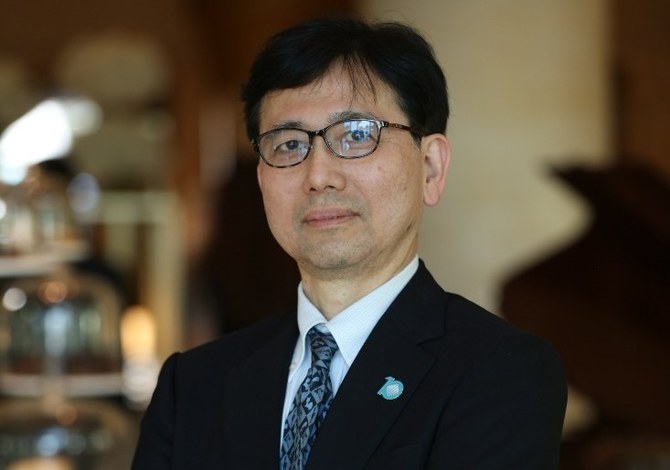
Japanese Cabinet Secretary for Public Affairs SHIKATA Noriyuki. (AN Photo/File)
Short Url
Updated 02 December 2023
Follow

Japan looks to Saudi Arabia for ‘new forms’ of collaboration: Shikata

  • With COP28 talks taking place in the UAE, decarbonization is part of many countries’ objectives and green strategies

DUBAI: Japanese Cabinet Secretary for Public Affairs Shikata Noriyuki told Arab News Japan that deep ties between his country and Saudi Arabia will pave the way for more opportunities to collaborate.

“There are emerging opportunities for a new way of life,” he said. “Especially if Saudi Arabia takes a leading role in presenting this new way of life with regards to sustainability issues.”

With COP28 talks taking place in the UAE, decarbonization is part of many countries’ objectives and green strategies.

Shikata said that when Japanese Prime Minister Kishida Fumio visited Saudi Arabia in July, it was clear that the Kingdom was on a path to transformation.

“We sense very rapid change taking place in the Kingdom. It’s very impressive,” he added.

Japan is also working on its own transformation, specifically a green one. The cabinet secretary said, however, that the change will need collaboration with the Gulf region as well as other Asian countries.

“We want to work on joint projects or investments to encourage such a green transformation in the rest of Asia,” he said. “This is kind of conducive to our vision of a free and open Indo-Pacific.”

At COP28, Japan introduced its new strategy to achieve a carbon-zero economy, which includes the idea of carbon pricing for the first time.

Japan not only will focus on the carbon emissions of major corporations, but also target zero-emission housing.

“This includes insulated windows to avoid extra heating costs,” Shikata said.

Other initiatives have been put in place, including the newly announced India-Middle East trade corridor.

“Japan is very attentive to this connectivity initiative between India and the Middle East,” he said, adding that a similar project is in the works with other Asian countries.

“We want to combine smart houses and urban transport so that we are eventually talking about smart, sustainable and carbon-neutral cities,” Shikata told Arab News Japan.

The conditions in Gaza have also been a topic of conversation at COP28, and Japan has consistently supported a two-state solution in order to realize peace.

“We have been working on the Jericho Agro-Industrial Park and trying to create jobs,” the cabinet secretary said, adding that Japan is encouraging its companies to invest. “However, with the political situation, it is very difficult to encourage investment.”

The industrial park aims to develop a fully functional and operational innovation business center in Palestine’s Jericho to improve the competitiveness of local businesses operating there.

There have been reports that Israeli strikes since Oct. 7 had damaged Japan International Cooperation Agency offices in Gaza.

However, Shikata said that once the situation in the enclave calms down, Japanese organizations will have “good motivation to go back and support reconstruction.”

* This article originally appeared on Arab News Japan, click here to read it.


Kremlin welcomes US sanctions waiver says US and Russia share interest in stable energy markets

Updated 6 sec ago
Follow

Kremlin welcomes US sanctions waiver says US and Russia share interest in stable energy markets

DUBAI: Russia sees ​a U.S. sanctions waiver on its oil as ‌an ‌attempt ​by ‌Washington ⁠to stabilise ​global energy ⁠markets, and the two countries ⁠have a shared ‌interest ‌in ​this, ‌Kremlin ‌spokesman Dmitry Peskov said on Friday.

"We see ‌actions by the United States aimed ‌at trying to stabilise energy markets. In this respect, our interests coincide," he said.

US Treasury Secretary Scott Bessent announced a temporary authorisation allowing countries around the world to purchase Russian oil currently stranded at sea on Thursday extending a measure that had previously been granted only to Indian refiners.

Bessent stressed in a post on X that the authorisation would not provide significant financial benefit to the Russian government. 

“This narrowly tailored, short-term measure applies only to oil already in transit and will not provide significant financial benefit to the Russian government, which derives the majority of its energy revenue from taxes assessed at the point of extraction,” Bessent said on a post on X. 

However, the measure received mix reviews in European capitals, with many fearing it could help replenish Russia's assualt on Ukraine. 

"I am concerned that we are further filling Putin's war chest," German Economy Minister Katherina Reiche said in Berlin on Friday.

Reiche said that she saw both sides to the United States' decision to issue ‌a 30-day ‌waiver ​for ‌the purchase ⁠of ​Russian oil ⁠products, understanding the increasing ecnomic and political turnout from the oil crisis, particurlarly in South Korea and Japan. 

"It seems to me that domestic political pressure in the United ⁠States is very, ‌very ‌high," ​Reiche said.

German ​Chancellor Friedrich Merz was more direct, saying on Friday that it was ‌wrong to ‌ease ​sanctions against ‌Russia ⁠for ​whatever reason. The sentiment was echoed by Norway’s Prime Minister, who also said sanctions should not be eased. 

Oil prices held gains above $100 Friday and most equity markets dropped after Iran's leader called for the blocking of the crucial Strait of Hormuz and the opening up of new fronts in the war against the United States and Israel.

With the conflict heading towards its third week and showing no signs of ending, investors are growing increasingly worried about an extended crisis that could fan inflation and hammer the global economy.