Ukraine says blackout at nuclear plant risked accident

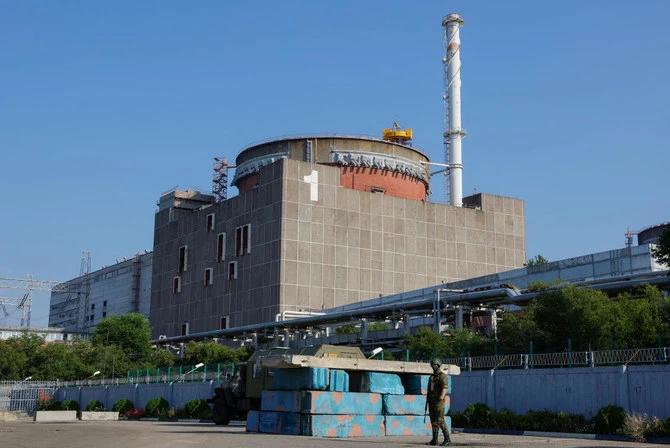
Ukraine said Saturday that two power lines connecting its electricity grid to the Zaporizhzhia nuclear plant were cut overnight, putting the plant at risk of an "accident". (Reuters/File)
Short Url
Updated 02 December 2023
Follow

Ukraine says blackout at nuclear plant risked accident

  • “Due to the complete blackout, the nuclear power plant switched to powering its own needs from 20 diesel generators,” Ukraine’s nuclear energy operator
  • The plant’s Russian-installed operator confirmed it resorted to diesel generators overnight

KYIV: Ukraine said Saturday that two power lines connecting its electricity grid to the Zaporizhzhia nuclear plant were cut overnight, putting the plant at risk of an “accident.”
The plant has been at the center of fighting since it was captured by Russian forces last year, and both sides have accused each other of compromising its safety.
“Due to the complete blackout, the nuclear power plant switched to powering its own needs from 20 diesel generators,” Ukraine’s nuclear energy operator said in a statement.
It said the plant was on “the verge of a nuclear and radiation accident” before Ukrainian specialists were able to promptly restore off-site power.
AFP was not able to immediately verify Ukraine’s version of events.
The plant’s Russian-installed operator confirmed it resorted to diesel generators overnight, but said that it had operated within safe limits and that no safety violations were reported.
The incident marks the eighth time the plant has been cut off from external power since the conflict began last year, the International Atomic Energy Agency (IAEA) warned.
“The most recent external power outage is yet another reminder about the precarious nuclear safety and security situation at the plant, which can be affected by events far away from the site itself,” IAEA chief Rafael Grossi said.
“The IAEA continues to do everything it can to help prevent a nuclear accident. I also call on all parties not to take any action that could further endanger the plant,” he added.
Since last year IAEA officials have been on the ground monitoring safety at the plant, which requires constant maintenance to prevent overheating.
It stopped supplying electricity to Ukraine’s grid in September 2022, and has been repeatedly rocked by shelling and drone attacks throughout the 21-month conflict.

Only 4% women on ballot as Bangladesh prepares for post-Hasina vote

Updated 26 January 2026
Follow

Only 4% women on ballot as Bangladesh prepares for post-Hasina vote

  • Women PMs have ruled Bangladesh for over half of its independent history
  • For 2026 vote, only 20 out of 51 political parties nominated female candidates

DHAKA: As Bangladesh prepares for the first election since the ouster of its long-serving ex-prime minister Sheikh Hasina, only 4 percent of the registered candidates are women, as more than half of the political parties did not field female candidates.

The vote on Feb. 12 will bring in new leadership after an 18-month rule of the caretaker administration that took control following the student-led uprising that ended 15 years in power of Hasina’s Awami League party.

Nearly 128 million Bangladeshis will head to the polls, but while more than 62 million of them are women, the percentage of female candidates in the race is incomparably lower, despite last year’s consensus reached by political parties to have at least 5 percent women on their lists.

According to the Election Commission, among 1,981 candidates only 81 are women, in a country that in its 54 years of independence had for 32 years been led by women prime ministers — Hasina and her late rival Khaleda Zia.

According to Dr. Rasheda Rawnak Khan from the Department of Anthropology at Dhaka University, women’s political participation was neither reflected by the rule of Hasina nor Zia.

“Bangladesh has had women rulers, not women’s rule,” Khan told Arab News. “The structure of party politics in Bangladesh is deeply patriarchal.”

Only 20 out of 51 political parties nominated female candidates for the 2026 vote. Percentage-wise, the Bangladesh Socialist Party was leading with nine women, or 34 percent of its candidates.

The election’s main contender, the Bangladesh Nationalist Party, whose former leader Zia in 1991 became the second woman prime minister of a predominantly Muslim nation — after Pakistan’s Benazir Bhutto — was the party that last year put forward the 5 percent quota for women.

For the upcoming vote, however, it ended up nominating only 10 women, or 3.5 percent of its 288 candidates.

The second-largest party, Jamaat-e-Islami, has not nominated a single woman.

The 4 percent participation is lower than in the previous election in 2024, when it was slightly above 5 percent, but there was no decreasing trend. In 2019, the rate was 5.9 percent, and 4 percent in 2014.

“We have not seen any independent women’s political movement or institutional activities earlier, from where women could now participate in the election independently,” Khan said.

“Real political participation is different and difficult as well in this patriarchal society, where we need to establish internal party democracy, protection from political violence, ensure direct election, and cultural shifts around female leadership.”

While the 2024 student-led uprising featured a prominent presence of women activists, Election Commission data shows that this has not translated into their political participation, with very few women contesting the upcoming polls.

“In the student movement, women were recruited because they were useful, presentable for rallies and protests both on campus and in the field of political legitimacy. Women were kept at the forefront for exhibiting some sort of ‘inclusive’ images to the media and the people,” Khan said.

“To become a candidate in the general election, one needs to have a powerful mentor, money, muscle power, control over party people, activists, and locals. Within the male-dominated networks, it’s very difficult for women to get all these things.”