

Tensions high in south Lebanon in anticipation of Hezbollah’s next move

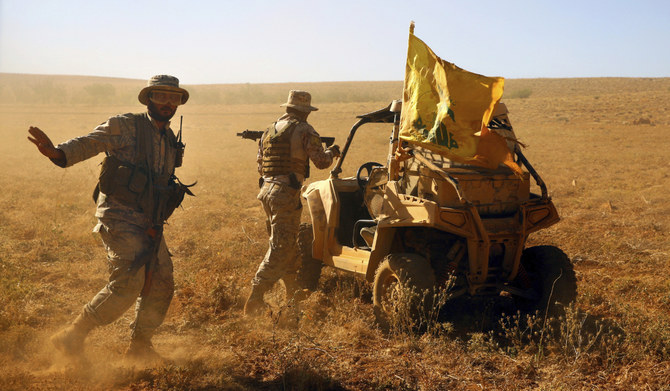
Hezbollah fighters stand near a four-wheel motorcycle positioned at the site where clashes erupted between Hezbollah and al-Qaida-linked fighters in Wadi al-Kheil or al-Kheil Valley on the Lebanon-Syria border, July 29, 2017. (AP)
Short Url
Updated 01 December 2023
Follow

Tensions high in south Lebanon in anticipation of Hezbollah’s next move

  • UNIFIL says priority remains preventing escalation, protecting civilian lives, ensuring security of peacekeepers

BEIRUT: Hezbollah’s next move in southern Lebanon remained a key concern on Friday as the Israeli army resumed military operations in Gaza.

Lebanon’s National News Agency said that two people were killed in the town of Hula after their house was targeted by Israel, identifying the victims as Nasifa Mazraani and her son Mohammed.

Army chief Gen. Joseph Aoun is set to leave office in 40 days amid fears of new escalations on the southern border with Israel.  

The caretaker Lebanese Cabinet is concerned that it might not be able to reach a solution for the coming vacuum in military leadership.

Defense Minister Maurice Slim explicitly rejected the extension of Aoun’s term as an exception to the rule after his meeting with Patriarch Bechara Al-Rahi on Friday.

The Maronite Patriarchate and various political factions support extending Aoun’s term as a temporary measure until a new president is elected.

Slim is affiliated with the Free Patriotic Movement, which rejects the extension of Aoun’s mandate.

He said: “The law does not permit the extension of the army commander’s term after reaching the retirement age.

“The exceptional cases provided for by the law do not apply to the present situation, and it’s impossible to disregard them whatever the reasons.”

Al-Rahi responded, saying that “the region is on fire, and we don’t have a president,” according to remarks cited by the Patriarchate.

Residents of border areas, who returned to their homes last week after the truce took effect, are worried that the situation might deteriorate in south Lebanon.

Many people fled to safer areas on Friday.

According to the UN Office for Coordination of Humanitarian Affairs, around 55,000 people have been displaced from south Lebanon due to tensions there.

About 52 percent of the displaced are females.

According to local statistics, hostilities on the southern front have led to the closure of around 52 private and public schools in border villages, where 6,000 students receive their education.

Moreover, Israel’s use of phosphorus bombs burned around 460 hectares of forests and over 20,000 olive trees.

The Israeli forces announced on Friday afternoon that their defense system intercepted a “suspicious flying object that crossed the border from the direction of Lebanon.”

According to security reports, Israeli reconnaissance aircraft continued to fly in the southern skies, especially over villages and towns closer to the border.

The Israeli army carried out a sweeping operation with medium machine guns around the Israeli Al-Raheb site opposite the Lebanese town of Aita Al-Shaab.

Andrea Tenenti, spokesperson for UNIFIL, the UN peacekeeping force in Lebanon, said the pillars of UN Resolution 1701, adopted 17 years ago to resolve the 2006 war between Israel and Hamas, remained valid.

Tenenti spoke as UNIFIL personnel continued carrying out their routine tasks.

He said that preventing escalation, protecting civilian lives, and ensuring the security of peacekeepers remained a priority.

Tenenti stressed that UNIFIL — led by Maj. Gen. Aroldo Lazaro — was actively working to reduce tension and prevent the risk of broader conflict through talks with both Israel and Lebanon.

The meetings are attended by officers from the Lebanese and Israeli sides under the supervision of the UN, represented by UNIFIL.

Hezbollah opened a second front in southern Lebanon on Oct. 8 in support of the resistance in the Gaza Strip.

The move constitutes a violation of UN Security Council Resolution 1701, which prohibits the presence of any armed entity in the area except for the Lebanese army and UNIFIL.

MP Pierre Bou Assi from the Lebanese Forces said that Resolution 1701 was issued after all parties, including Hezbollah, approved it.

He stated that its implementation should be natural and intuitive and that adherence to it is necessary to prevent war in Lebanon.


Sudan defense minister dismisses ‘intelligence document’ as fabrication after convoy strike

Updated 12 February 2026
Follow

Sudan defense minister dismisses ‘intelligence document’ as fabrication after convoy strike

  • Gen. Hassan Kabroun tells Arab News claims that army hid weapons in aid convoy are “completely false”

RIYADH: Sudan’s defense minister has firmly denied reports attributed to Sudanese intelligence alleging that a convoy targeted in North Kordofan was secretly transporting weapons under the cover of humanitarian aid.

Gen. Hassan Kabroun described the claims as “false” and an attempt to distract from what he called a militia crime.

The controversy erupted after news reports emerged that a document attributed to Sudan’s General Intelligence Service claimed the convoy struck in Al-Rahad on Friday was not a purely humanitarian mission, but was instead carrying “high-quality weapons and ammunition” destined for Sudanese Armed Forces units operating in the state.

The report further alleged that the convoy had been outwardly classified as humanitarian in order to secure safe passage through conflict zones, and that the Rapid Support Forces had destroyed it after gathering intelligence on its route and cargo.

Kabroun categorically rejected the narrative.

“First of all, we would like to stress the fact that this news is false,” he told Arab News. “Even the headline that talks about the security of the regions, such as Al-Dabbah, is not a headline the army would use.”

He described the document as fabricated and politically motivated, saying it was designed to “cover up the heinous crime they committed.”

The minister affirmed that the area targeted by drones is under full control of the Sudanese Armed Forces and does not require any covert military transport.

“Second, we confirm that the region that was targeted by drones is controlled by the army and very safe,” Kabroun said. “It does not require transporting any military equipment using aid convoys as decoys because it is a safe area controlled by the army, which has significant capabilities to transport humanitarian aid.”

According to the minister, the Sudanese military has both the logistical capacity and secure routes necessary to move equipment openly when needed.

“The army is professional and does not need to deliver anything to Kadugli or Dalang on board aid convoys,” he said. “The road between Dalang and Kadugli is open. The Sudanese forces used that road to enter and take control of the region. The road is open and whenever military trucks need to deliver anything, they can do so without resorting to any form of camouflage.”

Kabroun further rejected any suggestion that the military uses humanitarian operations as cover.

“Aid is transported by dedicated relief vehicles to the areas in need of this assistance,” he said. “Aid is not transported by the army. The army and security apparatus do not interfere with relief efforts at all, and do not even accompany the convoys.”

He stressed that the Sudanese Armed Forces maintains a clear institutional separation between military operations and humanitarian work, particularly amid the country’s crisis.

“These are false claims,” he said. “This fake news wanted to cover up the heinous crime they committed.”

Sudan has been gripped by conflict since April 2023, when fighting broke out between the Sudanese Armed Forces and the Rapid Support Forces, plunging the country into what the United Nations has described as one of the world’s worst humanitarian disasters.

The latest dispute over the convoy comes amid intensified fighting in South Kordofan, a strategically sensitive region linking central Sudan with the contested areas of Darfur and Blue Nile.

The false report suggested that intelligence monitoring had enabled the RSF to strike what it described as a military convoy disguised as humanitarian aid. But Kabroun dismissed that version outright.

“The intelligence agency is well aware of its duties,” he said. “The Sudanese Army has enough weapons and equipment to use in the areas of operations. These claims are completely false.”

He argued that the narrative being circulated seeks to shift blame for attacks on civilian infrastructure and humanitarian movements.

“This shows that they are trying to cover up the atrocities,” he added, referring to the militia.

Kabroun maintained that the army has regained momentum on multiple fronts and remains fully capable of sustaining its operations without resorting to deception.

“The region is secure, the roads are open, and the army does not need camouflage,” he said. “We are operating professionally and transparently.”

“These claims are completely false,” Kabroun said. “The Sudanese Army does not use humanitarian convoys for military purposes.”