

Pakistan headline inflation rises 29.2% year-on-year on back of gas price hike 

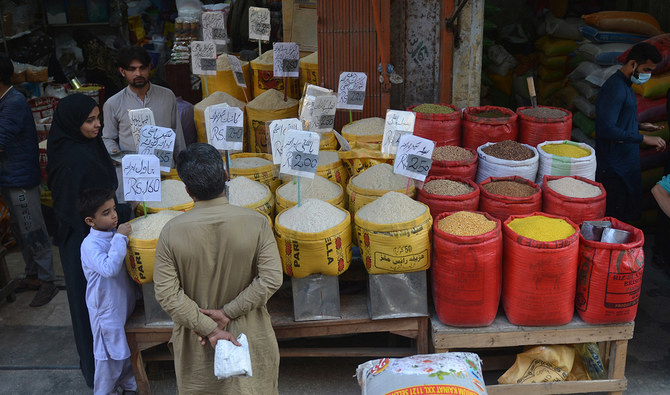
People buy pulses and grains at a wholesale market in Karachi on February 1, 2023. (AFP/File)
Short Url
Updated 01 December 2023
Follow

Pakistan headline inflation rises 29.2% year-on-year on back of gas price hike 

  • Prices went up by 2.7 percent in November as compared to a 1 percent increase in the month before 
  • Analysts say increase in inflation figures for November is ‘in line with expectations’ after gas price hike 

ISLAMABAD: Pakistan’s consumer price index (CPI) jumped 29.2 percent in November on a year-on-year basis, the country’s statistics bureau said on Friday, with analysts attributing monthly increase in prices to a recent hike in gas tariff. 

The headline inflation was recorded at 26.8 percent in October and 23.8 percent in November last year, according to the Pakistan Bureau of Statistics (PBS). 

Prices went up by 2.7 percent in November as compared to a 1 percent increase in the month before and a rise of 0.8 percent in November 2022. 

Financial analysts say the increase in inflation figures for the month of November was “in line with the expectations” after the gas price hike. 

“The inflation for the month of November is in line with the expectations. The major impact has come from the gas tariff hike,” Samiullah Tariq, a director at the Pakistan Kuwait Investment Company, to Arab News. 

“Going forward we hope that the inflation would ease off.” 

In late October, Pakistan announced a sharp increase in the price of natural gas for most households and industries ahead of the cash-strapped country’s first review of a $3 billion International Monetary Fund (IMF) bailout it entered in July. 

While the government did not increase the tariff for the protected category (57 percent of the domestic consumers), it increased the fixed monthly charge from Rs10 to Rs400 for this category. 

The price of gas was set at Rs2,100/mmbtu for export process industry, Rs2,400/mmbtu for export captive industry, Rs2,200/mmbtu for non-export process industry, Rs2,500/mmbtu for non-export captive industry, and Rs3,600/mmbtu for the CNG sector. 

In November, Pakistan cleared the first review of the nine-month standby arrangement, paving the way for Islamabad to receive a second tranche of around $700 million from the lender. 

Among the food items that recorded highest increase in November prices were tomatoes (60.42 percent), potatoes (14.92 percent), tea (12.95 percent), onions (12.32 percent), dry fruits (7.91 percent), fish (7.75 percent), eggs (7.15 percent) and fresh vegetables (4.47 percent), according to the PBS. 

Non-food items whose prices recorded the highest increased included gas charges (280.55 percent), woolen readymade garments (8.16 percent), dental services (5.19 percent), transport services (5.11 percent) and solid fuel (3.52 percent). 


Pakistan forms committee to negotiate financial advisory services for Islamabad airport privatization

Updated 18 February 2026
Follow

Pakistan forms committee to negotiate financial advisory services for Islamabad airport privatization

  • Committee to engage Asian Development Bank to negotiate terms of financial advisory services agreement, says privatization ministry
  • Inaugurated in 2018, Islamabad airport has faced criticism over construction delays, poor facilities and operational inefficiencies

ISLAMABAD: Pakistan’s Privatization Ministry announced on Wednesday that it has formed a committee to engage the Asian Development Bank (ADB) to negotiate a potential financial advisory services agreement for the privatization of Islamabad International Airport.

The Islamabad International Airport, inaugurated in 2018 at a cost of over $1 billion, has faced criticism over construction delays, poor facilities, and operational inefficiencies.

The Negotiation Committee formed by the Privatization Commission will engage with the ADB to negotiate the terms of a potential Financial Advisory Services Agreement (FASA) for the airport’s privatization, the ministry said. 

“The Negotiation Committee has been mandated to undertake negotiations and submit its recommendations to the Board for consideration and approval, in line with the applicable regulatory framework,” the Privatization Ministry said in a statement. 

The ministry said Islamabad airport operations will be outsourced under a concession model through an open and competitive process to enhance its operational efficiency and improve service delivery standards. 

Pakistan has recently sought to privatize or outsource management of several state-run enterprises under conditions agreed with the International Monetary Fund (IMF) as part of a $7 billion bailout approved in September last year.

Islamabad hopes outsourcing airport operations will bring operational expertise, enhance passenger experience and restore confidence in the aviation sector.

In December 2025, Pakistan’s government successfully privatized its national flag carrier Pakistan International Airlines (PIA), selling 75 percent of its stakes to a consortium led by the Arif Habib Group. 

The group secured a 75 percent stake in the PIA for Rs135 billion ($482 million) after several rounds of bidding, valuing the airline at Rs180 billion ($643 million).

Pakistan’s Finance Minister Muhammad Aurangzeb said this week the government has handed over 26 state-owned enterprises to the Privatization Commission.