

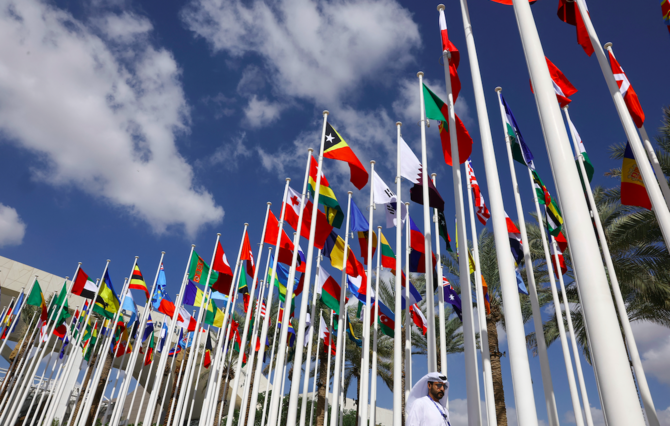

DUBAI: As world leaders, climate experts and global delegations convene in Dubai for the first day of the UN Climate Change Conference, members of African delegations are re-affirming that the needs of the Global South can no longer be neglected.
Nations in the Global South are on the “receiving end” of the worst of climate change effects and yet contribute fewer amounts to emissions, Nigerian special assistant on climate change, Yusuf Idris Amoke, told Arab News on the sidelines of the event, adding that due to the lack of infrastructure, technology and “know how” needed within the African continent, countries are struggling to adapt.
As one of the top 10 nations most vulnerable to the adverse effects of climate change, Nigerian delegates are looking to ensure that there is a focus on climate finance during the forum, Amoke said, instilling the importance of utilizing the Paris Agreement to hold countries responsible to keeping their promises and commitments to aid less developed countries to adapt to the impacts of global warming.
Calls for these nations to divest from fossil fuels, without providing alternatives, are inherently unjust, the special assistant noted, saying: “Financing third world countries or the Global South is key, as adapting and shifting from fossil fuel can only be done when you have alternatives.”
He added: “We are surviving on fossil fuel. We have for instance, for Nigeria, we have abundant coal resources. We have abundant oil, right. So shifting from those things, to things that don’t exist. It’s impossible … we need to be supported, not just financial support or technical support, we need capacity building. We need understanding of the impacts of climate change.”
The Secretary-General of the Madagascan Ministry of Environment, Mamitiana Adrianmanjato, echoed these notions, noting that as an island in the Indian Ocean, Madagascar is especially vulnerable to the effects of climate change and has witnessed them firsthand, from cyclones to flooding.
Without the adequate financing needed, the indebted country is currently unable to stifle the consistently “worsening” effects, Adrianmanjato said, stressing his hope that COP28 will be a platform for the nation to encourage members of the party states to replenish the climate fund and ensure that it is distributed justly.
Adrianmanjato added: “There are some countries that have brought forth finance, it is not sufficient. As an island on the Indian Ocean, we are really vulnerable, so our main forecast is first of all adaptation and financing for the adaptation.”
The repercussions witnessed from the lack of ability to adapt within less developed nations are not limited to climate alone. Instead, the equity deficit is causing a rippling effect that impacts health and infrastructure, Susan Chimpokosera, a member of the Malawi delegation, told Arab News.
She posited that the country is witnessing outbreaks of waterborne diseases that result from flooding while simultaneously leading to the displacement of people and damage to infrastructure.
In Nigeria, the effects have translated to struggles in food production. According to Amoke, the northern region, which normally doesn’t experience rain during this time, has been experiencing heavy rainfall.
This has led to the watering of crops and, therefore, a reduced amount of harvest, affecting food access and farmer livelihood.
The delegate of Malawi underscored that within the forum, calls for countries to focus on climate change and shifting energy sources while unable to keep up with the ever-increasing damages they are witnessing can no longer be sustained.
“In issues of climate financing, we are being under-supported. We know countries venture into different kinds of energy, some are using gas … but it will not be fair to ask different governments to support climate finances or climate change, when they’re also having other issues to handle. So then the support has to come right from the global region, and then cascading down to other countries,” Chimpokosera said.
The delegation hopes that as negotiations proceed over the next two weeks, countries no longer neglect the pressing needs of the Global South and that financing for less developed nations most susceptible to the adverse effects will be at the forefront of the talks.


