

Displaced Syrians face another harsh winter as fuel costs soar

The amount of humanitarian aid being provided to camps in northwest Syria has been falling steadily since 2021. (Supplied)
Short Url
Updated 30 November 2023
Follow

Displaced Syrians face another harsh winter as fuel costs soar

  • Families burning garbage to stay warm as prices become ‘unbearable’
  • Humanitarian aid to Syria has been falling steadily since 2021

DAMASCUS: Syrians displaced by war and living in camps in the northwest of the country are preparing for another difficult winter amid soaring fuel prices, dwindling humanitarian aid and a scarcity of jobs.

Abdul Salam Al-Youssef, 53, who had to leave his home in Al-Tah, south of Idlib, told Arab News: “We have been in random camps for three years, lacking the minimum necessities of life, and our suffering increases at the beginning of each winter.

“We, the heads of families, are responsible for large expenses because the price of all heating methods exceeds $150, and even the prices of heaters are high, and these are all costs that we are unable to bear.”

He added that the tents in which people had been living for the past three years were becoming worn and letting in water.

Khaled Abdel Rahman, also from Al-Tah, tells a similar story.

“I have been displaced for five years … and every year when winter comes, it brings with it worries for us,” he said.

“We used to receive support for heating materials at the beginning of every winter, but every year this support decreases. Until, in the last two years, we started burning nylon garbage or plastic containers. These materials are harmful to health, especially children, and we use these because we do not have the ability to buy heating materials because their price is very expensive for us.”

The average price of a ton of firewood was now about $150, he said.

“We do not have the ability to buy a single kilo of firewood in these bad conditions. Our tents are in very poor condition. We patch and sew them every winter, and with every strong wind we repair them again.”

The amount of humanitarian aid being provided to camps in northwest Syria has been falling steadily since 2021.
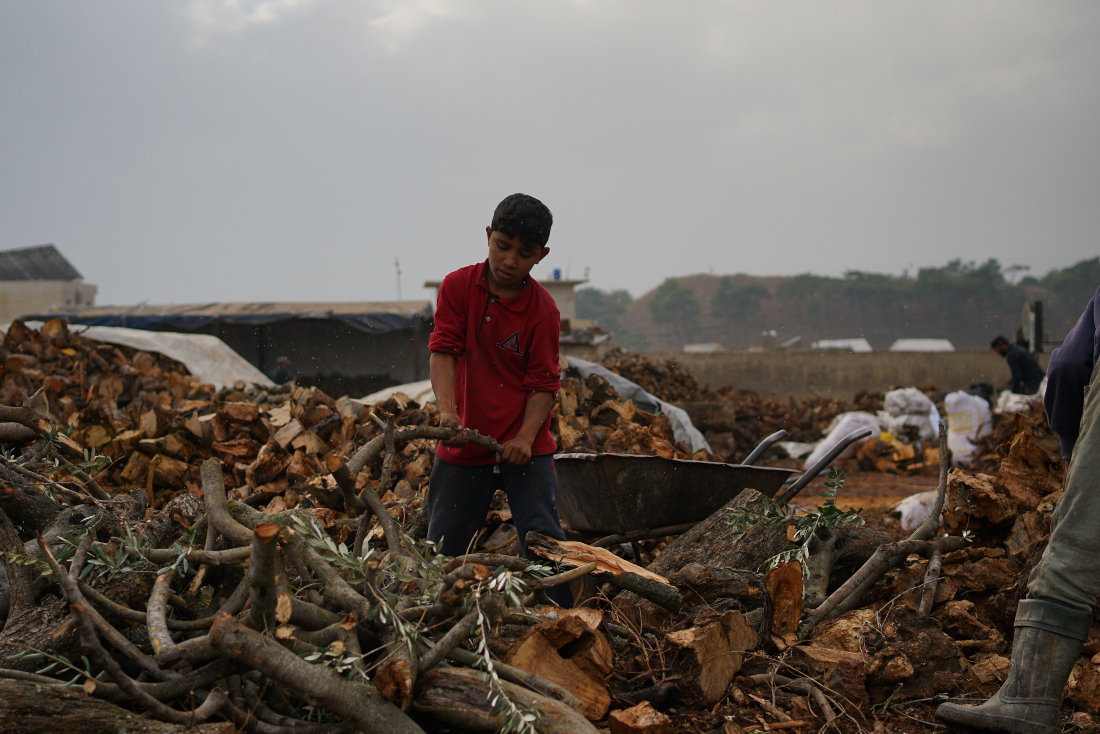


Displaced people accounted for almost half of the more than 6 million now living in northwest Syria. (Supplied)

Samir Al-Ahmad, who sells firewood at a local market, told Arab News: “Firewood in previous years was much cheaper than now, but the prices of all heating materials are very expensive.

“I wanted to install a diesel greenhouse, but I did not have the ability to do so, so I installed a wood-burning greenhouse because I can pay for firewood from my work in this market. Firewood is very expensive, with prices ranging from $140 to $210, depending on its type and quality.”

He added that these days, people bought only small amounts of firewood when they could afford it.

The Syria Response Coordinators team said that displaced people accounted for almost half of the more than 6 million now living in northwest Syria. Of those, more than 2 million — including 600,000 women, 888,000 children and 84,000 people with special needs — live in the region’s camps.


Israel’s ‘deliberate intention of preventing births among Palestinians’ meets ‘legal criteria of Genocide Convention’: Reports

Updated 10 sec ago
Follow

Israel’s ‘deliberate intention of preventing births among Palestinians’ meets ‘legal criteria of Genocide Convention’: Reports

  • Births in Gaza fell by 41% during conflict as maternal deaths, miscarriages surged
  • ‘The destruction of maternal care in Gaza reflects the deliberate infliction of conditions of life calculated to bring about the destruction of the Palestinian people, in whole or in part’

LONDON: Births in Gaza fell by 41 percent due to Israel’s war on the territory, with the conflict resulting in catastrophic numbers of maternal deaths, miscarriages and birth complications, two reports have found.

The data on pregnant women, babies and maternity care in the war-torn Palestinian enclave also revealed a surge in newborn mortality and premature births, The Guardian reported on Wednesday.

Dangerous wartime conditions and Israel’s systematic destruction of Gaza’s health systems were blamed for the alarming statistics.

The two reports were conducted by Physicians for Human Rights, in collaboration with the University of Chicago Law School’s Global Human Rights Clinic and Physicians for Human Rights — Israel.

Researchers highlighted Israel’s “deliberate intention of preventing births among Palestinians, meeting the legal criteria of the Genocide Convention.”

The reports build on earlier findings by PHR’s Israel branch. They place the testimonies of pregnant women and new mothers within the context of health data and field reports, which recorded “2,600 miscarriages, 220 pregnancy-related deaths, 1,460 premature births, over 1,700 underweight newborns, and over 2,500 infants requiring neonatal intensive care” between January and June 2025.

PHRI’s Lama Bakri, a psychologist and project manager, said: “These figures represent a shocking deterioration from pre-war ‘normalcy,’ and are the direct result of war trauma, starvation, displacement and the collapse of maternal healthcare.

“These conditions endanger both mothers and their unborn babies, newborns, and breastfed infants, and will have consequences for generations, permanently altering families.”

She added: “Beyond the numbers, what emerges in this report are the women themselves, their voices, choices and lived realities, confronting impossible dilemmas that statistics alone cannot fully capture.”

Maternal and newborn care in Gaza has been damaged by Israel’s destruction of health infrastructure, as well as fuel shortages, blocked medical supplies, mass displacement and relentless bombardment.

As a result, survival in Gaza’s overcrowded tent encampments has become the sole option for pregnant women and new mothers.

During the first six months of Israel’s war on the territory, more than 6,000 mothers were killed, at an average of two every hour, according to UN Women estimates.

It is also believed that about 150,000 pregnant women and new mothers have been forcibly displaced by the conflict.

In the first months of last year, just 17,000 births were recorded in Gaza, a 41 percent fall compared to the same period in 2022.

The researchers examined Israel’s apparent strategy to undermine Palestinian births, highlighting a targeted strike in December 2023 on the Al-Basma IVF clinic.

The attack on Gaza’s largest fertility center destroyed about 5,000 reproductive specimens and ended a pattern of 70-100 IVF procedures each month.

The strike was deliberately designed to target the reproductive potential of Palestinians, the Independent International Commission of Inquiry later found.

“Reproductive violence constitutes a violation under international law; when carried out systematically and with them intent to destroy, it falls within the definition of genocide of the Genocide Convention,” the reports said.

“The destruction of maternal care in Gaza reflects the deliberate infliction of conditions of life calculated to bring about the destruction of the Palestinian people, in whole or in part.”