

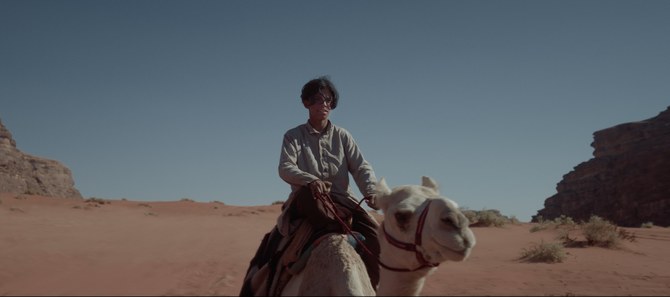
The local filmmakers on show in RSIFF’s ‘Arab Spectacular’ section 

‘Hajjan’ is directed by Abu Bakr Shawky. (Supplied)
Short Url
Updated 30 November 2023
Follow

The local filmmakers on show in RSIFF’s ‘Arab Spectacular’ section 

‘Hajjan’ 

Director: Abu Bakr Shawky 

Starring: Omar Al-Atawi, Azzam Nemr, Toleen Barbood 

Matar is the youngest child in a family of camel jockeys. When his brother falls in a race and is killed, Matar steps up to save his own camel, Hofara, from the butcher, beginning a potentially deadly trek through the desert in search of a better life. “This is a Saudi film, but it’s so universal,” Egyptian director Abu Bakr Shawky told Arab News in August. “The deeper we got into exploring this world, the more I found themes that are at the heart of great global storytelling; ideas of vengeance, of love, of running away from your problems and finding your destiny.” 

‘HWJN’ 

Director: Yasir Al-Yasiri 

Starring: Alanoud Saud, Nour Alkhadra 

The Iraqi director’s fantasy movie — based on the best-selling novel by Saudi writer Ibraheem Abbas — was given the honor of opening the festival on Nov. 30 (it also screens Dec. 1). “Hwjn” is set in a world where djinn are living invisibly among humans. The titular djinn and his family are disturbed when a human family moves into their Jeddah home, but he soon becomes fascinated by them, particularly Sawsan, played by Nour Alkhadra. Alkhadra told Arab News that she landed the part after sending Al-Yasiri a tape of her playing out scenes from Quentin Tarantino’s “Pulp Fiction.” 

‘Fever Dream’ 

Director: Faris Godus 

Starring: Sohayb Godus, Najm, Hakeem Jomah 

Expectations are high for the latest from the Godus brothers after the success of their debut feature “The Book of Sun,” which was picked up by Netflix. “Fever Dream” focuses on Abdulsamad, a former football star with a bad reputation who tries to mend his awkward relationship with his daughter Ahlam so that she will help him manage his reputation on social media and rebuild his fame in a positive light. They partner with a high-profile PR team and move into real-estate marketing. But as Abdulsamad’s fame grows, he discovers it’s not quite what he dreamed it would be. 

‘Naga’ 

Director: Meshal Aljaser 

Starring: Adwa Bader, Yazeed Almaiyul 

Bader was officially recognized as one of the Rising Stars at the Toronto International Film Festival, where “Naga” premiered. Bader plays Sarah, whose conservative father approves a shopping trip, on condition that she abide by a strict curfew. That ‘shopping trip’ is actually a cover story for Sarah’s secret date with Saad at a party in the desert, which quickly turns into a disaster, with Sarah stranded miles from home and in a desperate race against the clock to avoid her father’s ire. TIFF programmer Peter Kuplowsky said the film “blew me away with its shocking prologue” and that Meshal “was navigating so many provocative themes, and never at the expense of character or momentum.” 

‘Yesterday After Tomorrow’ 

Director: Abdulghani Alsaigh 

Starring: Ismael Al-Hassan, Ahmad Alsadam 

Alsaigh’s sci-fi movie is the story of two brothers living with their widowed mother having moved back into their childhood home. There, they discover a portal to the past — to a time when their father, whom they never met, was still alive. But the longer they stay there and try to connect with him, the harder it will be to reunite with their mother in the present. Meanwhile, distressed by their disappearance, she teams up with her best friend to try and discover what happened to them. 

‘Khaled El-Sheikh: Between the Thorns of Art and Politics’ 

Director: Jamal Kutbi 

Starring: Khaled El-Sheikh, Samawa El-Sheikh 

Kutbi’s documentary focuses on the famed Bahraini singer Khaled El-Sheikh, whose appetite for pushing musical boundaries has seen him richly rewarded, but also brought opprobrium from audiences uncomfortable with innovation. Kutbi follows El-Sheikh’s rise to stardom from his time as a university student in Kuwait studying economics and politics before dropping out to focus on music. 


Global gems go under the hammer 

Updated 16 January 2026
Follow

Global gems go under the hammer 

  • International highlights from Sotheby’s ‘Origins II’ auction, which takes place Jan. 31 in Diriyah 

Andy Warhol 

‘Muhammad Ali’ 

Arguably the most famous name in pop art meets arguably the most famous sportsman of the 20th century in this set of four screen prints from 1978, created at the behest of US investment banker Richard Weisman. “I felt putting the series together was natural, in that two of the most popular leisure activities at the time were sports and art, yet to my knowledge they had no direct connection,” Weisman said in 2007. “Therefore I thought that having Andy do the series would inspire people who loved sport to come into galleries, maybe for the first time, and people who liked art would take their first look at a sports superstar.” Warhol travelled to Ali’s training camp to take Polaroids for his research, and was “arrested by the serene focus underlying Ali’s power — his contemplative stillness, his inward discipline,” the auction catalogue states. 

Jean-Michel Basquiat 

‘Untitled’ 

Basquiat “emerged from New York’s downtown scene to become one of the most influential artists of the late 20th century,” Sotheby’s says. The largely self-taught artist’s 1985 work, seen here, “stands as a vivid testament to (his) singular ability to transform drawing into a site of intellectual inquiry, cultural memory, and visceral self-expression.” Basquiat, who was of Caribbean and Puerto Rican heritage, “developed a visual language of extraordinary immediacy and intelligence, in which image and text collide with raw urgency,” the catalogue continues. 

Camille Pissarro 

‘Vue de Zevekote, Knokke’ 

The “Knokke” of the title is Knokke-sur-Mer, a Belgian seaside village, where the hugely influential French-Danish Impressionist stayed in the summer of 1894 and produced 14 paintings, including this one. The village, Sotheby’s says, appealed to Pissarro’s “enduring interest in provincial life.” In this work, “staccato brushstrokes, reminiscent of Pissarro’s paintings of the 1880s, coalesce with the earthy color palette of his later work. The resulting landscape, bathed in a sunlit glow, celebrates the quaint rural environments for which (he) is best known.” 

David Hockney 

‘5 May’ 

This iPad drawing comes from the celebrated English artist’s 2011 series “Arrival of Spring in Woldgate, East Yorkshire in 2011,” which Sotheby’s describes as “one of the artist’s most vibrant and ambitious explorations of landscape, perception, and technological possibility.” Each image in the series documents “subtle shifts in color, light and atmosphere” on the same stretch of the Woldgate, “showing the landscape as something experienced over time rather than frozen in an instant.” The catalogue notes that spring has long been an inspiration for European artists, but says that “no artist has ever observed it so closely, with such fascinated and loving attention, nor recorded it in such detail as an evolving process.” 

Zarina  

‘Morning’ 

Sotheby’s describes Indian artist Zarina Hashmi — known by her first name — as “one of the most compelling figures in post-war international art — an artist whose spare, meditative works distilled the tumult of a peripatetic life into visual form.” She was born in Aligarh, British India, and “the tragedy of the 1947 Partition (shaped) a lifelong meditation on the nature of home as both physical place and spiritual concept.” This piece comes from a series of 36 woodcuts Zarina produced under the title “Home is a Foreign Place.” 

George Condo 

‘Untitled’ 

This 2016 oil-on-linen painting is the perfect example of what the US artist has called “psychological cubism,” which Sotheby’s defines as “a radical reconfiguration of the human figure that fractures identity into simultaneous emotional and perceptual states.” It’s a piece that “distills decades of inquiry into the mechanics of portraiture, drawing upon art-historical precedent while decisively asserting a contemporary idiom that is at once incisive and darkly humorous,” the catalogue notes, adding that the work is “searing with psychological tension and painterly bravura.”