



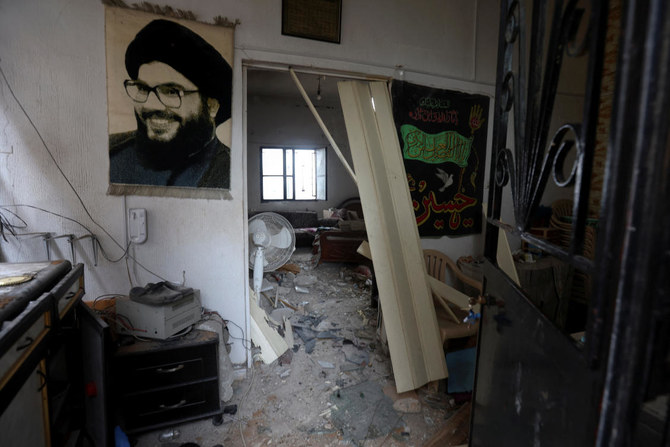

MAYS AL-JABAL, Lebanon: People in southern Lebanon who fled last month have rushed home to inspect damage during the temporary truce in the war between Israel and Palestinian group Hamas that they hope will end the worst border clashes in nearly 20 years.
Negotiators are urging Israel and Hamas to extend the six-day cease-fire in a conflict which has sent shockwaves around the region since Oct. 7, spilling across the Lebanese-Israeli border where Israel and Iran-backed Hezbollah have been trading fire.
Some 200 km (124 miles) from the Gaza Strip in southern Lebanon, people in areas scarred by Israeli shelling were grateful that they had been able to return home since Friday, when the cease-fire between Israel and Hamas came into effect.
“We are very happy to have returned to the village,” Mbadda Salloum, a resident from the village of Yaroun, said outside a church damaged in the recent hostilities.
He had fled north with his family to the capital, Beirut.
“We wish for this truce to be permanent, God willing.”
With Israel launching air and artillery strikes and Hezbollah firing rockets at Israeli positions on the frontier, it has marked the worst violence at the Lebanese border since Hezbollah, a Hamas ally, and Israel fought a war in 2006.
Many families are using the pause in fighting to collect belongings from their homes and survey damage. Schools and most shops are shut.
About 55,500 people across southern Lebanon had fled their homes as of Nov. 21, according to the United Nations. Many also fled their homes in northern Israel.
“They have missed their homes and their lands,” said Kassem Jaber, mayor of the village of Mhaibib. People had been waiting on the village outskirts till just after 7 am last Friday when the truce took effect, he said, then rushed back to their homes.
Huge chunks of walls were missing, windows were shattered, and piles of broken dishes and furniture were strewn across the living room of villager Amal Jaber.
“The buildings are not important, we care about the people (who have died),” she said.
Israeli attacks have killed about 100 people in Lebanon — 80 of them Hezbollah fighters — since Oct. 7.
PEOPLE ‘WANT THEIR LAND’
Mayor Jaber said that although no one in his village had been killed in Israeli strikes, homes had been destroyed and villagers were unable to harvest their olives. They had also missed out on planting next season’s crops.
He said people planned to stay. “People want dignity and they want their land.”
Yellow banners mourning Hezbollah fighters killed in the fighting lined roads in Mhaibib and other villages.
Abdel Al-Moneim Choukair, head of the municipality in the town of Mays Al-Jabal, a mile from the border, said many people had been returning to their homes as the cease-fire stretched into its fifth day.
Twenty kilometers to the west, in the village of Yater, a farmer in her 50s named Fatima Kryim gave thanks for the calm.
“We want to cultivate our land and plant before the winter,” said Kryim.
“We will be here until we hear the first shell, if it falls ... We will take advantage of the truce until the last moment.”
A senior Hezbollah politician, Hassan Fadlallah, said on Tuesday his group had started paying compensation to people who had suffered losses from Israeli strikes.
Citing a Hezbollah survey of damage caused by Israeli attacks, Fadlallah said 37 residential buildings had been totally destroyed and 11 more completely burned. Another 1,500 homes across the south had suffered varying degrees of damage.
In the village of Alma Al-Chaab, local hotel owner Milad Eid said about half of the farmland and groves of almonds, avocados and olives were burned, as well as eight houses and the water tank.
“If there’s a longer calm, we can actually repair all of this,” he said, adding that officials from Lebanon’s government and Hezbollah’s construction arm, Jihad Al-Bina, and some NGOs had visited to assess the damage.
“We just need it to be over,” he said of the war. “We want an extension (of the truce) to get to a full calm. It seems possible.”


