WASHINGTON: The Biden administration has told Israel that it must work to avoid “significant further displacement” of Palestinian civilians in southern Gaza if it renews its ground campaign aimed at eradicating the Hamas militant group, senior US officials said.
The administration, seeking to avoid more large-scale civilian casualties or mass displacement like that seen before the current temporary pause in the fighting, underscored to the Israelis that they must operate with far greater precision in southern Gaza than they did in the north, the officials said, briefing reporters on condition of anonymity under ground rules set by the White House.
Amid mounting international and domestic pressure about the rising Palestinian death toll, the White House has begun to put greater pressure on Israel that the manner of the coming campaign must be “carefully thought through,” according to one of the officials. The Israelis have been receptive when administration officials have raised these concerns, the official said.
Prime Minister Benjamin Netanyahu has made clear that Israeli Defense Forces will eventually restart military operations after the conclusion of the current, temporary ceasefire that has allowed for an exchange of hostages taken by Hamas for Palestinian prisoners held by Israel. The two sides agreed Monday to extend the truce for an additional two days and to continue swapping hostages for prisoners.
President Joe Biden has said he would like to see the pause — which has also allowed a surge of much-needed humanitarian aid to get into Gaza — continue as long as feasible. Secretary of State Antony Blinken will return this week to the Middle East as the US hopes to find a way to extend the ceasefire and get more hostages released, the State Department said Monday. It will be his third trip to the region since Israel’s war with Hamas began last month.
Still, Biden and top officials have also been clear-eyed about Israel’s desire to continue operations focused on Hamas that over the last seven weeks have largely focused on the north. They have said they support Israel’s goal of eliminating Hamas’ control over Gaza and the threat it poses to Israeli civilians, but have grown more vocal about the need to protect the lives of Palestinian civilians. Hamas has been known to seek shelter among the territory’s civilian population, and Israeli officials have released videos from northern Gaza of what they said are weapons stockpiles and firing locations placed among civilian infrastructure.
More than 13,300 Palestinians have been killed since the war began on Oct. 7, roughly two-thirds of them women and minors, according to the Hamas-run Health Ministry in Gaza, which does not differentiate between civilians and combatants. More than 1,200 people have been killed on the Israeli side, mostly civilians killed in the initial attack. At least 77 soldiers have been killed in Israel’s ground offensive.
The US believes roughly 2 million Palestinians are now in south and central Gaza. Biden administration officials have made clear to the Israelis that an already stretched humanitarian support network would be unable to cope with the sort of displacement that those from northern Gaza have endured in Israel’s retaliatory strikes and ground operations.
Biden administration officials have also told the Israelis they expect them to conduct operations in a way that will be “maximally deconflicted” with the operation of humanitarian aid facilities, United Nations-supported shelters and core infrastructure, including electricity and water.
The World Health Organization has warned that the war has caused a burgeoning public health crisis that is a recipe for epidemics as displaced Palestinians have been forced to take shelter in cramped homes and camps.
One administration official said vaccines are among the medical goods flowing into Gaza, but there has also been a focus on potable water supplies and sanitation to prevent outbreaks of typhoid and cholera. To that end, the White House has also pushed to get as much fuel into Gaza as possible — something the Israelis resisted, particularly in the first weeks of war, citing concerns that it would be siphoned by Hamas.
The officials said the US on Tuesday would dispatch the first of three US military humanitarian aid flights to northern Egypt carrying medical supplies, food aid and winter items for Gaza’s civilian population.


![]()
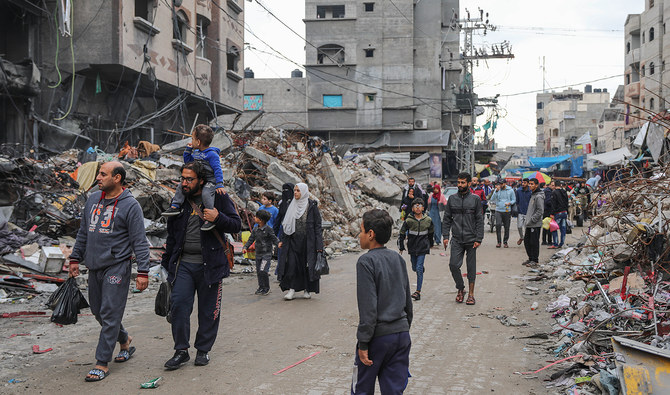
US tells Israel any military operation in Gaza must avoid further civilian displacement

Short Url
https://arab.news/vcqj6
US tells Israel any military operation in Gaza must avoid further civilian displacement
- The US wants Israel to carefully think its military campaign due to mounting pressure caused by Palestinian death toll
- Benjamin Netanyahu has already indicated Israeli forces will restart military operation after the conclusion of ceasefire
Latest updates


© 2026 SAUDI RESEARCH & PUBLISHING COMPANY, All Rights Reserved And subject to Terms of Use Agreement.