Authorities face calls to declare a hate crime in Vermont shooting of 3 men of Palestinian descent

1 / 2
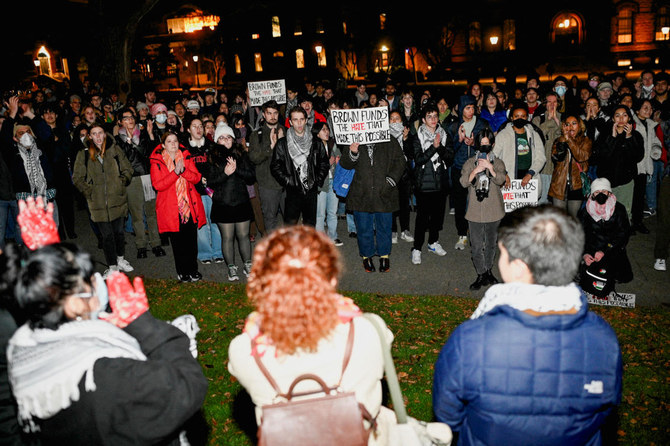
People hold up signs and protest following a vigil held on the grounds of Brown University, after three students of Palestinian descent were shot and wounded in Vermont, at the school's main green in Providence, Rhode Island on Nov. 27, 2023. (Reuters)
2 / 2
People hold up signs and protest following a vigil held on the grounds of Brown University, after three students of Palestinian descent were shot and wounded in Vermont, at the school’s main green in Providence, Rhode Island on Nov. 27, 2023. (Reuters)
Short Url
Updated 28 November 2023
Follow

Authorities face calls to declare a hate crime in Vermont shooting of 3 men of Palestinian descent

  • Jason J. Eaton, 48, was arrested and held without bail on three counts of attempted murder
  • The US Department of Justice, along with Vermont authorities, are still investigating whether Saturday’s gunfire on a Burlington street was a hate crime

BURLINGTON, USA: Vigils for three college students of Palestinian descent who were shot in Vermont over the weekend prompted calls for authorities to recognize the violence as a hate crime, and for unity among the Jewish and Arab communities.
Jason J. Eaton, 48, was arrested and held without bail on three counts of attempted murder. A not guilty plea was entered on his behalf on Monday.
The US Department of Justice, along with Vermont authorities, are still investigating whether Saturday’s gunfire on a Burlington street was a hate crime amid an increase in threats against Jewish, Muslim and Arab communities across the US since the Israel-Hamas war began, Attorney General Merrick Garland said. “There is understandable fear in communities across the country,” he said.
One vigil was held Monday night at Brown University in Rhode Island, where one of the victims, Hisham Awartani, is a student. Participants shouted at school president Christina Paxson as she addressed the crowd, demanding that Brown divest from investments that support Israel, according to media reports.
Robert Leikend, New England regional director for the American Jewish Committee, called for unity and finding common ground between the Jewish and Arab communities, saying in a statement Monday night that “hate should not beget more hate.”
He said a vigil after Eaton’s arrest “featured anti-Israel and antisemitic statements from some participants.” He didn’t name the location.
“The anger is understandable. The finger-pointing is not,” he said.
The vigil at Brown was closed to media. NBC News reported that Awartani said in a statement read by a professor that as much as he appreciates the love and support of the community, “I am but one casualty in a much wider conflict.”
The statement read, “Had I been shot in the West Bank, where I grew up, the medical services which saved my life here would have likely been withheld by the Israeli army. The soldier who would have shot me would go home and never be convicted.”
Awartani, Kinnan Abdalhamid and Tahseen Ali Ahmad, all age 20, were spending their Thanksgiving break in Burlington, and were out for a walk while visiting one of the victims’ relatives when they were confronted by a white man with a handgun, police said. The victims were speaking in a mix of English and Arabic and two of them were also wearing the black-and-white Palestinian keffiyeh scarves when they were shot, Police Chief Jon Murad said.
Abdalhamid told police he ran away, jumped a fence, and hid behind a house. He eventually knocked on another door, begging the woman who answered to call 911. At that point, he sat down, felt pain, and saw blood, according to an affidavit.
Two of the students were struck in their torsos, while one was hit in the lower body, Murad said. All three were being treated at the University of Vermont Medical Center, and one faces a long recovery because of a spinal injury, a family member said.
One of the students has been released from the hospital, according to media reports.
“I’ve been with them almost constantly since Saturday evening. I’ve been listening to them talk to one another and try to process the events, and I’m blown away by their resilience, by their good humor in the face of these difficult times,” said Rich Price, Awartani’s uncle.
The three have been friends since first grade at Ramallah Friends School, a private school in the West Bank, and all are “remarkable, distinguished students,” said Rania Ma’ayeh, head of the school.
Awartani is studying mathematics and archaeology at Brown; Abdalhamid is a pre-med student at Haverford College in Pennsylvania; and Ali Ahmad is studying mathematics and IT at Trinity College in Connecticut, Ma’ayeh said. Awartani and Abdalhamid are US citizens while Ali Ahmad is studying on a student visa, Ma’ayeh said.
Abdalhamid’s uncle Radi Tamimi, said at a news conference Monday his nephew grew up in the West Bank and “we always thought that that could be more of a risk in terms of his safety and sending him here would be a right decision.
“We feel somehow betrayed in that decision here and we’re just trying to come to terms with everything,” he said.
Eaton moved to Burlington over the summer from Syracuse, New York, and legally purchased the gun used in the shooting, Murad told reporters. According to a police affidavit, federal agents found the gun in Eaton’s apartment on Sunday. Eaton came to the door holding his hands, palms up, and told the officers he’d been waiting for them.
Eaton’s mother, Mary Reed, told the Daily Beast that Eaton, who had held various jobs as a farmer, ski instructor and researcher, had struggled with mental health issues, including depression. But she said he was in “such a good mood” when she saw him on Thanksgiving.
Syracuse police said Eaton’s name appeared in 37 police reports from 2007 until 2021, but never as a suspect. The cases ranged from domestic violence to larceny, and Eaton was listed as either a complainant or victim in 21 reports, according to Lt. Matthew Malinowski, the department’s public information officer.
Sarah George, state’s attorney, said that law enforcement officials do not yet have evidence to support a hate crime charge, which under Vermont law must be proven beyond a reasonable doubt. But, she said, “I do want to be clear that there is no question that this was a hateful act.”
Demonstrations have been widespread and tensions in the US have escalated as the death toll rises in the Israel-Hamas war. A fragile cease-fire between Israel and Hamas was set to continue for two more days past Monday as 11 more hostages were handed over to the Red Cross in Gaza under what was originally a four-day truce deal.


UK cyclists to ride 550km in Saudi Arabia to save children with heart defects

Updated 3 sec ago
Follow

UK cyclists to ride 550km in Saudi Arabia to save children with heart defects

  • The H&K Cycle Club was the first team to take the Hejaz route, and their endeavour has since 2022 inspired hundreds of other cyclists to follow suit
  • The cyclists expect to face scorching heat, brutal headwinds, sandstorms, and long no-U-turn stretches of roads, along with physical and mental exhaustion

LONDON: A cycling team from London set out on Sunday on a 550km journey from Makkah to Madinah in Saudi Arabia to raise funds for children in developing countries with congenital heart defects.

This is the fifth year that Shamsul Abdin, the head of the H&K Cycle Club, and 40 riders aged between 18 and 65, are taking on the challenge through the Hejaz region.

Abdin told Arab News that the “Hijrah Ride” was a replication of the journey made by Prophet Muhammad over 1,400 years ago, when he migrated from Makkah to Madinah, where he established the first city-state of Islam. This migration, known as Hijrah, also marked the beginning of the Islamic Hijri calendar.

The H&K Cycle Club has expanded from just six riders 14 years ago to more than 40 members from various cities across the UK, including London, Manchester, Oxford, and Birmingham. In November, they began their training in the freezing temperatures of the UK, aiming to cycle over 100 kilometers each day within 6 to 7 hours for a 4-day ride in Saudi Arabia. On Wednesday, they are expected to arrive in Madinah.

Riders from the H&K Cycle Club are expected to arrive in Madinah on Wednesday. (Muntada Aid)

They have cycled throughout the UK and parts of Europe, riding from London to Istanbul to raise funds for various causes through Muntada Aid, a charity that works on projects in developing countries and organizes the “Hijrah Ride”.

They were also the first cycling team to take the Hejaz route, and their endeavour has since inspired hundreds of other cyclists to follow suit. Abdin has seen Saudi Arabia become more bike-friendly over the past five years, with cycling lanes integrated into city development, while drivers, locals, and authorities are now more aware of cyclists on the roads.

The cyclists expect to face scorching heat, brutal headwinds, sandstorms, and long no-U-turn stretches of roads, along with physical and mental exhaustion. For many riders, this will be their fifth ride in Hejaz. Some of them include Uber and bus drivers, business analysts, and even entrepreneurs, according to Abdin.

“The headwind feels like climbing a mountain; it’s a constant resistance. To overcome this challenge, we ride in a peloton, taking turns at the front. One person heads into the wind while the others line up behind, shielded from the gusts. After a while, we rotate, allowing everyone a chance to lead,” Abdin explained.

Almost £923,000 has been raised by the “Hijrah Ride” since its inception, to reach a target of one million pounds this year. Some of the money went into emergency aid programs in Gaza and Sudan. Muntada Aid aims to raise about £250,000 for its flagship project, “Little Hearts,” which will fund 150 surgeries for children with congenital heart defects in Pakistan and Bangladesh this year.

“I fell in love with this project, which gives children the opportunity to live up to their potential as adults, truly,” said Abdin, who was awarded the MBE (Member of the Order of the British Empire) in December for his contribution to charitable fundraising.

Shamsul Abdin, the head of the H&K Cycle Club. (Muntada Aid)

The riders will be escorted by two vehicles, one in front and one in the rear, carrying paramedics and media staff, along with food and water. They will split into two groups based on their cycling powers. Along the route, they will pass several locations, including Jeddah on the Red Sea, King Abdullah Economic City, Rabigh, Masturah, and Badr, before reaching the elevated roads of Madinah, where their journey, which started with performing Umrah in Makkah, will end.

Muntada Aid is a part of Al-Muntada Trust, which was founded in 1986 by a group of Middle Eastern students, including individuals from Qatar and Saudi Arabia, to address the famine crisis in Ethiopia. Since then, the organization has assisted children in 17 countries, including Somalia, Sudan, Chad, Kosovo, Bosnia, Bangladesh, Pakistan, Mali, and Niger. They focus on developing infrastructure in education, health, water and sanitation sectors.

Nasrun Mir, the marketing director of Muntada Aid, told Arab News that they support “Hijrah Ride” with financial backing and logistics, and that they have obtained permits through communication with the Saudi Ministry of Transport, the Ministry of Foreign Affairs, the Saudi embassy in London, and the British Consulate in Jeddah.

Muntada Aid is a part of Al-Muntada Trust, which was founded in 1986 by a group of students, including individuals from Qatar and Saudi Arabia. (Muntada Aid)

Mir, who is joining the journey as part of the media team this week, said that the reception in Saudi Arabia could not be friendlier.

“People offer us free food and drinks. They want to have conversations with us. They want to know what we do. In the Middle East, there is still no concept of using sports as a tool for charity. The general idea is that if I want to give money to the charity, I’ll give it to them. You don’t need to run. You don’t need to cycle,” Mir said.

In one incident, a local community prevented the riders from passing through their village unless they disembarked and sat down to eat with them. In particular sections of the road near Madinah, a Saudi police vehicle has escorted the riders for a few kilometers, he added.

“There have been incidents where people have stopped us from eating our own food during the break. 
They literally took our food and said, ‘No, you come to our village; you cannot eat your food. You have to have food, which we will prepare.’ This delayed ride for a couple of hours,” Mir said.