Pakistan eyes up to $10 billion IT exports annually in next three years

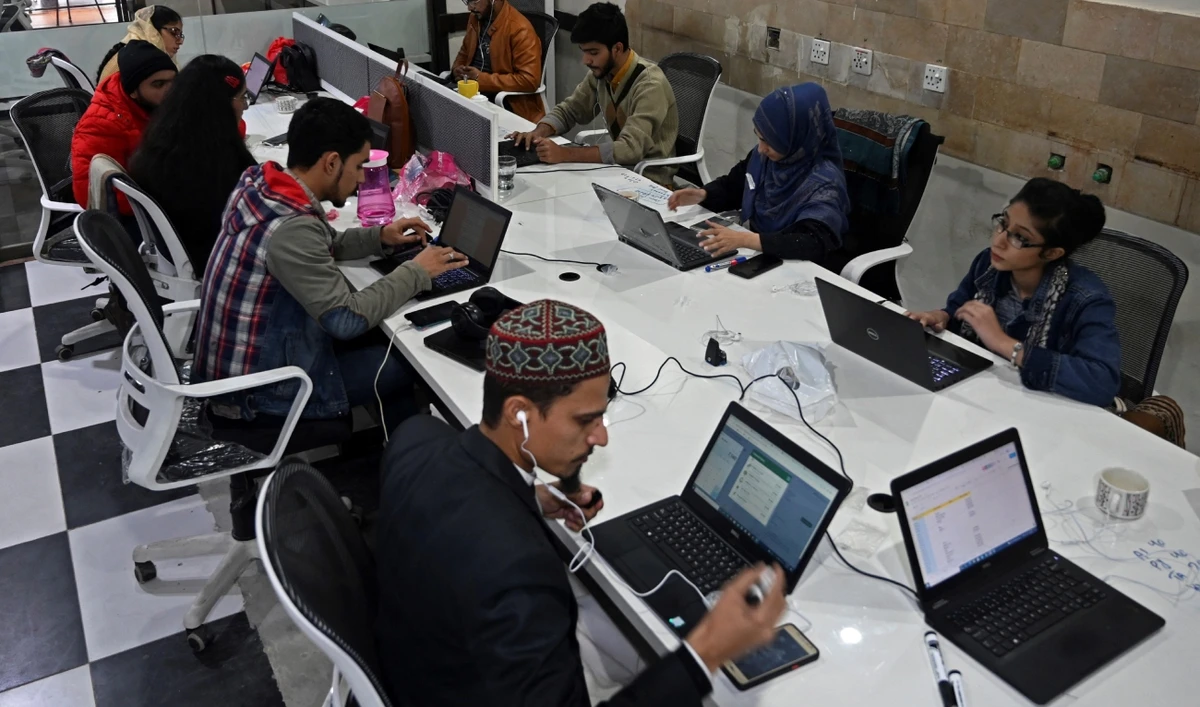
In this picture taken on January 8, 2022, employees of Taza Transforming Agriculture talk with customers at a call centre in Lahore, Pakistan. (AFP/File)
Short Url
Updated 23 November 2023
Follow

Pakistan eyes up to $10 billion IT exports annually in next three years

  • Caretaker Minister Dr. Umar Saif on Thursday unveiled Pakistan’s first ever IT and IT-enabled Services export strategy 
  • The strategy, developed by Pakistan along with its global partners, is closely aligned with the vision to boost IT exports

ISLAMABAD: Pakistan’s Caretaker Information Technology Minister Dr. Umar Saif on Thursday unveiled the country’s first ever IT and IT-enabled Services (ITeS) export strategy, which aims to increase Pakistan’s IT exports up to $ 10 billion in the next three years. 

The strategy has been developed by the Pakistan Software Export Board (PSEB), under the Pakistani Ministry of IT and Telecommunication, in collaboration with PricewaterhouseCoopers (PwC) and other international partners, which is closely aligned with Pakistan’s vision to boost IT exports. 

Dr. Saif said information and communication technology (ICT) was the only key to open the door to stabilizing and strengthening Pakistan’s economy. 

“According to the official figures, [Pakistan’s] IT exports are $2.6 billion, we will add another 200,000 skilled people to the existing IT workforce, which will increase exports to $ 5billion,” the minister said at a ceremony in Islamabad. 

“Similarly, allowing IT companies to keep dollars (dollar retention facility) will increase exports by one billion dollars, while the establishment of The Pakistan Startup Fund will increase the total volume of IT exports by another $1 billion to help it meet the target of $10 billion.” 
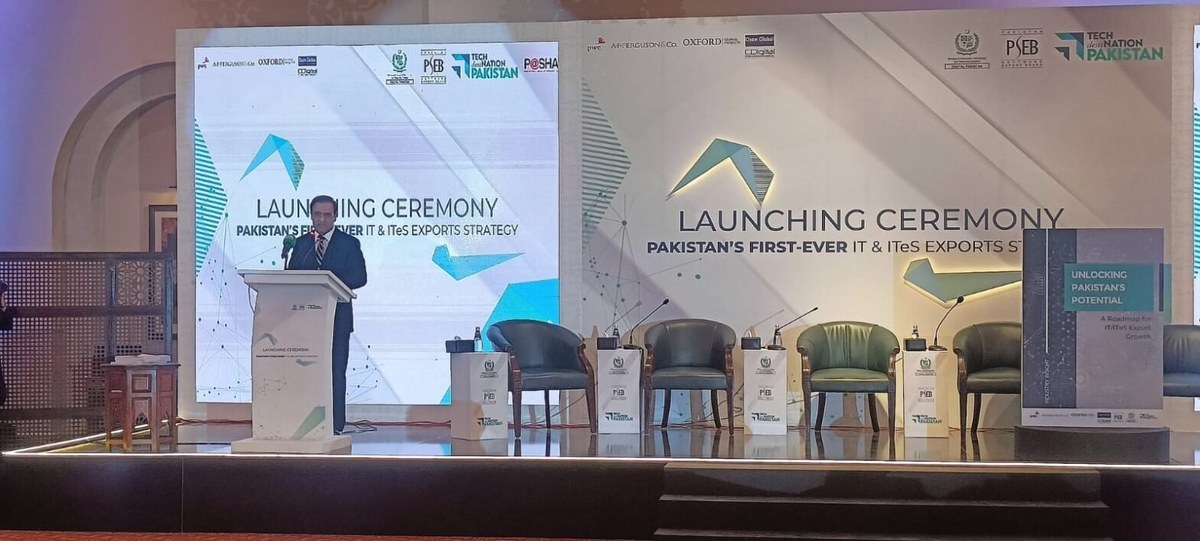


Pakistan Information Technology Minister Dr. Umar Saif is addressing the launching ceremony of the country’s first-ever IT and IT-enabled Services (ITeS) export strategy in Islamabad, Pakistan, on November 23, 2023. (Ministry of Information)

The minister emphasized the strategy’s potential, presenting a vision that prioritizes human resource development, capacity building, the implementation of a freelancers’ facilitation program, a startup funding initiative, and the nurturing of a resilient IT ecosystem. 

He said the comprehensive approach extended to the facilitation of business-friendly policies and international marketing efforts, ensuring a dynamic environment that could propel the industry to flourish on the global stage. 

“This report confirms that there is a substantial opportunity for Pakistan to grow its IT/ITeS Export revenues to $10-$18 billion by 2028 and would make Pakistan a Global IT hub, with a commensurate increase in the domestic industry to over $6 billion per annum,” Dr. Saif said. 

“Additionally, an increase of activity, capacity, and capability of the IT/ITeS Industry will have spin-off benefits for associated industries and the economy at large – for example e-Commerce, Financial Services, or the provision of public services (e-Government).” 

Zohaib Khan, chairman of Pakistan Software Houses Association (P@SHA), delivered a resonant message on the critical role of the IT industry in shaping Pakistan’s economic landscape. He underscored the pivotal importance of the industry’s participation, emphasizing how the report was meticulously guided by industry insights. 

Gerard Newman, the study project director and a former senior partner of PwC UK, shed light on the significant opportunities for Pakistan’s IT export revenues. He identified priority market segments with significant global market size and relatively limited competition, and the need for an enabling business environment to support the growth of Pakistan’s IT industry. 

The ceremony also featured a panel discussion with industry experts, addressing key aspects of the strategy, including challenges and the way forward. The discussions emphasized unanimous agreement on strategies to remove current constraints and penalties inhibiting the industry’s growth, according to the Pakistani IT ministry. 

The event underscored Pakistan’s commitment to elevating its IT export revenues, aiming for substantial growth of over $10 billion annually in the upcoming years. 

Pakistan plans Benghazi consulate, lending legitimacy to Libya’s eastern authorities

Updated 6 sec ago
Follow

Pakistan plans Benghazi consulate, lending legitimacy to Libya’s eastern authorities

  • Libya descended into turmoil after a 2011 NATO-backed uprising toppled Muammar Qaddafi and has been divided into eastern, western authorities
  • The UN-recognized government in Tripoli controls the west, while the Libyan National Army forces based in ‌Benghazi hold ‌the east and the south

KARACHI: Pakistan is in talks to open a consulate ​in the eastern Libyan city of Benghazi, three sources with knowledge of the matter said, a move that could give a diplomatic boost to eastern authorities in their rivalry with Libya’s west.

Libya descended into turmoil after a 2011 NATO-backed uprising toppled Muammar Qaddafi and has been divided into eastern and western authorities since a 2014 civil war. The UN-recognized government in Tripoli controls the west, while

Libyan National Army leader Field Marshal Khalifa Haftar’s forces based in ‌Benghazi hold ‌the east and south, including major oilfields.

Islamabad would be ‌joining ⁠a ​small ‌group of countries with a diplomatic presence in Benghazi. Haftar discussed the move with officials during an ongoing visit to Pakistan, the sources said.

Haftar met Pakistan’s army chief on Monday to discuss “professional cooperation,” the Pakistani military said. He was due to sit down with Prime Minister Shehbaz Sharif on Tuesday, the sources said, declining to be identified because they were not authorized to speak to the media.

Pakistan’s prime ⁠minister’s office and foreign ministry did not respond to requests for comment.

The LNA’s official media page ‌said Haftar and his son Saddam met senior Pakistani ‍army officials “within the framework of strengthening bilateral ‍relations and opening up broader horizons for coordination in areas of common ‍interest.” It did not give further details and Reuters could not immediately reach eastern Libyan authorities for comment.

Pakistan’s air force said in a statement that Saddam Khalifa Haftar met Air Chief Zaheer Ahmed Baber Sidhu to discuss expanding defense cooperation, including joint training, ​with Islamabad reaffirming its support for the “capability development” of the Libyan air force. Pakistan’s army chief Field Marshal Asim Munir visited Benghazi in December, ⁠where he signed a multibillion-dollar defense deal with the LNA, previously reported by Reuters.

All three sources said the decision to open a consulate in Benghazi was linked to the $4 billion defense deal, one of Pakistan’s largest-ever arms sales.

Libya has been under a UN arms embargo since 2011, although UN experts have said it is ineffective. Pakistani officials involved in the December deal said it did not violate UN restrictions. Haftar has historically been an ally of the UAE, which supported him with air power and viewed him as a bulwark against extremists, while Pakistan — the only nuclear-armed Muslim-majority nation — signed a wide-ranging mutual defense pact with Saudi Arabia ‌late last year.