

Imam-e-Kaaba says ongoing war in Gaza marks ‘one of darkest periods in human history’

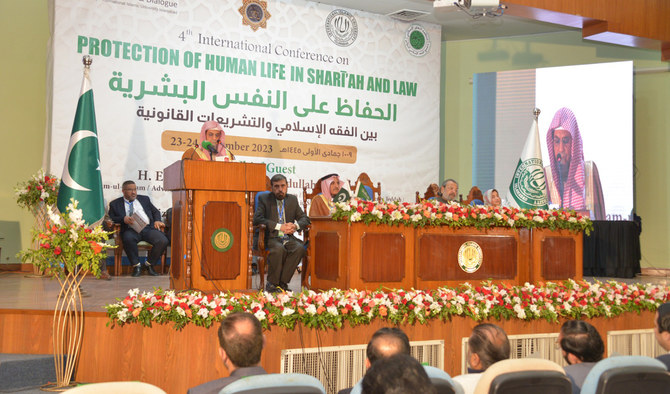
Imam-e-Kaaba Sheikh Saleh bin Humaid addresses a conference on the protection of human life in Islamabad, Pakistan on November 23, 2023. (Photo courtesy: Islamic International University)
Short Url
Updated 23 November 2023
Follow

Imam-e-Kaaba says ongoing war in Gaza marks ‘one of darkest periods in human history’

  • Sheikh Saleh bin Humaid is currently in Pakistan on a four-day visit to enhance bilateral relations
  • He will lead Friday prayers at Islamabad’s Faisal Mosque, meet top Pakistani officials during visit

ISLAMABAD: Imam-e-Kaaba Sheikh Saleh bin Humaid said on Thursday the ongoing massacre of innocent people in Gaza marked “one of the darkest periods in human history,” demanding global powers halt crimes against humanity in Palestine. 

He expressed these views while addressing the fourth international conference on the protection of human life in Shariah and law, jointly organized by International Islamic University Islamabad and International Islamic Fiqh Academy Jeddah. 

Sheikh Saleh, an adviser to the Kingdom’s Royal Court, is in Islamabad on a four-day visit to enhance brotherly ties between Pakistan and Saudi Arabia. 

“The ongoing massacre of innocent people in Gaza marks one of the darkest periods in human history,” Sheikh Saleh said. “Global powers must uphold the sanctity of human lives and halt crimes against humanity in Gaza.” 

He said taking a human life was prohibited by all religions, yet Muslims continued to face mass atrocities under the guise of ‘human rights’ in Gaza. 


Pakistan's caretaker education minister Madad Ali Sindhi (3rd right) presents a souvenir to Imam-e-Kaaba Sheikh Saleh bin Humaid (3rd left) in Islamabad, Pakistan on November 23, 2023. (Photo courtesy: Islamic International University)

The Imam-e-Kaaba prayed to Allah to deliver severe punishment to the oppressors and relieve the Palestinians of the hardships they faced. 

He said Islam places special emphasis on the sanctity of human life, and both religion and human life hold distinct importance in the Islamic law, without discrimination based on belief. 

“Allah has sworn to protect human life, and those who unjustly take a life face the promise of hell,” he added. 

During his visit, Sheikh Saleh will lead Friday prayers at the iconic Faisal Mosque in Islamabad, and meet with the Pakistani president, prime minister and other officials. 

Speaking at the conference, he praised the Pakistani hospitality and extended greetings on behalf of the Custodians of the Two Holy Mosques and scholars of Saudi Arabia. 

He said the ongoing collaboration between the Islamic Fiqh Academy and International Islamic University was crucial, and educational and research institutions in Muslim countries should prioritize mutual cooperation. 


Pakistan cabinet reviews private Hajj policy as mandatory pilgrim training enforced

Updated 14 January 2026
Follow

Pakistan cabinet reviews private Hajj policy as mandatory pilgrim training enforced

  • Cabinet sends draft Private Hajj Policy 2027–2030 to committee for further review
  • Religion minister warns pilgrims who skip mandatory training will be barred from Hajj

ISLAMABAD: Pakistan’s federal cabinet on Wednesday reviewed proposals for stricter oversight of private Hajj operators, as authorities separately warned that pilgrims who failed to complete mandatory training would be barred from performing Hajj next year.

The cabinet, chaired by Prime Minister Shehbaz Sharif, was briefed on a draft Private Hajj Policy for 2027–2030, which includes third-party registration and scrutiny of private Hajj operator companies, according to a statement from the Prime Minister’s Office.

“The Federal Cabinet directed that the draft Private Hajj Policy 2027–2030, presented by the Ministry of Religious Affairs and Interfaith Harmony regarding third-party registration and scrutiny of private Hajj operators’ companies, be referred to the Hajj Policy Committee for further deliberation in light of the views of Cabinet members,” the prime minister’s office said in a statement.

The development comes as Religious Affairs Minister Sardar Muhammad Yousaf said on Wednesday pilgrims who failed to attend both phases of mandatory Hajj training would not be allowed to perform the pilgrimage.

“Pilgrims who do not complete mandatory Hajj training will be barred from performing Hajj,” the ministry quoted Yousaf as saying during a training workshop in Islamabad.

Around 120,000 pilgrims are currently undergoing training at 200 locations nationwide, with the second phase scheduled to begin after Ramadan. The training aims to familiarize pilgrims with Saudi laws, Hajj rituals and safety protocols to prevent accidents in crowded areas.

Saudi Arabia has allocated 179,210 pilgrims to Pakistan for Hajj 2026, including about 118,000 seats under the government scheme, while the remainder will be handled by private tour operators.

Under Pakistan’s government Hajj package, the estimated cost ranges from Rs1.15 million to Rs1.25 million ($4,049.93 to $4,236), subject to final agreements with service providers.