

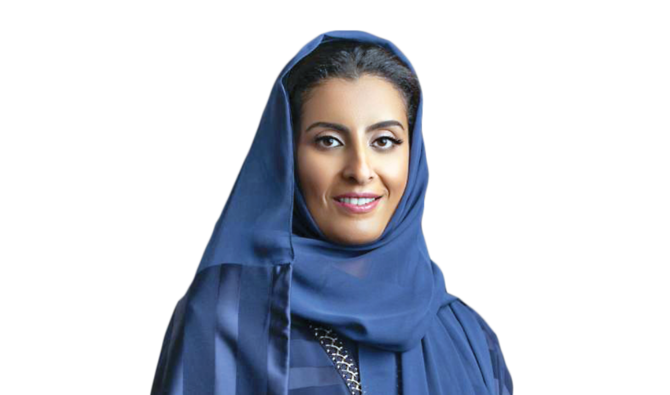
Who’s Who: Princess Lolowa bint Nawaf, chair of Mawaddah Association for Family Development
Updated 23 November 2023
Arab News
Princess Lolowa bint Nawaf has been the chair of Mawaddah Association for Family Development since October 2020.
The organization is dedicated to education, training, guidance, reform, and family awareness through sustainable development initiatives.
In her role, Princess Lolowa has focused on enhancing the association’s public standing, securing funds, and overseeing the performance of directors, members, committees, and staff.
The association’s main goal is to foster a generation of conscious, united families capable of addressing challenges and contributing significantly to family stability.
Since 2020, the princess has simultaneously served as the vice president of marketing and strategic partnerships at Shamel Food Co. This has involved managing the marketing team, collaborating with social media and marketing agencies, and overseeing partnerships with beverage suppliers and aggregators.
In 2016, Princess Lolowa became economic adviser at the Saudi Embassy in Washington, D.C. As the point of contact for all economic and business-related matters, she collaborated with the US Chamber of Commerce on several programs, facilitated meetings with key players in the Saudi market, and actively participated in events related to economic matters and Vision 2030.
From 2010 to 2015, she was a senior relationship manager at SABB, where she focused on building a portfolio of high-net-worth clients. Her responsibilities included investment advice, wealth management, credit and facilities requests, and day-to-day transactions.
Between 2006 and 2009, she worked at HSBC Saudi Arabia Ltd. in various capacities, including as a management information systems officer. As business development manager, from 2007 to 2009, she played a pivotal role in supporting SABB distribution channels and directing sales of investment products to key corporate clients.
She began her professional career in 2005 as a public relations intern at Factiva, a Dow Jones and Reuters company.
The princess gained a bachelor’s degree in business management, with a focus on marketing and management information systems, from Babson College in Massachusetts, in the US, and she is currently studying for a master’s degree in non-profit management at Northeastern University in Boston, America.
How AI is expanding access for Saudi Arabia’s deaf community
Real-time transcription, language tools and AI assistants are reshaping communication
Updated 24 min 24 sec ago
Jasmine Bager
DHAHRAN: On a recent evening in Dhahran, about 20 members of the local deaf community gathered, their hands moving swiftly through the air like conductors guiding intricate symphonies.
The event was organized by Riyadh-based awareness advocate Mohammad Alfayez, known on social media as “Prince Mohami.”
Alfayez is a Cued Speech user — a communication method that pairs mouth movements with hand signals to clarify spoken language for people who are deaf. He uses a cochlear implant, a surgically implanted device that bypasses the inner ear and sends sound signals directly to the auditory nerve. Multilingual, he is fluent in American Sign Language, Arabic Sign Language, and spoken and written English and Arabic.
After spending more than a decade in the US, Alfayez moved back to his hometown of Riyadh last Ramadan. Since then, artificial intelligence has become what he describes as a lifeline.
“ChatGPT helped me be more independent. I used to have to ask my little nieces: ‘Can you call for me,’ but I want to be independent. I’m over 18,” Alfayez said.
Image of Riyadh-based deaf-awareness advocate Mohammad Alfayez, known on social media as ‘Prince Mohami.’ (Supplied)
He believes Saudi Arabia’s rapid embrace of AI could significantly expand access to essential services for the deaf community, building on systems already common in the US.
“We need help with services — in hospitals, police stations, embassies — it is much more common in the US to go to a coffee shop and they would be able to sign with you because they learned it in school. You know, ASL is offered in high school and college in the US. Here in Saudi, we have French, English and other languages, why not include sign language? There are places that teach it but they are a few and limited.”
The demand is considerable.
According to the Kingdom’s 2022 disability census, approximately 84,000 people in Saudi Arabia have hearing impairments, accounting for 5.1 percent of people with disabilities.
Among those working to support the community is educator Abdulrahman Khalid, who also attended the gathering.
“I use AI daily because I teach deaf students here in Dammam,” Khalid told Arab News.
DID YOU KNOW?
• Saudi Arabia’s SAMAI initiative has trained over 1 million people in AI skills since its launch in 2024.
• At Saudi Aramco, a pilot program is exploring how AI can better support deaf employees in the workplace.
• Most teachers of deaf students in Saudi Arabia are not deaf themselves — and deaf educators remain rare.
“Sometimes, students cannot understand context because of the way the traditional news is written. In that case, they use programs like ChatGPT and say, ‘Explain this news to me.’ This helps them understand it better.”
Written language presents another hurdle, as many students with hearing impairment struggle with sentence structure and grammar.
“Using these programs helps them form sentences ‘properly’ in daily conversations. For example, a deaf student might write: ‘Today I go place…restaurant…coffee…’ You’ll notice the sentence has missing words. But with ChatGPT, they can write, ‘Correct this sentence so it becomes complete.’ Then they can use it in conversations, such as on WhatsApp,” he said.
Part of this linguistic gap stems from the fact that most teachers of students with hearing impairment are not deaf themselves — something that distinguishes Khalid.
“I am only one of a few deaf teachers who teaches the deaf in Saudi Arabia,” he said.
The shortage is partly due to strict qualification requirements for teaching roles, including licensing exams with written components that can be significantly more challenging for deaf candidates.
Deaf-awareness advocate Mohammad Alfayez, known on social media as ‘Prince Mohami’, has a big following on social media. (Supplied)
Another attendee, Khalid Al-Zahrani, brings both corporate and academic experience to the conversation. Fluent in ASL, he has worked at Saudi Aramco for three years within a division focused on AI-driven product innovation. He is currently involved in a pilot program exploring how artificial intelligence can better support deaf employees within the company.
Al-Zahrani earned a degree in ASL from Gallaudet University, a private institution founded in 1864 in Washington, DC, that specializes in education for deaf and hard-of-hearing students.
As AI has advanced rapidly in recent years, he has observed shifting attitudes toward the technology — though adoption within the deaf community remains inconsistent.
“Some people in the deaf community are scared of AI, to be honest, they are not fully aware of how to use AI, but we are dragging them to get involved with AI. Instead of hiring an interpreter, we can ‘hire a technology’ that can translate or give us a better understanding,” Al-Zahrani told Arab News.
While Saudi Aramco is developing internal AI tools, he hopes Arabic Sign Language will eventually be integrated into future systems as more qualified specialists enter the field. Such developments could lower costs while making communication faster and more accessible.
Another Gallaudet alumna, AlHanouf AlHenaki, who divides her time between Riyadh and Washington, DC, joined the discussion remotely.
Opinion
This section contains relevant reference points, placed in (Opinion field)
“As a deaf woman, I see AI as an empowering tool that enables me to participate, understand and make decisions confidently in predominantly hearing work environments,” she wrote to Arab News.
She also advocates for stronger deaf representation in the design and development of emerging technologies.
“I use AI-powered tools like real-time transcription apps, speech-to-text services, and translation assistants. These tools help me communicate both within the deaf community and with hearing colleagues,” she said.
She expressed particular enthusiasm for one widely used platform.
“ChatGPT is perfect the way it is!” she said.
According to the Ministry of Education, the SAMAI initiative, launched in 2024, has trained more than 1 million Saudis in AI-related skills.
As AI adoption accelerates across the Kingdom, advocates say expanding accessible technologies — including Arabic Sign Language recognition and real-time translation tools — will be critical to ensuring that the deaf community remains fully included in Saudi Arabia’s digital transformation.