

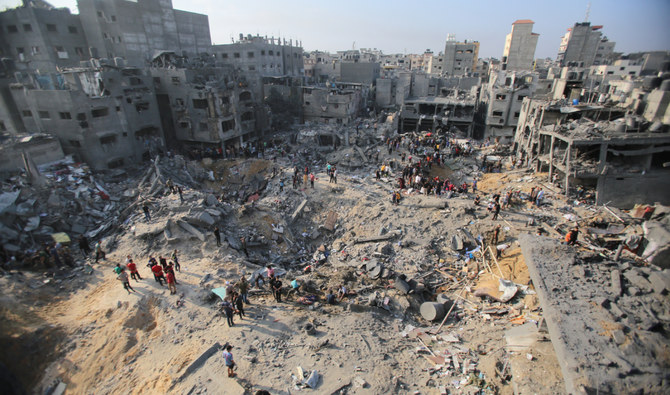

ATHENS/IRBIL: As the hostage deal agreed by Israel and Hamas ushers in the potential for a brief pause in the fighting in Gaza, thoughts are already turning in some quarters to the possibility of the Palestinian enclave’s recovery from unprecedented physical devastation.
If the experience of other Arab cities battered by conflict in recent years is anything to go by, the recovery of Gaza will not be a straightforward task, complicated by issues such as financing, leadership and guarantees of a lasting peace.
The Arab world is no stranger to the labor of rebuilding. More than 8,000 buildings were destroyed in Mosul’s Old City during the battle to retake the northern Iraqi city from Daesh in 2017. Syria’s Aleppo likewise saw more than 35,000 of its structures ruined during the continuing civil war, which began in 2011.
These cities share one characteristic in common — their destruction. But the extent of their reconstruction since has hinged on a complex web of factors, including geographical location, size (both in area and population), the current security situation, and the actions, or lack thereof, taken by local and national governments.
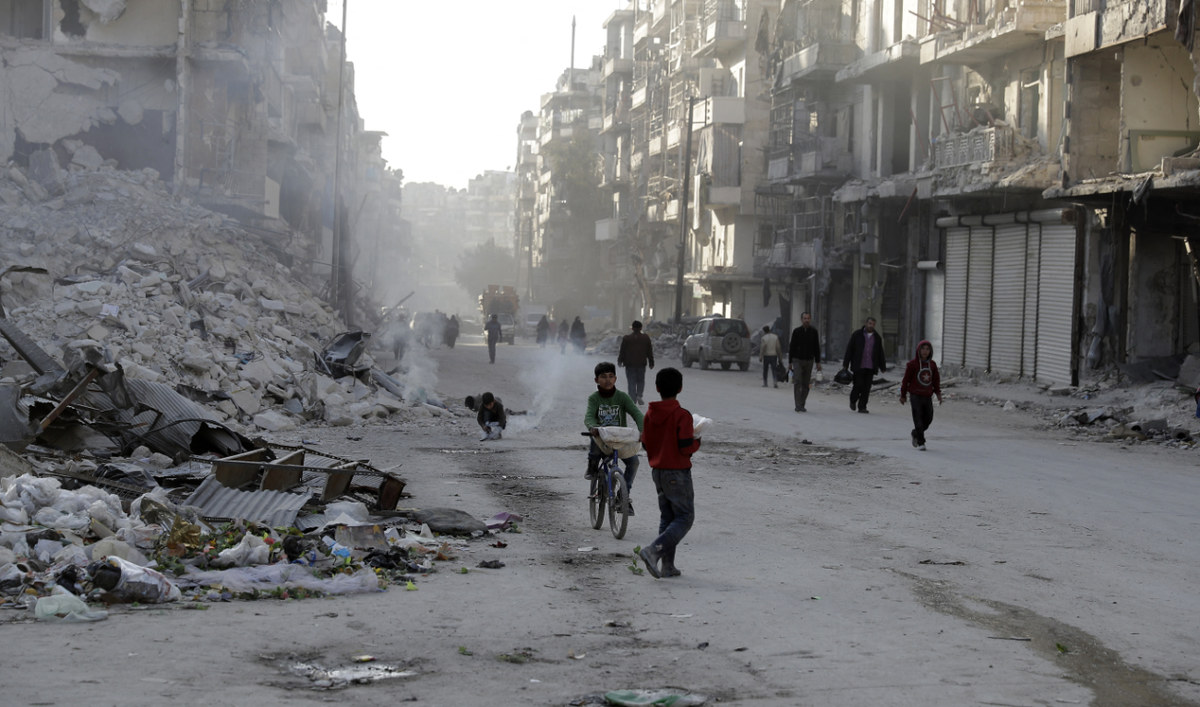
A picture taken on March 9, 2017 in the northern Syrian city of Aleppo, which was recaptured by government forces in December 2016, shows people walking past heavily damaged buildings. (AFP)
For example, while much of Mosul remains in ruins, the relative lack of conflict for the past six years has enabled rebuilding initiatives such as “Revive the Spirit of Mosul,” a multimillion-dollar project led by UNESCO with assistance from the EU and UAE, which intends to revitalize the iconic Iraqi city.
Aleppo faces similar issues. The city is being reconstructed in a piecemeal fashion, with those in formerly opposition-held neighborhoods in the east and Kurdish-majority, semi-autonomous neighborhoods in the north complaining of neglect by the central government in Damascus.
Other residents complain that Iran-backed, pro-government militias have monopolized aid and the entire reconstruction process.
Further complicating reconstruction in both Aleppo and Mosul are claims that many of the UN’s damage assessments are carried out only on buildings of cultural or historical significance rather than on housing and residential infrastructure.
This has meant that while massive UNESCO projects and promises of donations to rebuild historic districts are well-meaning, they often neglect the real needs of civilians on the ground.
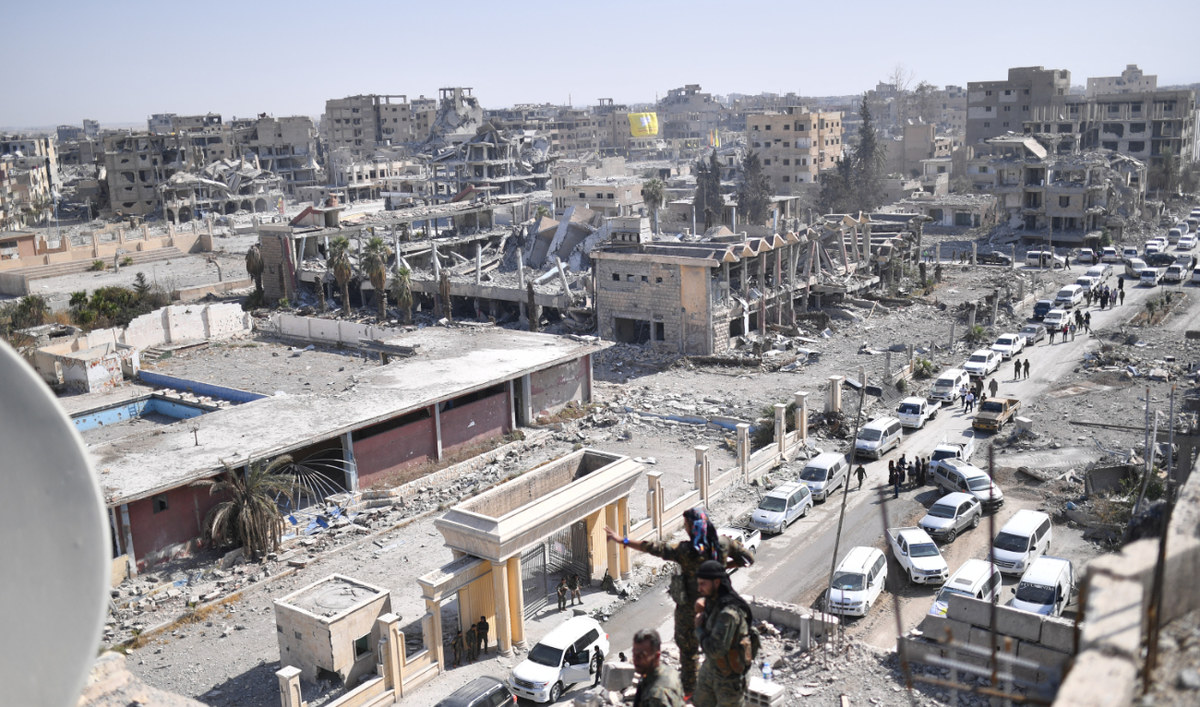
A fighters of the Syrian Democratic Forces (SDF) flashes the victory gesture as he stands guard with his comrades on a rooftop in Raqqa on October 20, 2017, after retaking the city from Daesh fighters. (AFP)
Raqqa, meanwhile, under the US-backed Autonomous Administration of North and East Syria, has enjoyed relative stability and security since its liberation, which has helped its reconstruction.
With the assistance of the local administration and international humanitarian organizations, more than 400 of the city’s 528 schools have been entirely or partially rebuilt, and 90 percent of the city’s water network has been repaired, according to information provided to Arab News by Abdul Salam Hamsork, vice president of Raqqa’s Executive Council.
Gaza has not had the chance to enjoy any such stability, having been subjected to multiple, intense military campaigns in recent decades.
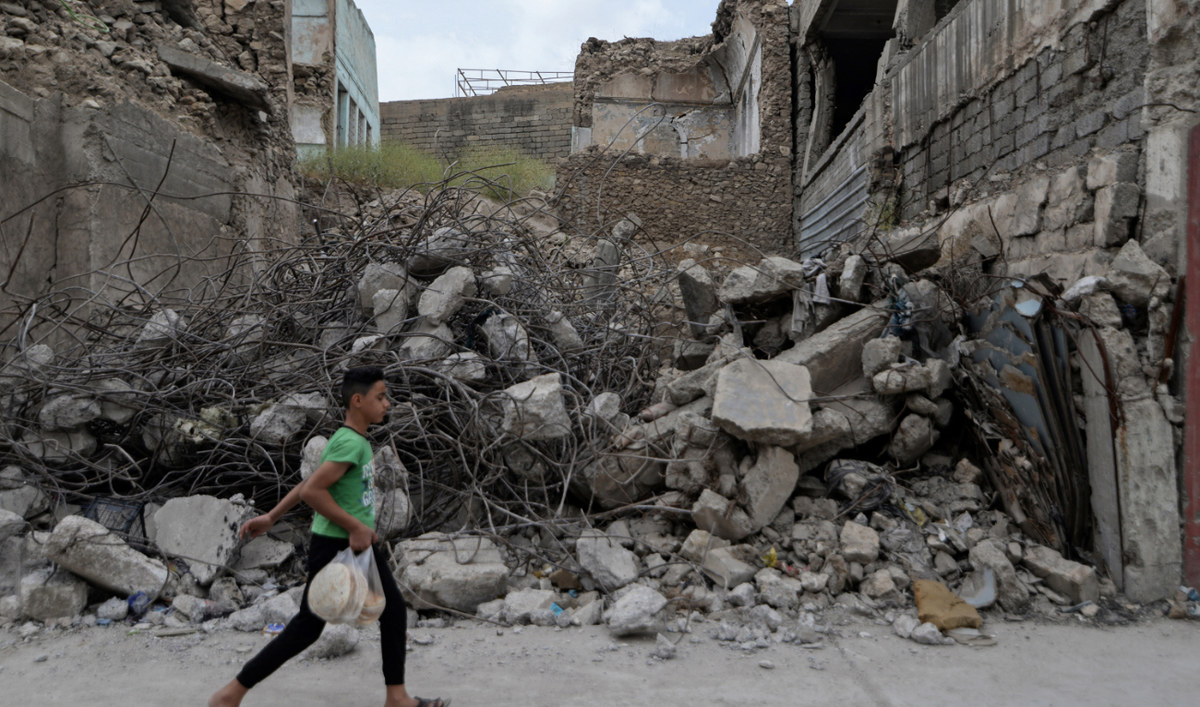
A boy walks past the rubble of destroyed houses in the war-ravaged old part of Iraq’s northern city Mosul, a site heavily damaged by Daesh fighters in the 2017 battle for the city, on April 21, 2021. (AFP)
While previous reconstructions of civilian homes and infrastructure were carried out by the International Relief Agency and the UN Development Program, the conflict that began on Oct. 7 is unprecedented in its scale, Dr. Saleh Abdel Aty, a Palestinian lawyer, researcher and human rights activist, told Arab News.
“During this ongoing aggression, the occupation forces destroyed 60 percent of the housing units, completely or partially destroying approximately 250,000 housing units, in addition to the destruction that occurred to buildings, infrastructure, service facilities, factories, farms and shops,” he said.
“Reconstruction is possible, of course, but it requires an international conference to end the siege and agree on an international vision to end the occupation and prevent it from controlling the reconstruction process.”
GAZA DAMAGE IN NUMBERS
- 41k Housing units destroyed and 222k damaged as of Nov. 15 — 45 percent of the total. (OCHA)
- 279 Educational facilities damaged as of Nov. 15 — more than 51 percent of the total. (OCHA)
- 9 of Gaza’s 35 hospitals left partially functioning as of Nov. 16. (Ministry of Health)
- 70 percent People in southern Gaza with no access to clean water as of Nov. 16. (UNRWA)
For many Palestinians still living under the threat of bombardment and displacement, talk of rebuilding now is premature. After decades of siege and military onslaught, hopelessness is an overriding feeling among Gazans.
“It is way too early to talk about reconstruction when the Israeli war continues with no end in sight,” Osama Al-Sharif, a journalist and political commentator based in Amman, told Arab News.
“The true objectives of Israel’s aggression remain unclear. What is obvious is that Israel is trying to make most of northern Gaza, including Gaza City, a buffer zone. It is applying a scorched-earth policy by carrying out deliberate mass destruction of that part. Gazans may never be allowed to return to the north, which has been turned into a wasteland.”
The destruction of Gaza also opens up a worrying possibility — the return of settlements. In 2005, as part of the Israeli disengagement in the enclave, more than 20 Israeli settlements inside Gaza were dismantled and both Israeli settlers and military forces withdrew from the area.
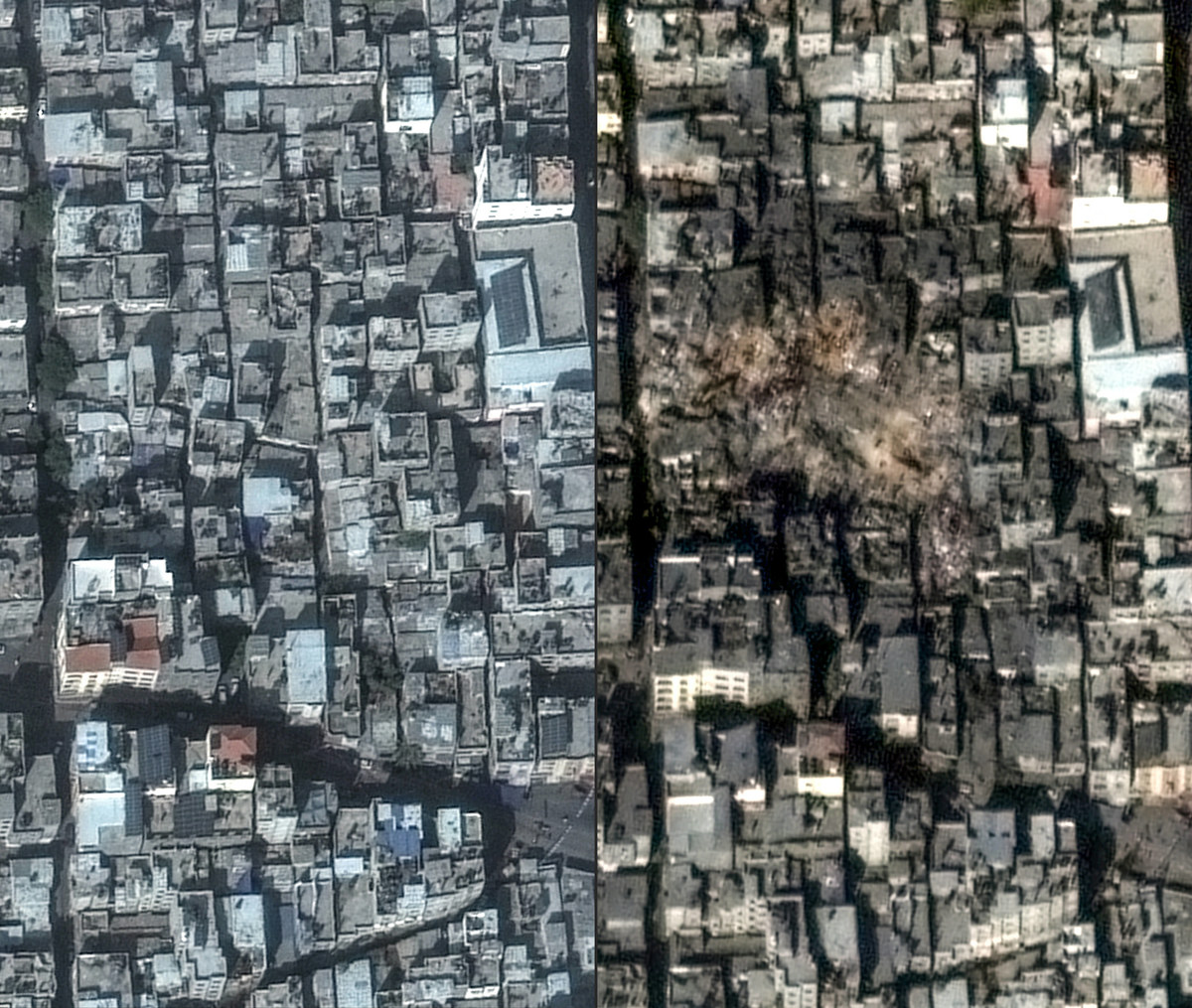
This combination of handout satellite images released by Maxar Technology and created on November 1, 2023, shows (L) an overview of the Jabalia refugee camp on October 31, 2023 and the destruction in the same camp after it was hit by an Israeli strike. (AFP)
Although Israel has not made any statements or endorsed the return of settlers, two weeks ago several former Gaza settlers who spoke to Voice of America expressed their desire to return to their former settlements after hostilities end.
With a temporary ceasefire as part of the hostage exchange deal now on the cards, there is a glimmer of hope for a sustained end to the fighting, or at the very least a window of opportunity to deliver vital aid to Gaza’s stricken population.
But until sustained peace is guaranteed, there is little appetite to support major reconstruction in Gaza if those buildings will only be flattened again in the next round of violence.
Indeed, as long as the region lives under the shadow of armed groups and the cloud of a potentially wider regional war, it may be impossible to get funds for reconstruction.
“Either reconstruction won’t happen at all due to a lack of resources, intense security and political fragmentation, or it will become a continuation of conflict by other means involving local and outside contenders,” Amr Adly, Muhammad Alaraby and Ibrahim Awad said in a jointly written essay from 2021 for the Carnegie Middle East Center on the topic of postwar reconstruction in the region.
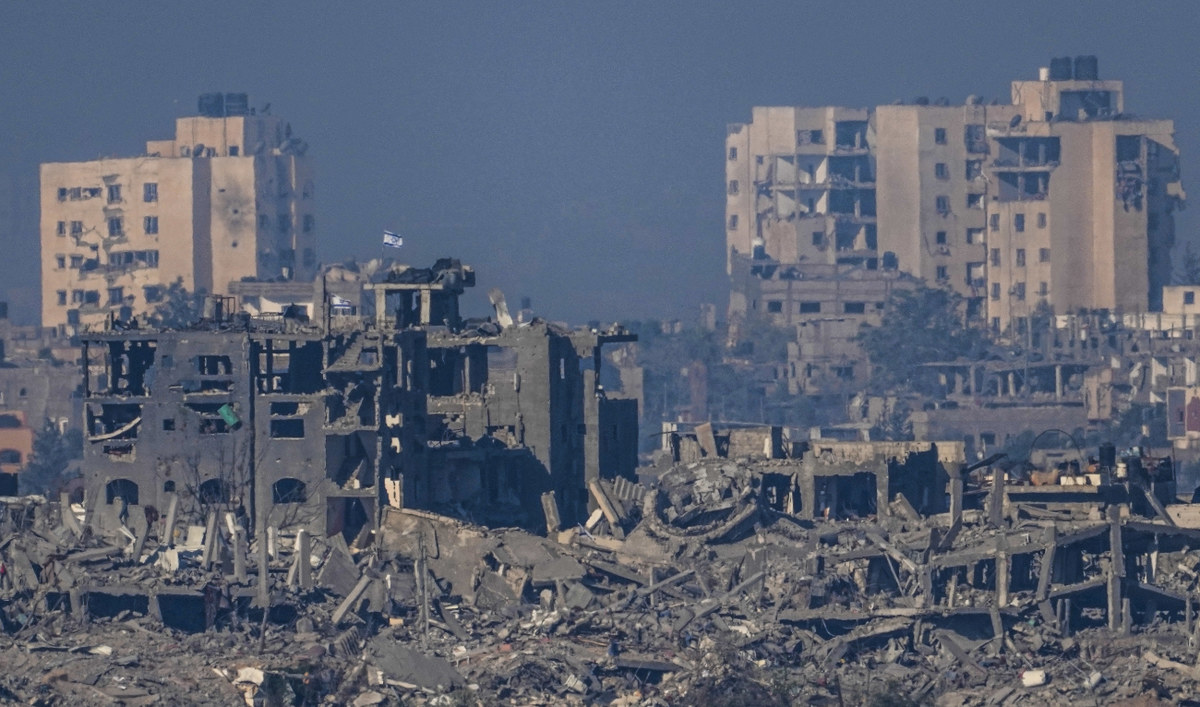
Israeli flags stand on the top of destroyed buildings in the Gaza Strip, as seen from southern Israel on Saturday, Nov. 18, 2023. (AP)
The lack of a guarantee that future conflicts will not ravage cities is one of the main obstacles to progress in many destroyed cities around the world.
Most Syrian political entities insist that the implementation of UN Resolution 2254 of 2015, which calls for a political settlement in Syria, is a prerequisite for any sort of reconstruction, rebuilding or return of refugees.
“For Gaza not to be destroyed, the very reason why resistance exists in the first place would have to be removed altogether — and that is the freedom of the Palestinian people,” Palestinian author and commentator Ramzy Baroud told Arab News.
“Construction must also be linked to another process: that of protecting Gaza from future Israeli wars and subsequent destruction.”
Baroud cautions that reconstruction efforts must not be politicized.
“Israel, the US and their Western allies must not be allowed to link the reconstruction of Gaza to their own political agendas against Hamas, the Islamic Jihad or any other Palestinian group,” he said, adding that “those who have lost everything are ordinary people who are victims of Israeli war crimes.”
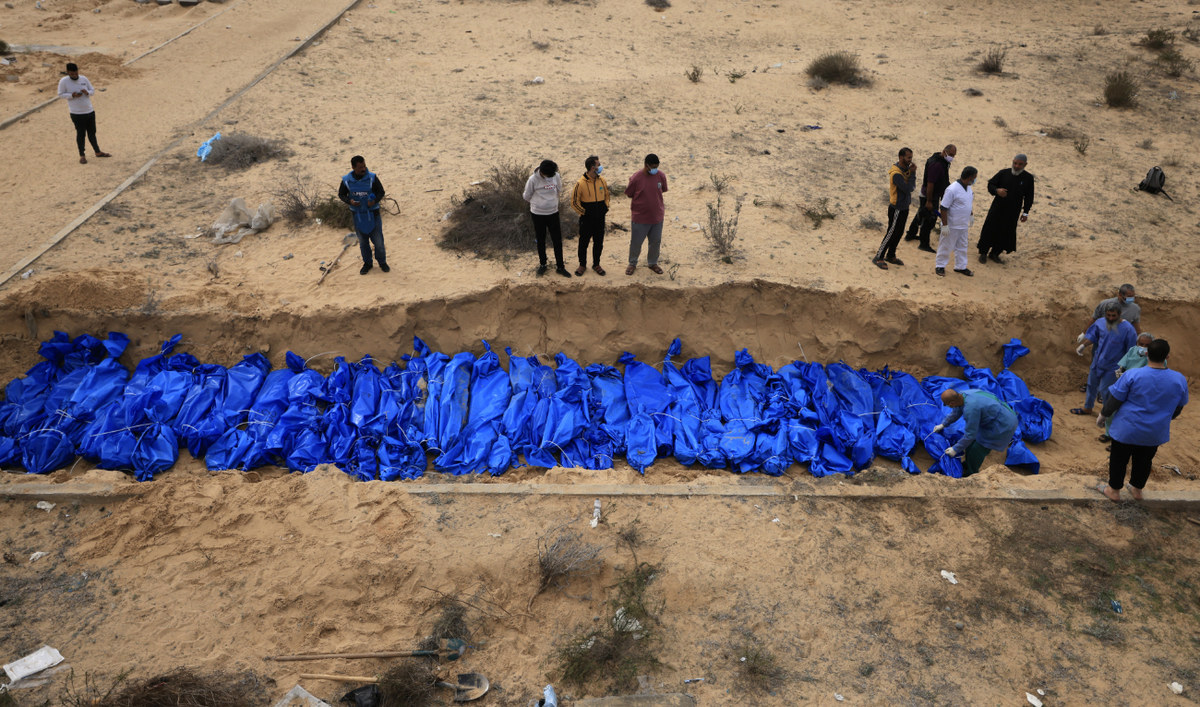
Palestinians bury bodies in a mass grave in Khan Yunis cemetery, in the southern Gaza Strip on November 22, 2023. (AFP)
Removing political agendas from any potential rebuilding may prove exceedingly difficult, particularly given that all aid and equipment must first travel through Israeli territory to reach Gaza. A long embargo on cement imports has slowed past repair and reconstruction work.
As Israel also has a track record of carrying out punitive demolitions of the homes of family members of Palestinian militants, it is unclear whether the country’s increasingly right-wing government would be willing to contribute to, or even tolerate, reconstruction efforts in Gaza.
“Theoretically, reconstruction is not an issue if the aggression stops and international aid flows in,” said Amman-based commentator Al-Sharif. “Western and Arab countries will contribute to a reconstruction plan, which may take years to accomplish.”
The costs associated with any potential reconstruction have yet to be assessed, but will surely be massive. For reference, the UN stated in 2017 that the reconstruction of Mosul’s basic infrastructure would cost $1 billion.
The UN said in October this year that even prior to the current war, Gaza was already in need of billions of dollars’ worth of aid, with the region suffering from one of the highest unemployment rates in the world and a 64 percent food insecurity rate.
Reconstruction and development work also needs donors, at a time when funds for Gaza have already been on the decline. From 2008 to 2022, aid provided to Gaza slipped from $2 billion to $500 million.
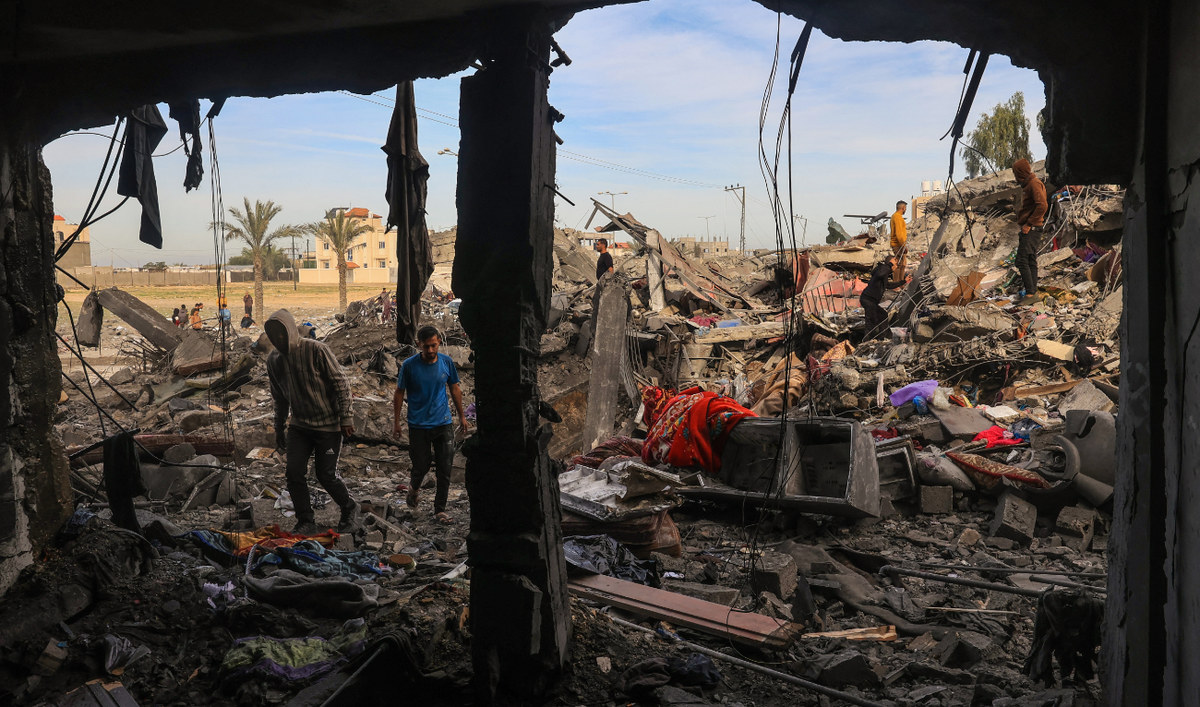
Palestinians check the rubble following Israeli strikes in the southern Gaza Strip on November 22, 2023. (AFP)
How Gaza’s reconstruction could be paid for is a source of some dispute. One idea that has been floated is the development of the Gaza Marine offshore gas field, located 36 km off the coast in the Mediterranean Sea.
Amos Hochstein, the US special presidential coordinator for global infrastructure and energy security, traveled to Israel on Monday in a move that could boost prospects for Gaza to develop its offshore gas reserves after the war.
“We shouldn’t exaggerate its potential, but it can absolutely be a revenue stream for a Palestinian government, and to ensure there is an independent energy system for Palestine,” Hochstein said in an interview on Sunday.
Even if all political, access, material and financial hurdles are somehow overcome, cities such as Aleppo, Raqqa and Mosul show that progress can still be slow.
Despite the passage of six years or more, vast swathes of these cities remain depopulated and in ruins — testament to the immense challenge of rebuilding after the guns and bombs fall silent.


