

UK foreign secretary Cameron hosts Arab, Islamic ministers to discuss Israel-Hamas conflict

1 / 4
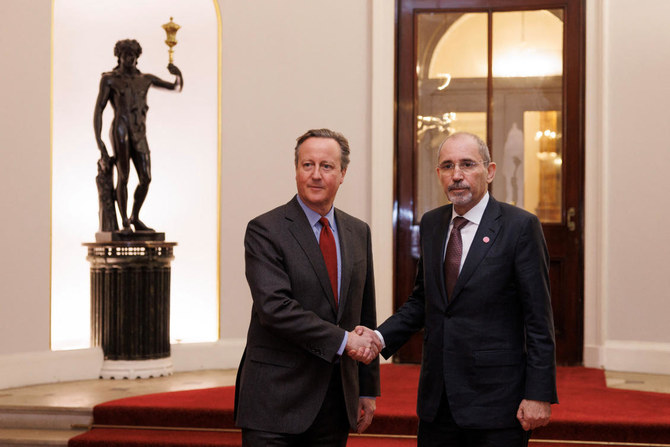
British Foreign Secretary David Cameron greets the Minister of Foreign Affairs of Jordan, Ayman Safadi, as he welcomes Arab and Islamic counterparts to Lancaster House in London on Nov. 22, 2023. (Reuters)
2 / 4
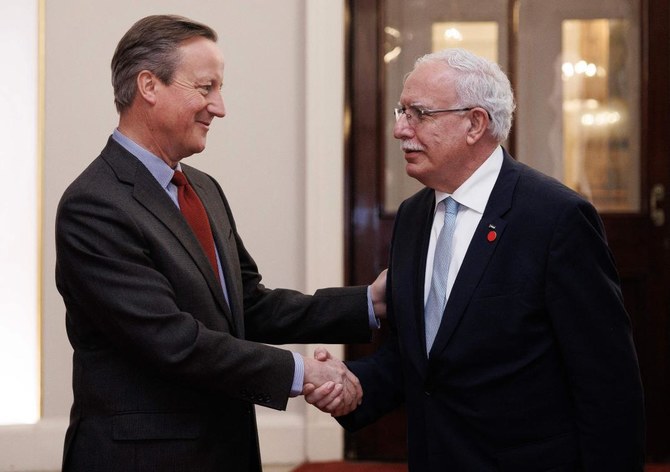
Britain’s Foreign Secretary David Cameron and Palestine’s Foreign Minister Riyad Al-Maliki pose for a photograph ahead of a meeting of Arab and Islamic Leaders, at Lancaster House in London on Nov. 22, 2023. (AFP)
3 / 4
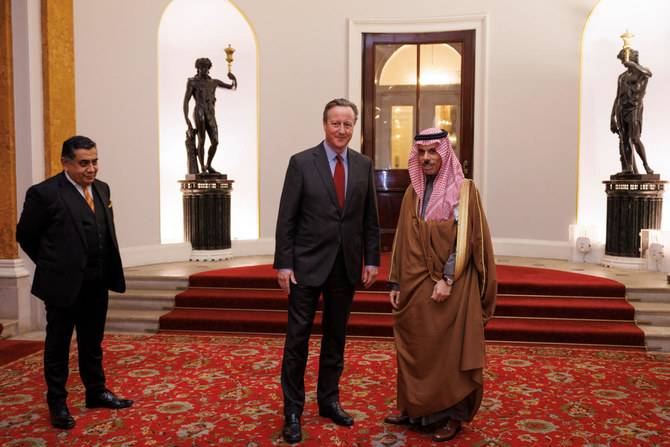
British Foreign Secretary David Cameron greets the Minister of Foreign Affairs of Saudi Arabia, Faisal bin Farhan Al-Saud, as he welcomes Arab and Islamic counterparts to Lancaster House in London on Nov. 22, 2023. (Reuters)
4 / 4
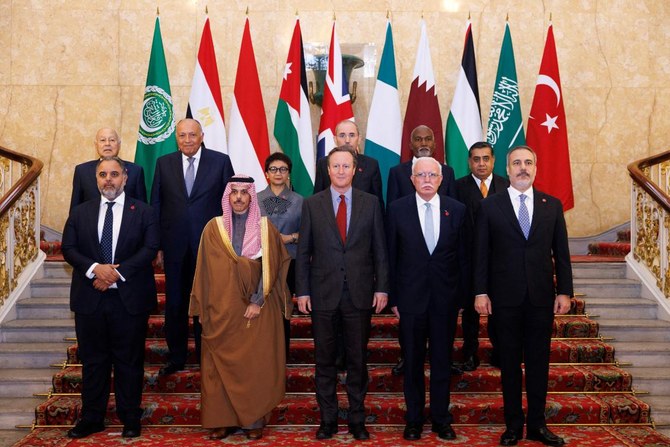
Britain’s Foreign Secretary David Cameron and his counterparts from Arab and Islamic countries in London ahead of a meeting at Lancaster House in London on Nov. 22, 2023. (AFP)
Short Url
Updated 22 November 2023
Follow

UK foreign secretary Cameron hosts Arab, Islamic ministers to discuss Israel-Hamas conflict

  • UK foreign secretary Cameron hosts Arab, Islamic ministers to discuss Israel-Hamas conflict
  • Pledges support to prevent regional escalation, including in Lebanon and Yemen

LONDON: UK Foreign Secretary David Cameron on Wednesday met with foreign ministers from Arab and Islamic countries in London to discuss cooperation on the crisis in Israel and Gaza, how to secure the release of all hostages, increase the amount of aid into Gaza, and reach a long-term political solution to the crisis.

The ministerial committee mandated by the Joint Arab-Islamic Extraordinary Summit was headed by Saudi Foreign Minister Prince Faisal bin Farhan, and included his counterparts from Jordan, Egypt, the Palestinian Authority, Turkiye, Indonesia and Nigeria, as well as Secretary-General of the Arab League Ahmed Aboul Gheit.

UK Minister of State for Foreign Commonwealth and Development Affairs for Middle East, North Africa, South Asia and the United Nations at the Foreign, Commonwealth and Development Office Lord Ahmad also attended the talks.

The visit followed an agreement reached overnight between Israel and Hamas on coordinated hostage releases and a pause in the fighting, the UK’s FCDO said in a statement.

Cameron emphasised the importance of allowing humanitarian organizations to bring in more fuel so they can carry out lifesaving work unimpeded, including powering hospitals or desalination plants, which supply 80 percent of Gaza’s water.

“The foreign secretary discussed with leaders at the meeting how to reinvigorate diplomatic efforts toward a viable two-state solution, which provides security for both Israelis and Palestinians, and restated the UK’s condemnation of the rise in settler violence in the West Bank,” the FCDO said.

“He committed to continued UK support to prevent wider regional escalation, including in Lebanon and Yemen,” it added.

Cameron said: “Today I have chaired a meeting of leaders from Arab countries and other Islamic states on the situation in Israel and Gaza.

“The agreement reached last night is an important opportunity to get the hostages out and more aid into Gaza to help the Palestinian people.

“We discussed how to use this step forward to think about the future and how we can build a peaceful future which provides security for Israel but also peace and stability for the Palestinian people.”

The meeting welcomed the joint mediation efforts of Egypt, Qatar, and the US, which resulted in the truce, the timing of which will be announced within 24 hours and is extendable, the Saudi Press Agency reported.

The ministerial committee stressed the importance of the members of the Security Council and the international community taking effective and urgent measures for a complete cease-fire in the Palestinian enclave, saying that this is a priority for all Arab and Islamic countries.

Members of the committee called on Britain to play a balanced role consistent with international law and international humanitarian law to reach an immediate cease-fire and implement all relevant international resolutions, SPA said.

The meeting discussed the need to revive the peace process, and the Arab and Islamic officials stressed the importance of ensuring a just, lasting and comprehensive peace, through the implementation of international resolutions related to the two-state solution, and enabling the Palestinian people to achieve their legitimate rights to establish an independent and sovereign Palestinian state, with East Jerusalem as its capital.

“The members of the ministerial committee called on the international community to assume its responsibility by rejecting all forms of selectivity in the application of international legal and moral standards, and condoning the heinous crimes committed by the occupation forces and settler militias against the Palestinian people in the Gaza Strip and the occupied West Bank, including East Jerusalem,” SPA reported.

The delegation, which was formed as a “Peace Committee” at the Joint Arab Islamic Extraordinary Summit, held in Riyadh on Nov. 11, is visiting the capitals of UN Security Council permanent members, arriving in London after meetings in Beijing and Moscow, and with further trips planned to Paris and Washington.

The UK has helped lead the international response to the humanitarian crisis by recently announcing £30 million ($37.4 million) in additional aid to the Palestinian territories, more than doubling the aid commitment for this year, the FCDO said.


Sudan’s war robs 8 million children of 500 days’ education

Updated 8 sec ago
Follow

Sudan’s war robs 8 million children of 500 days’ education

  • British NGO Save the Children says many teachers are leaving their jobs due to unpaid salaries

PORT SUDAN: Almost three years of war in Sudan have left more than 8 million children out of education for nearly 500 days, the NGO Save the Children said on Thursday, highlighting one of the world’s longest school closures.

“More than 8 million children — nearly half of the 17 million of school age — have gone approximately 484 days without setting foot in a classroom,” the children’s rights organization said in a statement.

Sudan has been ravaged by a power struggle between the army and the Rapid Support Forces since April 2023.

This is “one of the longest school closures in the world,” the British NGO said.“Many schools are closed, others have been damaged by the conflict, or are being used as shelters” for the more than 7 million displaced people across the country, it added. North Darfur in western Sudan is the country’s hardest-hit state: Only 3 percent of its more than 1,100 schools are still functioning.

In October, the RSF seized the city of El-Fasher, the capital of North Darfur, and the last of Darfur’s five capitals to remain outside their control.

West Darfur, West Kordofan, and South Darfur follow with 27 percent, 15 percent, and 13 percent of their schools operating, respectively, according to the statement.

The NGO added that many teachers in Sudanese schools were leaving their jobs due to unpaid salaries.

“We risk condemning an entire generation to a future defined by conflict,” without urgent investment, said the NGO’s chief executive, Inger Ashing.

The conflict, which has claimed tens of thousands of lives, has triggered the “world’s worst humanitarian crisis,” according to the UN.

On Sunday, UN Human Rights commissioner Volker Turk condemned the increasing number of attacks against “essential civilian infrastructure” in Sudan, including hospitals, markets, and schools.

He also expressed alarm at “the arming of civilians and the recruitment of children.”

The UN has repeatedly expressed concern about the “lost generation” in Sudan.

Even as war rages in the southern Kordofan region, Prime Minister Kamil Idris has announced that the government will return to Khartoum after operating from the Red Sea city of Port Sudan, some 700 km away, for nearly three years.

Main roads have been cleared, and cranes now punctuate the skyline of a capital scarred by the war. Since then, officials have toured reconstruction sites daily, promising a swift return to normal life.

Government headquarters, including the general secretariat and Cabinet offices, have been refurbished. But many ministries remain abandoned, their walls pockmarked by bullets.

More than a third of Khartoum’s 9 million residents fled when the RSF seized the city in 2023. 

Over a million have returned since the army retook the city.

A jungle of weeds fills the courtyard of the Finance Ministry in central Khartoum, where the government says it plans a gradual return after nearly three years of war.

Abandoned cars, shattered glass, and broken furniture lie beneath vines climbing the red-brick facades, built in the British colonial style that shaped the city’s early 20th-century layout.

“The grounds haven’t been cleared of mines,” a guard warns at the ruined complex, located in an area still classified as “red” or highly dangerous by the UN Mine Action Service, or UNMAS.

The central bank is a blackened shell, its windows blown out. Its management announced this week that operations in Khartoum State would resume, according to the official news agency SUNA.

At a ruined crossroads nearby, a tea seller has reclaimed her usual spot beneath a large tree.

Halima Ishaq, 52, fled south when the fighting began in April 2023 and came back just two weeks ago.

“Business is not good. The neighborhood is still empty,” the mother of five said,

Near the city’s ministries, workers clear debris from a gutted bank.

“Everything must be finished in four months,” said the site manager.

Optimism is also on display at the Grand Hotel, which once hosted Queen Elizabeth II.

Management hopes to welcome guests again by mid-February.