

UK Home Secretary sacked for criticizing police handling of pro-Palestinian protests, ex-PM Cameron returns

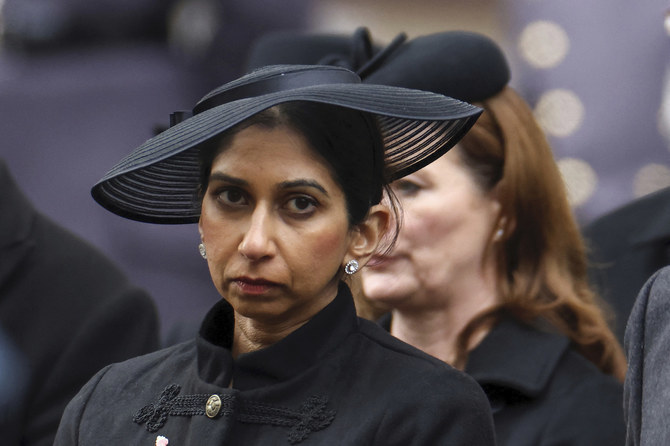
British Home Secretary Suella Braverman attends the annual Remembrance Sunday ceremony at the Cenotaph in London, on November 12, 2023. (AP)
Short Url
Updated 14 November 2023
Follow

UK Home Secretary sacked for criticizing police handling of pro-Palestinian protests, ex-PM Cameron returns

  • Latest reset for a prime minister whose party is badly lagging the Labour Party before an election expected next year
  • Return of Cameron suggests Sunak wants to bring in more centrist, experienced hands rather than appease right in his party

LONDON: British Prime Minister Rishi Sunak brought back former leader David Cameron as foreign minister on Monday in a reshuffle triggered by his firing of interior minister Suella Braverman after her criticism of police threatened his authority.

It was the latest reset for a prime minister whose party is badly lagging the Labour Party before an election expected next year. The return of Cameron suggested Sunak wanted to bring in more centrist, experienced hands rather than appease the right of his party which supported Braverman.

It also awakens divisive debate over Brexit: Britain’s decision to leave the European Union, which Cameron triggered by holding a referendum in 2016 even though he backed staying in the bloc.

Under fire from opposition lawmakers and members of the governing Conservative Party to eject Braverman, Sunak seemed to have brought forward a long-planned reshuffle to bring in allies and remove ministers he felt were not performing.

His hand was forced when the ever-controversial Braverman defied him last week in an unauthorized article accusing police of “double standards” at protests, suggesting they were tough on right-wing demonstrators, but easy on pro-Palestinian marchers.

The opposition Labour Party said that inflamed tensions between a pro-Palestinian demonstration and a far-right counter protest on Saturday, when nearly 150 people were arrested.

While her removal was not a surprise, it was the appointment of Cameron which caused shock in the Conservative Party, welcomed by more centrist lawmakers but hated by some of the right who described it as the ultimate “Brexit surrender.”

Cameron said he was glad to take on his new role because at a time of global change, “it has rarely been more important for this country to stand by our allies, strengthen our partnerships and make sure our voice is heard.”

“Though I may have disagreed with some individual decisions, it is clear to me that Rishi Sunak is a strong and capable prime minister, who is showing exemplary leadership at a difficult time,” he wrote on X, formerly Twitter.

Brexit Returns

Lawmakers in the centrist wing of the party said Cameron’s appointment would bring international experience, and send a wider message to the country.

“It’s a sign to the Tory blue wall and moderate voters, we aren’t heading to the right,” one Conservative lawmaker said, using a phrase that is used to describe traditional Conservative-supporting areas in the south of England.

Some lawmakers had feared that Braverman was determined to remake the Conservatives as the “nasty party,” a moniker former Prime Minister Theresa May used in 2002 to try to persuade the party to shed its reputation of being uncaring.

But Cameron’s return compounded the anger felt by some on the right of the party after her sacking. They said Braverman’s stance on how the police dealt with protests was correct and predicted she would become a vocal force among those who do not hold ministerial positions in parliament.

Some Brexit supporters also said the fact Cameron had campaigned for Britain to stay in the European Union after he called a referendum on membership for 2016 meant the so-called “remain” wing of the party had taken over.

James Cleverly, previously foreign minister, was appointed to replace Braverman. He is seen as a safe pair of hands and was quick to say his new role was “to keep people in this country safe.”

With Braverman sidelined, her attentions might focus on preparing for a possible future race for leader of the party if, as the opinions polls suggest, the Conservatives lose the election expected next year.

The Labour Party has consistently held an around 20-point lead in the polls, and Sunak has failed to reduce that gap.

He tried to relaunch himself as a representative of “change” at his party’s conference last month, when his message was overshadowed by a poorly communicated decision to cancel part of the country’s biggest rail project.

Labour had called Sunak weak since Braverman’s article was published on Wednesday. Now, opposition lawmakers said his decision to appoint Cameron was an act of desperation.

Lawmaker Pat McFadden, Labour’s national campaign coordinator, said: “A few weeks ago Rishi Sunak said David Cameron was part of a failed status quo, now he’s bringing him back as his life raft.”

“This puts to bed the prime minister’s laughable claim to offer change from 13 years of Tory failure.”


Coast Guard is pursuing another tanker helping Venezuela skirt sanctions, US official says

Updated 22 December 2025
Follow

Coast Guard is pursuing another tanker helping Venezuela skirt sanctions, US official says

  • US oil companies dominated Venezuela’s petroleum industry until the country’s leaders moved to nationalize the sector, first in the 1970s and again in the 21st century under Maduro and his predecessor, Hugo Chávez

WEST PALM BEACH, Florida: The US Coast Guard on Sunday was pursuing another sanctioned oil tanker in the Caribbean Sea as the Trump administration appeared to be intensifying its targeting of such vessels connected to the Venezuelan government.
The pursuit of the tanker, which was confirmed by a US official briefed on the operation, comes after the US administration announced Saturday it had seized a tanker for the second time in less than two weeks.
The official, who was not authorized to comment publicly about the ongoing operation and spoke on the condition of anonymity, said Sunday’s pursuit involved “a sanctioned dark fleet vessel that is part of Venezuela’s illegal sanctions evasion.”
The official said the vessel was flying a false flag and under a judicial seizure order.
The Pentagon and Department of Homeland Security, which oversees the US Coast Guard, deferred questions about the operation to the White House, which did not offer comment on the operation.
Saturday’s predawn seizure of a Panama-flagged vessel called Centuries targeted what the White House described as a “falsely flagged vessel operating as part of the Venezuelan shadow fleet to traffic stolen oil.”
The Coast Guard, with assistance from the Navy, seized a sanctioned tanker called Skipper on Dec. 10, another part of the shadow fleet of tankers that the US says operates on the fringes of the law to move sanctioned cargo. It was not even flying a nation’s flag when it was seized by the Coast Guard.
President Donald Trump, after that first seizure, said that the US would carry out a “blockade” of Venezuela. It all comes as Trump has ratcheted up his rhetoric toward Venezuelan President Nicolás Maduro.
This past week Trump demanded that Venezuela return assets that it seized from US oil companies years ago, justifying anew his announcement of a “blockade” against oil tankers traveling to or from the South American country that face American sanctions.
Trump cited the lost US investments in Venezuela when asked about his newest tactic in a pressure campaign against Maduro, suggesting the Republican administration’s moves are at least somewhat motivated by disputes over oil investments, along with accusations of drug trafficking. Some sanctioned tankers already are diverting away from Venezuela.
US oil companies dominated Venezuela’s petroleum industry until the country’s leaders moved to nationalize the sector, first in the 1970s and again in the 21st century under Maduro and his predecessor, Hugo Chávez. Compensation offered by Venezuela was deemed insufficient, and in 2014, an international arbitration panel ordered the country’s socialist government to pay $1.6 billion to ExxonMobil.
Maduro said in a message Sunday on Telegram that Venezuela has spent months “denouncing, challenging and defeating a campaign of aggression that goes from psychological terrorism to corsairs attacking oil tankers.”
He added: “We are ready to accelerate the pace of our deep revolution!”
Sen. Rand Paul, R-Kentucky, who has been critical of Trump’s Venezuela policy, called the tanker seizures a “provocation and a prelude to war.”
“Look, at any point in time, there are 20, 30 governments around the world that we don’t like that are either socialist or communist or have human rights violations,” Paul said on ABC’s’ “This Week.” ”But it isn’t the job of the American soldier to be the policeman of the world.”
The targeting of tankers comes as Trump has ordered the Defense Department to carry out a series of attacks on vessels in the Caribbean and eastern Pacific Ocean that his administration alleges are smuggling fentanyl and other illegal drugs into the United States and beyond.
At least 104 people have been killed in 28 known strikes since early September. The strikes have faced scrutiny from US lawmakers and human rights activists, who say the administration has offered scant evidence that its targets are indeed drug smugglers and that the fatal strikes amount to extrajudicial killings.
Trump has repeatedly said Maduro’s days in power are numbered. White House chief of staff Susie Wiles said in an interview with Vanity Fair published last week that Trump “wants to keep on blowing boats up until Maduro cries uncle.”
Sen. Tim Kaine, D-Virginia, told NBC’s “Meet the Press” on Sunday that Trump’s use of military to mount pressure on Maduro runs contrary to Trump’s pledge to keep the United States out of unnecessary wars.
Democrats have been pressing Trump to seek congressional authorization for the military action in the Caribbean.
“We should be using sanctions and other tools at our disposal to punish this dictator who is violating the human rights of his civilians and has run the Venezuelan economy into the ground,” Kaine said. “But I’ll tell you, we should not be waging war against Venezuela. We definitely should not be waging war without a vote of Congress.