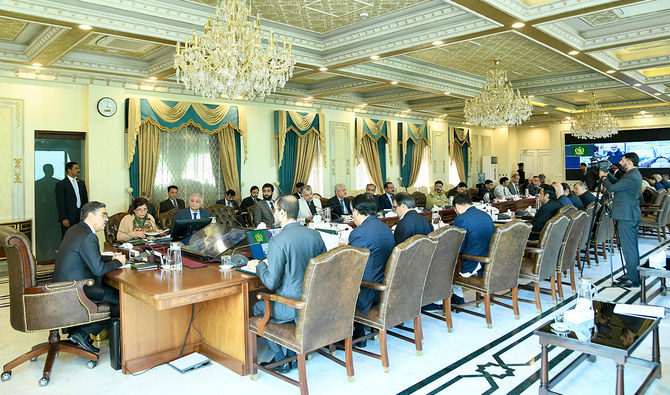
ISLAMABAD: Pakistan is drafting a “comprehensive policy framework” for the formation of its first carbon credits market, the prime minister’s office said in a statement on Monday after Premier Anwaar-ul-Haq Kakar chaired a meeting of the national Climate Change Council.
Carbon markets are becoming an indispensable tool in the global climate fight, with carbon pricing instruments now covering over 20 percent of global greenhouse gas emissions, generating $53 billion in revenue at the end of 2021, according to the Carbon Pricing Leadership Coalition, a 17 percent increase in revenue from the previous year.
A carbon offset credit is a transferable instrument certified by independent entities or governments, and each credit represents a reduction of one metric ton of carbon dioxide, or an equivalent greenhouse gas.
The credits, to be effective, must represent an environmentally sound project that helps to mitigate climate change, such as preserving a forest that was slated to be cleared, or the building of a clean energy project to eliminate burning of a fossil fuel. After purchasing a credit, a company can “retire” it to claim a reduction in their own greenhouse gas reduction goals.
Setting up a carbon market is part of efforts by Pakistan, one of the country’s worst hit by climate change, to reduce 15 percent green house gasses with the country’s own resources and 35 percent with the support of international grants by 2030.
“Approval to form a committee of experts from the Pakistan Climate Change Council under the Ministry of Climate Change of the Prime Minister,” the PMO said.
“The committee will work to create a comprehensive policy framework for the formation and trading of carbon credits market in Pakistan and to make it more efficient and effective.”
The meeting of the Climate Change Council, according to the PMO, also discussed policy guidelines for trade in carbon markets in Pakistan.
“The meeting was told that a comprehensive policy framework is being made in consultation with all relevant government agencies, NGOs and civil society, which will be implemented soon,” the statement added. “Under this, a strategy is being formed under the supervision of experts in this field to make trading of carbon credits in the carbon markets in Pakistan easy and useful for the country.”
There are broadly two types of carbon markets: compliance and voluntary, according to UNDP.
Compliance markets are created as a result of any national, regional and/or international policy or regulatory requirement. Voluntary carbon markets – national and international – refer to the issuance, buying and selling of carbon credits, on a voluntary basis.
The current supply of voluntary carbon credits comes mostly from private entities that develop carbon projects, or governments that develop programs certified by carbon standards that generate emission reductions and/or removals.
Demand comes from private individuals that want to compensate for their carbon footprints, corporations with corporate sustainability targets, and other actors aiming to trade credits at a higher price to make a profit.


![]()

Pakistan says working on ‘comprehensive policy framework’ to form its first carbon market
Short Url
https://arab.news/wnnwm
Pakistan says working on ‘comprehensive policy framework’ to form its first carbon market
- In a nutshell, carbon markets are trading systems in which carbon credits are sold and bought
- One tradable credit equals one ton of greenhouse gas reduced, sequestered or avoided
Latest updates


© 2026 SAUDI RESEARCH & PUBLISHING COMPANY, All Rights Reserved And subject to Terms of Use Agreement.