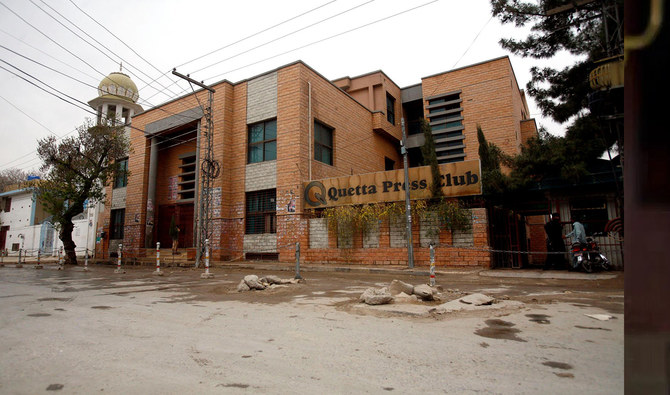
KARACHI: Journalists in Pakistan’s southwestern Balochistan province on Saturday condemned the temporary closure of Quetta Press Club by police, demanding an inquiry into what they called an attack on media freedom in violation of the country’s constitution.
The incident took place after the Baloch Yakjehti Committee (BYC), an ethnic rights movement led by local activist Mahrang Baloch, organized a seminar at the press club, prompting the police to lock the facility. However, supporters of the rights movement broke the lock and entered the club.
Last year, Baloch gained national visibility by leading a protest march to Islamabad, saying her objective was to bring attention to enforced disappearances and extrajudicial killings in her province, though the government denied the state’s involvement in any such activities.
“The Balochistan Union of Journalists strongly condemns the closure of the Quetta Press Club by the administration in harsh terms, considering it an attack on press freedom and a blatant violation of the Article 19 of the Constitution,” said a statement that called for investigation into the issue.
“The closure of the Press Club is an assault on the freedom and rights of journalists, which is unacceptable,” it added. “This move by the administration is a conspiracy to silence journalists, and we will protest vigorously against it.”
The union pointed out that journalists were already facing threats and challenges, though it added they would continue to fulfill their responsibilities and remain undeterred by such measures.
“Article 19 of Pakistan’s Constitution grants every citizen the freedom of expression, and the closure of the Press Club is a clear violation of it,” the statement continued. “The Balochistan Union of Journalists demands a high-level investigation into the matter so that journalists can fulfil their duties without fear or danger.”
When contacted, Banaras Khan, the general secretary of Quetta Press Club, told Arab News the district administration had asked the club’s administration to cancel the program, citing security reasons.
“Half of the participants came and half were on their way when the police locked the gate,” he said, adding he had refused to cancel the program.
“I informed the authorities that I wouldn’t force the participants to leave,” Khan revealed. “If the provincial administration wanted to, they could, but they should then lock the gate, and we would leave as well,” he said, highlighting his disagreement with the officials that made him warn that the journalists would vacate the premises in protest.
Shahid Rind, a Balochistan government spokesperson, said, however, it was the decision of the police, deployed outside the club for its protection, to lock the facility as a strategy to deal with the large crowd, adding the government had no intention to stop the program.
“Our position is clear,” he said. “We didn’t put any locks, nor did we want to stop the seminar.”
Rind said the organizers had mentioned in their invitations only registered participants would attend the program.
He said the gate was temporarily locked by the police.
“After that, the seminar continued throughout the day,” he added. “If we had wanted to stop the seminar, or if the state had wanted to stop it forcefully, would the seminar have been allowed to take place?”


![]()

Journalists protest temporary closure of Quetta Press Club, demand media freedom inquiry
Short Url
https://arab.news/gt4xw
Journalists protest temporary closure of Quetta Press Club, demand media freedom inquiry
- Police locked the facility after rights activist Mahrang Baloch decided to hold a seminar at the facility
- The Balochistan Union of Journalists issued a statement, describing it as an attack on press freedom
Latest updates





© 2026 SAUDI RESEARCH & PUBLISHING COMPANY, All Rights Reserved And subject to Terms of Use Agreement.