

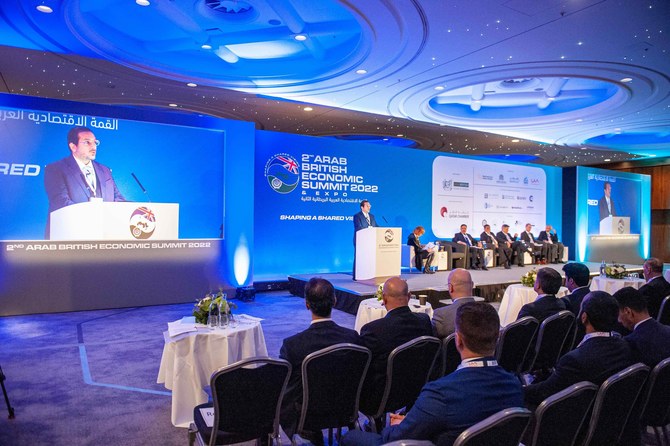

LONDON: Stakeholders from across the Arab world and the UK are set to gather in London for the third Arab-British Economic Summit, of which Arab News is a media partner.
Organized by the Arab-British Chamber of Commerce at the Hilton Metropole, government officials, senior executives, thought leaders and decision-makers will share ideas and debate trade and emergent investment opportunities in tech-based industries.
Among the industries highlighted by the event, set for Nov. 20, are e-commerce, finance, franchising and sustainable tourism.
The summit comes amid an evolution in Gulf-British trade, with the Lord Mayor of the City of London, Nicholas Lyons, noting an ever-widening pool of opportunities, and ABCC CEO Bandar Ali Reda keen to stress the “ambitious vision” of Arab governments.
“Many thousands of UK companies and businesspeople are looking keenly to the Gulf to grow their businesses,” Ali Reda told Arab News.
“In looking to the Gulf, UK businesses are attracted by the dynamism of its economies and the growing opportunities opening up as a result of the spectacular transformation we’re witnessing across the Gulf.”
FASTFACTS
Organized by the Arab-British Chamber of Commerce at the Hilton Metropole, government officials, senior executives, thought leaders and decision-makers will share ideas and debate trade and emergent investment opportunities in tech-based industries.
The summit comes amid an evolution in Gulf-British trade, with the Lord Mayor of the City of London, Nicholas Lyons, noting an ever-widening pool of opportunities.
He said this transformation is driven by both a vision and “determined forward thinking” of Gulf leaderships aimed at securing future sustainable prosperity for their peoples.
That effort has resulted in both seismic population growth — doubling across the Gulf Cooperation Council member states from 26 million in 1995 to more than 52 million at last count in 2021 — and rapid industrial development.
Ali Reda said the changes have rendered “most sectors open to foreign investment, involvement of the private sector and business partnerships.”
He added that while questions remain over the ease of travel and availability of visas for Arabs wishing to bring their expertise to the UK, the ABCC has held briefings on the electronic travel authorization rules being introduced by the Home Office.
“We can expect to see growing opportunities for Arab tech entrepreneurs within the UK’s innovative sector and vice versa,” he said.
“The ABCC is playing its role in facilitating closer partnerships and engagement in these areas that are drivers of the economy of the future.
“Indeed, one of the senior civil servants with responsibilities for the ETA is speaking at the summit.”
That flow of expertise comes with a sense that the Arab world is migrating from purely a consumer to a contributor across a range of fields.
Ali Reda said there is “great expertise and talent” in the Gulf regarding artificial intelligence, “and youth in the Arab world are particularly inspired by the opportunities presented by AI.”
He added: “Policymakers are keeping ahead of the game by adopting new regulatory frameworks that will enable the benefits of AI to be made available to wider sections of the population, while not losing sight of the challenges that AI presents.”
With Ali Reda noting its already “hugely transformative” effect on Arab economies, AI will be featured in the summit’s third session.
As Arab economies become stronger and more diverse, he said he expects to see the continuing evolution and emergence of new opportunities, describing the possibilities as “immeasurable.”
He added: “Both sides can gain a great deal from each other as each side has much to offer. In many ways, our economies complement each other.”
Ali Reda said: “The core bilateral relationships between the UK and the Arab world are today founded on greater equivalence, synergies and reciprocity.
“It’s a more diverse partnership, and not simply about buying and selling and boosting exports, as it possibly was in the past.”
He acknowledged the UK’s participation in growing the GCC’s domestic talent pool, pointing to the many top British universities, schools and educational establishments that have set up branches in the Gulf and cater to the region’s growing student base.
“English qualifications remain very well regarded and are in increasing demand across the Arab world,” he said.
“UK universities are attracting increasing numbers of students from the Gulf countries to come and complete their studies in the UK. These trends of collaboration and partnership seem unlikely to diminish.”


