

Smart parking innovation for special needs claims top spot at Al-Ahsa hackathon

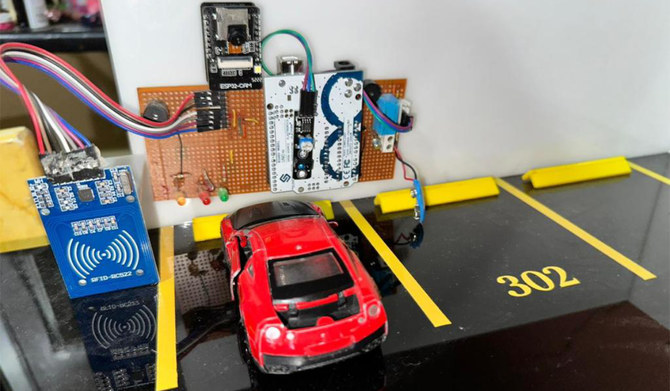
The core concept behind the ‘Smart Park’ project revolves around supporting people with special needs by installing sensors on their dedicated parking spaces. (Supplied)
Short Url
Updated 18 November 2023
Follow

Smart parking innovation for special needs claims top spot at Al-Ahsa hackathon

  • The core concept behind the “Smart Park” project, as Al-Thabit explained to Arab News, revolves around supporting people with special needs by installing sensors on their dedicated parking spaces

RIYADH: A project created for people with special needs has claimed the top spot at the 2023 Al-Ahsa Forum for Startups’ Sana Hackathon after an arduous development journey.

Developed collaboratively by Yaqeen Al-Thabit, Joud Al-Kulaib and Sakina Al-Oufi, the project introduces a technological solution to safeguard parking spaces designated for individuals with special needs.

The project seeks to establish a service model linked to technology so as to instill in this segment of the community the confidence they deserve for seamless integration into society, enabling them to exercise their full rights in education and employment. The project also integrates technology with government entities, enabling direct penalties for parking violations.


Yaqeen Al-Thabit, Joud Al-Kulaib and Sakina Al-Oufi collaborated on this project to safeguard parking spaces designated for special needs individuals. (Supplied)

The core concept behind the “Smart Park” project, as Al-Thabit explained to Arab News, revolves around supporting people with special needs by installing sensors on their dedicated parking spaces. Immediate alerts are triggered when a vehicle without the required barcode or sticker occupies the space. The project also incorporates an informative display showcasing space availability, coupled with surveillance cameras to monitor and penalize violators.

“The concept emerged from an experience at a public parking lot, witnessing the misuse of a space designated for individuals with special needs. Confronted with this issue, the idea was conceived as a proactive measure to tackle and prevent the recurrence of such problems in the future,” she said.

The concept emerged from an experience at a public parking lot, witnessing the misuse of a space designated for individuals with special needs.

Yaqeen Al-Thabit, ‘Smart Park’ project member

Al-Thabit noted that the integration of cameras with traffic monitoring systems ensures swift enforcement against offenders.

The overarching goal of the project, said Al-Thabit, is to establish an obstacle-free environment in parking spaces for people with special needs. The initiative seeks to enhance their mobility, improve parking facilities that often deprive them of fundamental rights, and educate communities about the rights of this significant demographic.

Addressing the misuse of parking spaces reserved for people with special needs, she emphasized the negative moral impact of such actions, which reflect irresponsibility, negligence, and a blatant violation of their rights as enshrined by legislation.

Another issue facing people with special needs is the lack of dedicated ramps for wheelchairs and the insufficient spaces between designated parking spots, Al-Thabit added, emphasizing the importance of each person parking in their assigned space.

She underscored the need for able-bodied individuals to refrain from occupying parking spaces reserved for people with disabilities. It is not just about regulations, legislation, or technology, she pointed out; it is a shared societal ethos. The key, she asserted, lies in fostering a collective awareness that not only condemns such actions but actively works toward preventing them.


Young photographer highlights Qatif’s natural springs

Updated 8 sec ago
Follow

Young photographer highlights Qatif’s natural springs

RIYADH: Young photographer Redha Al-Hammad is documenting the fading natural springs of Qatif, a landscape shaped by water for thousands of years, before their stories disappear.

His new project, “O Breaker of the Louz,” captures the cultural memory surrounding the springs that once sustained one of the oldest settlements in the Arabian Peninsula.

Alhammad, a 20-year-old visual artist from Qatif and student at the American University of Sharjah, developed the project to preserve his hometown’s identity and share its untold narratives.

Qatif’s springs once fueled its agricultural prosperity, nourished date-palm droves, supported early communities, and served as fathering spaces for trade, social life and storytelling. Today, only one spring — Ayn Al-Labbani — still flows.

With limited written research available, Al-Hammad relied on oral histories from relatives and community elders.

“The good thing about being from a small city is that everyone knows everyone,” he told Arab News. “The stories that we hear … that our parents and our older family members tell us … a lot of the time they can kind of … get drowned out.”

One of his key sources was Abdulrasul Al-Gheryafi, an English teacher and local historian who grew up swimming in the springs and has long studied their disappearance. His firsthand accounts shaped the project and provided the folktale that inspired its title.

Al-Hammad began photographing at Ayn Al-Labbani, where locals still gather. He initially “had no idea” what the work would become until Al-Gheryafi shared the tale of a knight who encountered a mysterious voice while at a spring. The project became centered on the idea that springs are more than water sources; they are magical spaces embedded with communal memory and identity.

Al-Hammad wrote a poem based on the story to accompany the images and express what photography alone could not.

What started out as field notes for his research naturally formed as poetic lines, which luckily earned the seal of approval from poet, friend and collaborator Dalia Mustafa.

“Seeing her develop as a writer as well, that helped me come to terms with what poetry could be within the context of photographic work,” he said.

The project blends documentary photography with lyrical elements, a technique Al-Hammad first explored in “Mahanet” (“Did you not yearn for me?”), created with Mustafa during the Jameel Arts Centre Youth Assembly.

Told through low-contrast, dreamlike images, “Mahanet” maps memories, grief and changing landscapes in Qatif.

“I kind of recreated this experience that I had with my dad whenever I would go back home and he would drive me around,” Al-Hammad said, recounting how his father would explain how a sea once existed where there is now a residential area, or which streets were once fields of palm trees.

His second project, “L3eeb” (“Player”), developed under the Kingdom Photography Award, examines the role of football in transforming overlooked spaces into communal “third spaces” for Saudi youth.

Al-Hammad was mentored by photographer, visual artist and photo book publisher Roi Saade, whose guidance he describes as invaluable: “It fit perfectly, the pairing, because he works in kind of the same realm of narrative-based work. And he was with me every step of the way.

“The Kingdom Photography Award program is very important for people like me who are at the early stages of their artistic journey and have something to say, would definitely benefit from having a platform and … the kind of guidance and mentorship that the professionals around me provided.”

All Al-Hammad’s work centers on his hometown, Qatif. Initially, his photography was personal, helping him reconnect with home after years abroad. Over time, he expanded his focus to share Qatif’s culture and heritage with wider audiences, emphasizing the region has as rich and vibrant a voice as other parts of the Kingdom. 

Al-Hammad and Mustafa plan to turn “Mahanet” into a book next year, continuing their collaboration. 

Citing Saudi Arabia’s rich cultural diversity, Al-Hammad hopes similar opportunities expand to other artistic mediums. Through his work, he seeks to inspire others to document their communities, preserve local heritage and contribute to a broader understanding of the Kingdom’s identity.