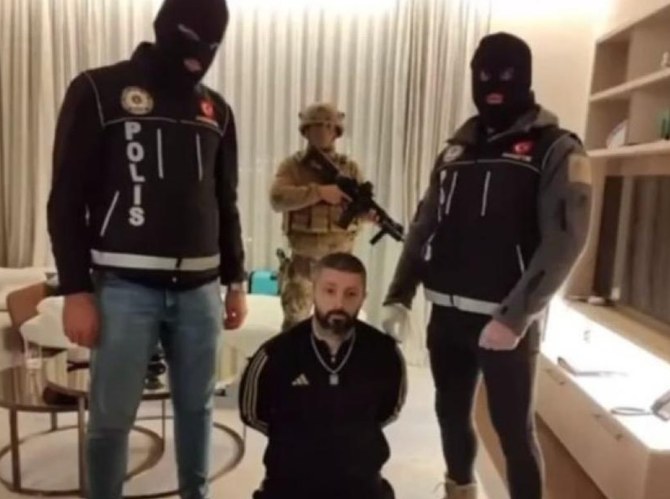
ANKARA: In a collaborative effort between Croatian and Turkish authorities, bolstered by Interpol’s support, Turkiye played a pivotal role in the apprehension of Nenad Petrak, a Croatian drug trafficker, during the early hours of Saturday in Istanbul.
The meticulously executed Operation Cartel-2 led to the arrest of Petrak, who was on Interpol’s red notice list for his alleged involvement in ferrying narcotics from South America into Europe.
He stands accused as the mastermind behind an expansive transnational criminal network involving widespread drug trafficking operations.
Petrak’s capture unfolded in Uskudar, located on the Anatolian side of Istanbul, as part of the broader Europe-wide initiative termed Operation Adriatica.
The Croatian Office for the Suppression of Corruption and Organized Crime’s report delineates Petrak’s footprint as a drug dealer operating across nine countries, a testament to the international scale of his illicit activities.
Turkish authorities had vigilantly tracked Petrak for an extended period, culminating in his apprehension during this operation.
Turkiye has intensified its anti-drug measures in recent weeks, signaling a concerted effort catalyzed further by the appointment of a new interior minister who has conducted dozens of anti-narcotics operations across the country.
This strategic push has reverberated across the region, marking a substantial impact on combating cross-border drug-related offenses.
Colin P. Clarke, director of research at The Soufan Group, thinks this is a crucial arrest against a critical node in transnational organized crime.
“So much of the international community’s efforts are focused strictly on counterterrorism, but taking down drug cartels is also essential to ensuring domestic stability,” he told Arab News.
“As we’ve seen with some of the drug trafficking groups in Europe, when these organizations grow too powerful, they can pose a significant danger to the public and the security services.”
Interior Minister Ali Yerlikaya took to his social media platform to affirm the nation’s commitment to eradicating domestic and international organized crime networks, denouncing them as purveyors of toxicity.
“Our resolve to rid our nation of these criminal organizations and drug peddlers remains resolute,” Yerlikaya said.
“Our relentless pursuit against drug traffickers and organized crime syndicates will escalate with unwavering determination.”
Petrak’s capture is expected to contribute to the ongoing global fight committed to dismantling drug cartels.
Last week, the ringleader of Kompanio Bello, another drug cartel, who was wanted with a red notice, was apprehended in Istanbul.
Authorities in Albania and Italy were seeking him for charges including “intentional homicide, drug trafficking, kidnapping, deprivation of liberty, forging travel documents, and (illegally) providing weapons and ammunition.”
The cartel leader Dritan Rexhepi had been put under international surveillance for a long time and entered Turkiye through Istanbul Airport with a Colombian passport under the alias Benjamin Omar Perez Garcia.
The operation was carried out through intelligence sharing with the Italian police.
Ersel Aydinli, professor at the international relations department at Bilkent University in Ankara, said a direct but unacknowledged relationship exists between transnational criminal activities and regional stability in international relations.
“When states fail to have good cooperation practices, this can lead to a potential surge in transnational illicit activities, from terrorism to organized crime. In recent decades, our region has seen high levels of human mobility, and along with this, naturally, a rise in levels of cross-border organized crime,” he told Arab News.
“As societies start to feel the effects of this, they put pressure on their governments, which in return begin cooperating more on these matters, using existing international instruments and agencies such as Interpol and Europol.”
According to Prof. Aydinli, these recent high-profile arrests indicate that states can collect valuable intelligence, share it effectively, and achieve concrete outcomes.
“They signal an end to any brief sense people might have had of a loss of control over these criminal networks and are also a signal to the criminal networks themselves that the era of relaxed business is over,” he said.
For Aydinli, regional security is always based on governments’ willingness to cooperate.
“These types of practices of cooperation are thus crucial because they serve as the foundations for larger security cooperation in the sense of being trust and confidence-building measures among the states and within the intergovernmental institutional capacities,” he said.
Turkish authorities apprehended in early July Isaac Bignan, also known as the “Black Mamba,” and Jurean Anthony Finix, a Dutch national — two key figures in the criminal organization led by Dutch drug lord Joseph Johannes Leijdekkers. They were both wanted by Interpol with a red notice.


![]()

Turkiye steps up commitment to combat cross-border drug networks
Short Url
https://arab.news/j7jsm
Turkiye steps up commitment to combat cross-border drug networks
- Direct, unacknowledged relationship exists between transnational criminal activities, regional stability in international relations, analyst says
- Petrak’s capture unfolded in Uskudar, located on the Anatolian side of Istanbul, as part of the broader Europe-wide initiative termed Operation Adriatica


Latest updates


© 2026 SAUDI RESEARCH & PUBLISHING COMPANY, All Rights Reserved And subject to Terms of Use Agreement.