

Celebrated Pakistani classical dancer says ‘escorted out’ of British event for Gaza ceasefire call

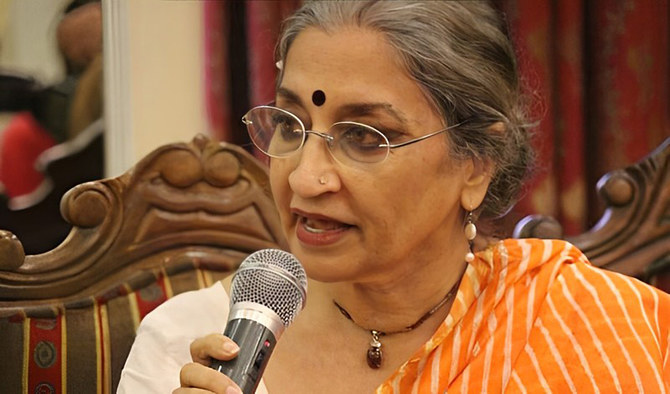
An undated file photo of Pakistani classical dancer and human rights activist Sheema Kermani. (Photo courtesy: Sheema Kermani/Facebook)
Short Url
Updated 18 November 2023
Follow

Celebrated Pakistani classical dancer says ‘escorted out’ of British event for Gaza ceasefire call

  • Sheema Kermani spoke up for peace in Gaza at a gathering arranged to celebrate King Charles’s birthday
  • British High Commission says she disrupted an important climate change speech before voluntarily leaving

KARACHI: Pakistan’s legendary classical dancer and leading human rights activist Sheema Kermani said on Saturday she was “escorted out” of an event at the British Deputy High Commission in Karachi after she called for peace in Gaza by raising the slogan “Ceasefire Now.” 

Israel besieged the Gaza Strip and launched airstrikes after a surprise attack was initiated by Hamas on Oct. 7 in response to the deteriorating condition of Palestinian people living under Israeli occupation. 

According to Palestinian health authorities, at least 12,000 people, including 5,000 children, have died in the area since the beginning of the Israeli offensive that has led to disproportionate killings of civilians in attacks on hospitals and residential neighborhoods. 

Western leaders, including British Prime Minister Rishi Sunak, visited Israel last month to express solidarity with its people in the wake of the Oct. 7 attack that led to the killings of about 1,200 Israelis. 

Kermani said she raised the slogan to seek an end to Israel’s relentless bombardment and military invasion of Gaza at a gathering arranged to celebrate King Charles’s birthday on Friday. 

“Amid the congratulations showered upon the British Government and the royal family, there was a visible absence of any acknowledgment of the atrocities unfolding in Gaza,” she said while speaking to Arab News. 

“Unable to remain silent, I felt compelled to take a stand and raised a slogan calling for ceasefire,” she continued. “Regrettably, as I was being escorted out and I left the gathering, none of the other attendees, not a single one, chose to join me in expressing their dissent.” 

Responding to Arab News’s query about the incident, a spokesperson of the British High Commission issued this written statement: “We are disappointed that an important speech on tackling climate change in Pakistan was interrupted at the UK’s National Day event. A disruptive guest was asked to stop shouting, but instead volunteered to leave and later apologised to High Commission staff.” 

Historians widely view the Israel-Palestine issue as an outcome of British colonialism since its authorities expressed support for the establishment of a national homeland for the Jewish people in Palestine in the 1917 Balfour Declaration. 

At the time, Palestine was part of the Ottoman Empire, and the declaration significantly influenced the future geopolitical landscape of the region. 

Britain was later granted the mandate to govern Palestine by the League of Nations after World War I. 

This period between 1920 and 1948 was marked by rising tensions and conflict between the Jewish and Arab populations, making it difficult for the British administration to balance the commitments made in the Balfour Declaration with the political and civil rights of the Arab population in Palestine. 


Pakistan launches $136 million Ramadan relief package for 12.1 million families

Updated 8 sec ago
Follow

Pakistan launches $136 million Ramadan relief package for 12.1 million families

  • Rs13,000 per family to be transferred via bank accounts, mobile wallets under cashless system
  • Pakistan’s national space agency says the Muslim fasting month is likely to begin from Feb. 19

ISLAMABAD: Prime Minister Shehbaz Sharif on Saturday launched a Rs38 billion ($136 million) Ramadan relief package, pledging direct digital cash transfers of Rs13,000 ($47) each to 12.1 million low-income families across Pakistan.

Pakistan’s national space agency announced a day earlier the Ramadan crescent would likely be visible on Feb. 18, with the first fast expected to fall on Feb. 19, subject to official confirmation.

The government will distribute the relief package through bank accounts and regulated mobile wallet platforms, fully replacing the previous utility store-based subsidy model with a digital payment mechanism overseen by the State Bank of Pakistan.

“This year, Rs38 billion have been allocated ... that will not only be distributed to the rightful people in all four provinces, but also to Gilgit-Baltistan and Azad Kashmir through these wallets and digital bank accounts,” the prime minister said during a ceremony in the federal capital, adding that 12.1 million families would benefit.

The allocation marks a sharp increase from last year’s Rs 20 billion ($72 million) Ramadan program, as the government expands coverage and deepens its shift toward cash-based targeted subsidies.

Officials said Rs28 billion ($101 million) has been earmarked for families not currently receiving support under any federal income assistance program, while an additional Rs10 billion ($36 million) will go to those already registered under existing social protection schemes.

Syed Imran Shah, federal minister for poverty alleviation and social security, said the digital framework would allow transfers to be made in a “safe, effective and easy way,” reducing leakages and preserving beneficiaries’ dignity by eliminating long queues and physical distribution centers.

Amir Ali Ahmed, secretary of the Benazir Income Support Program (BISP), said the 2026 rollout builds on last year’s digital transition, when around two million beneficiaries received payments electronically.

A third-party validation report issued in December 2025 confirmed the transparency and operational effectiveness of the system, he added.

The prime minister said he would personally oversee periodic reviews of the program to ensure timely disbursement.

The government had scrapped the Utility Store-based Ramadan subsidy system last year, arguing that it led to quality concerns, long queues and administrative inefficiencies.

The digital transfer model aims to move toward a targeted subsidy regime aligned with broader efforts to expand financial inclusion and reduce cash-based leakages.