

A Pakistani fisherwoman and her companion: the sea

This picture taken on November 15, 2023, shows Pakistani fisherwoman Hakima Omar, 63, displaying a catch in the waters off Rehri Goth coastal village in Karachi. (AN Photo)
Short Url
Updated 18 November 2023
Follow

A Pakistani fisherwoman and her companion: the sea

  • Hakima Omar, 63, has been fishing for over three decades to fend for her six children and ailing husband
  • Untreated waste, oil spills from Karachi’s two ports have endangered marine life and livelihoods of fisherfolk

KARACHI: Balancing a lightweight fiber boat on her head, 63-year-old Hakima Omar walked to a weathered jetty this week, then set her boat on the water and paddled into the deep sea where, with practiced hands, she threw her net into the water.

This has been a four-decade-long morning routine for Omar, one of a handful of fisherwomen working on Karachi’s coast by the Arabian Sea.

The mother of six became the family’s sole breadwinner when her husband fell seriously ill about three decades ago. Today, in the twilight of her life, it is sheer determination and a love for the sea that propels her to pedal her boat into the sea day in and out and bring back catch to sustain her family.

“I have a love for the river and the sea and my love for it doesn’t end,” Omar told Arab News as she anchored her boat several miles from the Karachi shore.

“They [my kids] tell me to stay home because I’m an old woman, but I’ve been doing this since childhood, so I can’t just stay still, I enjoy it a lot. I catch fish and crabs, and I look forward to it.”
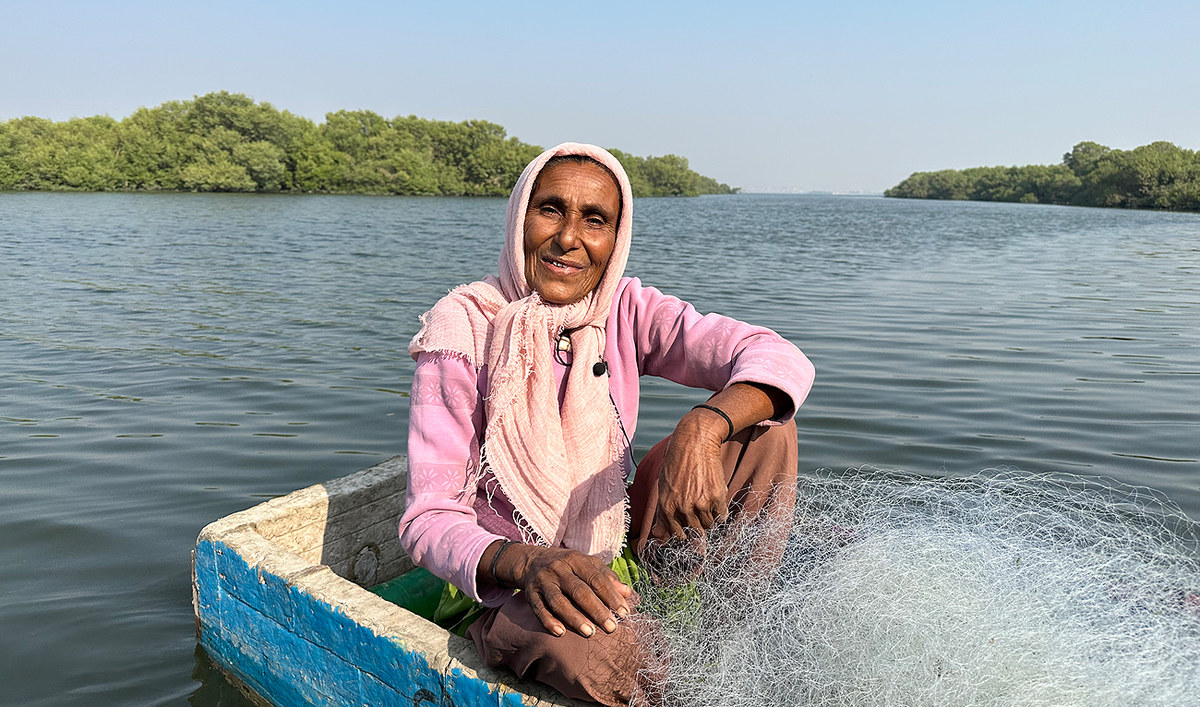


In this picture taken on November 15, 2023, a Pakistani fisherwoman, Hakima Omar, 63, gestures during an interview with Arab News near Rehri Goth coastal village in Karachi. (AN Photo)

Even rain, storms and high tides in the river can’t deter Omar from fishing: “I’d be fishing sitting on the branch of a tree.”

Omar said she sold some of the fish she caught, making profits of up to Rs2,500 ($9) a day, and took the leftover home to her family:

“If I don’t come to the sea and fish, then we only eat plain bread at home … When fish gets expensive, we can’t buy it for eating and selling. If I go and fish myself then I can both eat and sell. I am also in some debt, so I can only pay it off through fishing.”

But fishing used to be much easier in the past, Omar said. Untreated waste and oil spills from Karachi’s two ports have endangered marine life and the livelihoods of Pakistan’s fisherfolk in recent years.

“You’d just be able to catch fish right outside your home in shallow waters [in the past], but now you have to cover miles to fish in deeper waters and work harder because of the pollution and muddy waters,” Omar said.

Passing ships also make the job hard for fisherfolk like Omar who use light boats.


In this picture taken on November 15, 2023, a Pakistani fisherwoman, Hakima Omar, paddles her boat in the waters off Rehri Goth coastal village in Karachi. (AN Photo)

“Whenever a ship passes by, the waves and flow get higher and I have to move to the shore,” she said.

“Whenever I see a ship, I come back to the shore and then go back to deep waters when the ship has passed by, and the waves calm down.”

There were many times when she had fallen off her boat and had to swim back to it, Omar recalled, saying no one had come to her help.
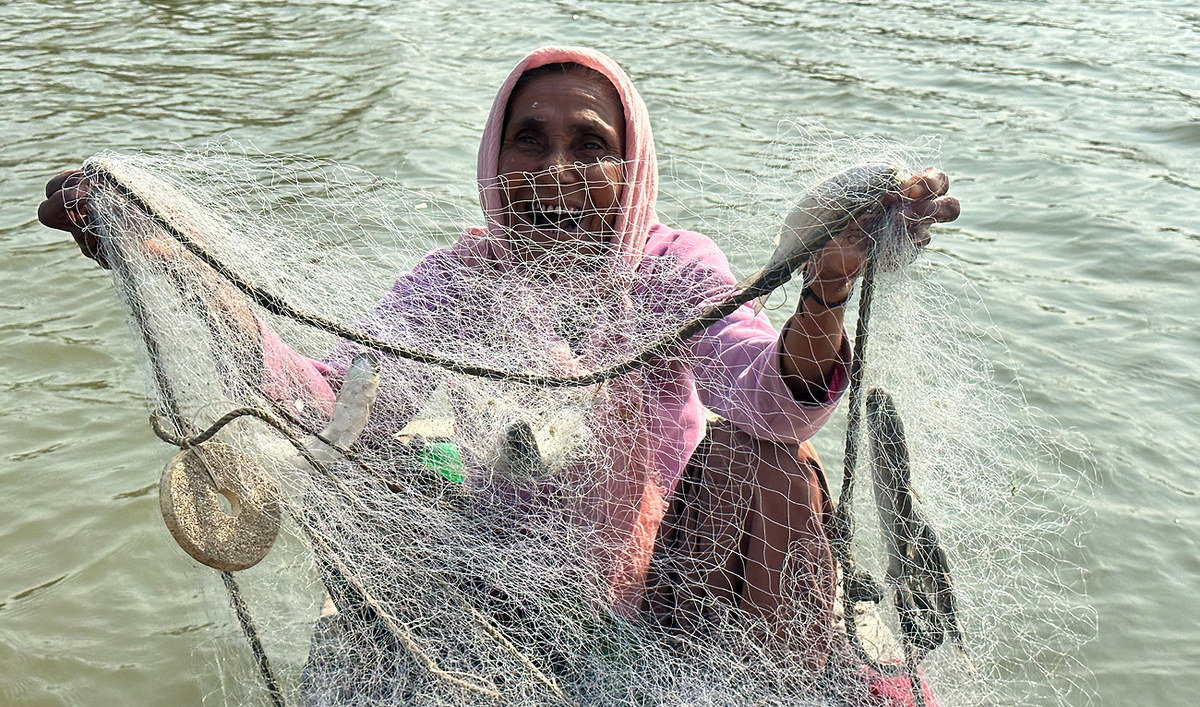


This picture taken on November 15, 2023, shows Pakistani fisherwoman Hakima Omar, 63, displaying a catch in the waters off Rehri Goth coastal village in Karachi. (AN Photo)

“It’s not because of any man that I’ve become capable of doing this … Allah helps and wills. That’s why I’m able to work hard,” she said.

Her husband, Omar Haroon, who has acute kidney disease and stays at home, said he admired his wife’s courage and dedication to family.

“Previously I was the breadwinner and she was the housewife,” Haroon said with a smile. “Now, I am the housewife and she is the breadwinner.”
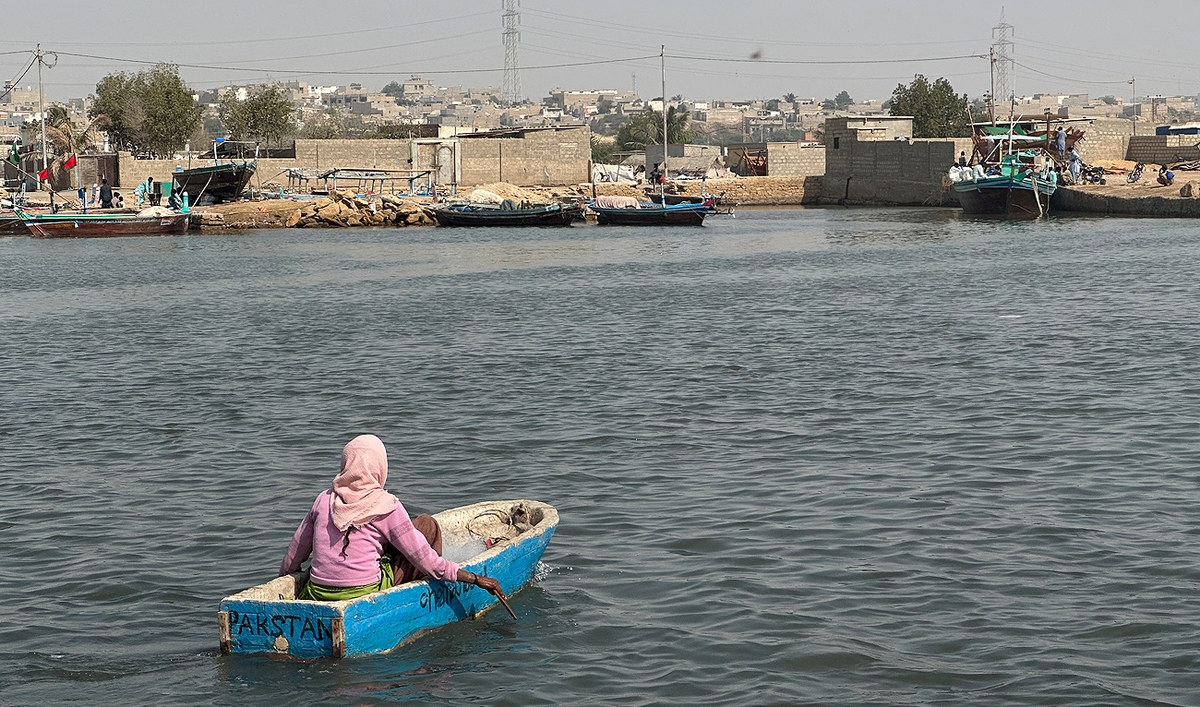


In this picture taken on November 15, 2023, a Pakistani fisherwoman, Hakima Omar, paddles her boat in the waters off Rehri Goth coastal village in Karachi. (AN Photo)


Pakistan approves upgrades to national ID cards in push to strengthen digital ecosystem

Updated 24 February 2026
Follow

Pakistan approves upgrades to national ID cards in push to strengthen digital ecosystem

  • The amendments allow for QR-based verification, authentication controls, biometric expansion, and card format updates
  • The measures advance integrated digital governance through National Data Exchange Layer and broader digital ID ecosystem

ISLAMABAD: Pakistan has notified amendments to the National Identity Card and Pakistan Origin Card rules and introduced QR-based verification and stronger fraud controls, the National Database and Regulatory Authority (NADRA) said on Tuesday, amid efforts to strengthen the country’s digital ecosystem.

The amendments modernize Pakistan’s identity document framework by legally embedding QR-based verification, strengthening authentication controls across digital services, expanding biometric recognition and updating card formats for key citizen categories.

A core reform is the statutory introduction of the Quick Response (QR) code as a defined security and verification feature, authorizing the use of “QR code or any other technological feature” in lieu of current microchip enabling NADRA to adopt evolving verification technologies without repeated rule amendments.

This QR-enabled capability directly strengthens Pakistan’s Digital ID ecosystem and supports interoperability through the National Data Exchange Layer, according to the national database regulator.

“This establishes a robust legal basis for quick and secure verification of identity credentials in both offline and online environments,” NADRA said.

“This will also enable all citizens to carry similar card instead of currently prevalent two types of national identity cards one of which is with microchip and the other without.”

Pakistani state media reported in August that the country was developing digital identities of all its citizens to enable secure and efficient payments. The measures came as part of a broader effort to digitize the economy for greater transparency.

QR-based credentials allow rapid front-end validation of identity attributes in service delivery settings, while also enabling back-end systems to confirm authenticity and status through trusted exchanges. This is expected to improve speed, transparency and consistency of identity verification across government entities and regulated sectors, reduce manual handling, and lower the risk of fraud and impersonation, according to NADRA.

The amendments also strengthen the enforcement effect of card suspension. The Rules now clarify that where a card is suspended, all verification, authentication and related services linked to that card shall stand suspended forthwith. This closes a key risk area by ensuring that once a card is suspended, it cannot continue to be used through digital verification channels or institutional authentication processes.

“The amendments also introduce standardized identification for residents of Azad Jammu and Kashmir by requiring an inscription indicating ‘Resident of Azad Jammu and Kashmir’ in the manner specified by the Authority, thereby ensuring uniform geographic identification on the document,” NADRA said.

“Overall, these amendments strengthen the legal and technological foundations of Pakistan’s identity system by enabling secure QR-based verification, reinforcing the integrity of digital authentication services, improving biometric assurance,” it said. “They also advance readiness for integrated digital governance by supporting structured interoperability through the National Data Exchange Layer and a broader Digital ID ecosystem.”