NEW DELHI: When Mohana Talapatra returned to Delhi to care for her aging parents, she planned to stay for good, but last year, after they both died, she left for Bangalore to save her own health and life.
Brought up in the Indian capital, she had been away since 1995 — first to study abroad and then to work. Adjusting to her hometown after more than two decades of absence was not easy, marred by constant illness.
“The first thing that hit me in Delhi once I returned in 2017, was the burning eyes, nausea and persistent headaches,” she told Arab News.
“At first, I couldn’t place the cause and medical tests did not surface any serious issue.”
Talapatra soon started connecting her worsening symptoms to Delhi’s poor air quality after noticing they vanished whenever she traveled outside the city. The urgency grew in 2023, when she was hospitalized with severe bronchial asthma and struggled to breathe.
“I didn’t think I would have survived if I hadn’t checked myself into the hospital at the time. It took three months and a full course of steroids to clear. That was the final tipping point for me to make this decision about leaving Delhi,” she said.
“In 2025, after I lost my mother, I knew there was no more reason to continue staying in this gas chamber, and risking my lungs and my life.”
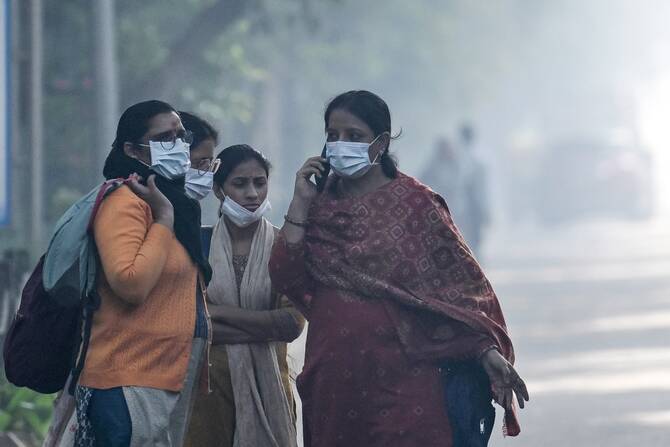
Talapatra is one of many Delhiites who decided to leave the city or are planning to because of its increasingly toxic air.
Home to 30 million people, Delhi has not recorded an Air Quality Index, or AQI, below 50 — the threshold for “good” air — since Sept. 10, 2023.
The city’s AQI over the past few months has usually been above 370, or “very poor,” often hitting 400, which means “severe” air quality, with certain areas recording even 500 and above, which is classified as “hazardous.”
According to a study conducted last month by community-based civic engagement platform LocalCircles, 82 percent of Delhi residents surveyed had one or more persons in their close network with a severe health condition due air pollution. At least 73 percent were worried about being able to afford future healthcare for their family if they continued to reside in Delhi, and at least 8 percent were planning to “move out soon” from the capital region.
“I try to get away from Delhi as much as possible, for as many months as possible and as many weeks as possible, to go to cities where there is less pollution,” said Sreekara Adwaith, a 24-year-old who grew up in Delhi and has faced lung issues in childhood.
While he functions normally and is generally healthy, during the worst pollution periods in winter, his respiratory problems return if he stays in the city.
“The problem with the Delhi pollution season is that you never feel healthy, like, throughout those two to three months, you’re just constantly sick and coughing,” he said.
“I think it is really difficult to live with that ... My family, luckily, all of them still live in Hyderabad, so I go to Hyderabad whenever I can. The air is not like a lot better — it’s still bad in Hyderabad — but nothing compares to Delhi.”
Pollution in New Delhi and its satellite cities such as Gurgaon, Noida and Ghaziabad arises from a combination of factors. On a regional scale, stubble burning in neighboring states and biomass burning for heating contribute to the smog. Locally, vehicle emissions, urban waste burning and dust from construction sites add to the problem, which is further aggravated by weather conditions.
In winters, cold temperatures and low wind speeds cause a temperature inversion, which traps pollutants close to the ground instead of letting them disperse, turning the city’s already polluted air into a hazardous haze.
“We have lived with this problem for three decades, and irrespective of the party in power, they have all failed the citizens,” said Chetan Mahajan, who left a corporate career and moved out of Gurgaon in 2015.
“Pollution is annual and predictable. We understand the causes well. We need to approach it like a scientific problem ... The science isn’t hard to understand, but the lack of political will is.”
He remembers how in the 1980s Delhi had winters when people could see the sky and the sun was not blocked by smog. But his son had no chance to experience the Delhi he knew from the past and at the age of 6 started to develop respiratory conditions and wheeze.
“The doctors said that this would be the new normal, and we should buy the nebulizers and put him on medication if we wanted to stay in the city,” Mahajan said.
“We decided not to stay. It took some time to plan, and when I got laid off from my job, it was not a downer but a huge relief.”
He moved his family to a mountain village in Uttarakhand, where his son’s health quickly improved. He would soon go for 20-km hikes and from a frail child grew into his school’s sports captain.
Mahajan now runs the Himalayan Writing Retreat for emerging authors, which offers workshops and writing space — and a life in which returning to Delhi is out of the question.
“The mountains give one a wonderful, simple life, and one that allows mind space and quiet,” he said. “Even if they fixed the air, we would not go back.”