

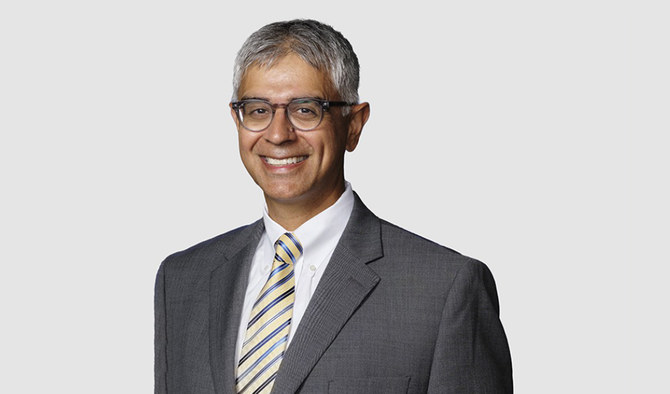
President Biden nominates first Pakistan-born, Muslim-American judge on federal appeals court

An undated file photo of Adeel Mangi. (Photo courtesy: social media)
Short Url
Updated 16 November 2023
Follow

President Biden nominates first Pakistan-born, Muslim-American judge on federal appeals court

  • During his career, Adeel Mangi represented Muslim community in New Jersey in its quest to open mosques in the area
  • Mangi’s nomination comes at a time when Biden administration is facing criticism for supporting Israel’s war in Gaza

ISLAMABAD: US President Joe Biden on Wednesday nominated a leading lawyer as the first Pakistan-born, Muslim-American judge on a federal appeals court, amid criticism of his Middle East policy following Israel’s Gaza attack, ahead of next year’s elections.
Biden nominated New Jersey attorney Adeel Mangi to join the Philadelphia-based 3rd US Circuit Court of Appeals.
Mangi, who was born in Pakistan, started his legal career more than two decades ago at Patterson Belknap and became a partner in 2010. During his professional journey, he successfully fought a case on behalf of the Muslim community in New Jersey that wanted to establish mosques in Bernards Township and Bayonne.
According to Reuters, his nomination is in line with the Biden administration’s decision to diversify the federal judiciary.
“I applaud @POTUS's nomination of Adeel Mangi to serve on the U.S. Court of Appeals for the Third Circuit,” Senator Bob Menendez from New Jersey proclaimed in a social media post. “I was honored to call him and share that I would strongly encourage the President to make him the first Muslim American nominated for a seat on our federal appeals courts.”

The US-based NBC News reported that Mangi’s nomination has been made at a time when the Biden administration has been facing increasing pressure to address Islamophobia following the recent Israel-Gaza conflict.
“Some Muslim voters have expressed frustration with Biden’s declaration last month of unwavering support for Israel without seeking a cease-fire,” it added.


Pakistan says repaid over $13.06 billion domestic debt early in last 14 months

Updated 29 January 2026
Follow

Pakistan says repaid over $13.06 billion domestic debt early in last 14 months

  • Finance adviser says repayment shows “decisive shift” toward fiscal discipline, responsible economic management
  • Says Pakistan’s total public debt has declined from over $286.6 billion in June 2025 to $284.7 billion in November 2025

KARACHI: Pakistan has repaid Rs3,650 billion [$13.06 billion] in domestic debt before time during the last 14 months, Adviser to the Finance Minister Khurram Schehzad said on Thursday, adding that the achievement reflected a shift in the country’s approach toward fiscal discipline. 

Schehzad said Pakistan has been repaying its debt before maturity, owed to the market as well as the State Bank of Pakistan (SBP), since December 2024. He said the government had repaid the central bank Rs300 billion [$1.08 billion] in its latest repayment on Thursday. 

“This landmark achievement reflects a decisive shift toward fiscal discipline, credibility, and responsible economic management,” Schehzad wrote on social media platform X. 

Giving a breakdown of what he said was Pakistan’s “early debt retirement journey,” the finance official said Pakistan retired Rs1,000 billion [$3.576 billion] in December 2024, Rs500 billion [$1.78 billion] in June 2025, Rs1,160 billion [$4.150 billion] in August 2025, Rs200 billion [$715 million] in October 2025, Rs494 billion [$1.76 billion] in December 2025 and $1.08 billion in January 2026. 

He said with the latest debt repaid today, the July to January period of fiscal year 2026 alone recorded Rs2,150 billion [$7.69 billion] in early retirement, which was 44 percent higher than the debt retired in FY25.

He said of the total early repayments, the government has repaid 65 percent of the central bank’s debt, 30 percent of the treasury bills debt and five percent of the Pakistan Investment Bonds (PIBs) debt. 

The official said Pakistan’s total public debt has declined from over Rs 80.5 trillion [$286.6 billion] in June 2025 to Rs80 trillion [$284.7 billion] in November 2025. 

“Crucially, Pakistan’s debt-to-GDP ratio, around 74 percent in FY22, has declined to around 70 percent, reflecting a broader strengthening of fiscal fundamentals alongside disciplined debt management,” Schehzad wrote. 

Pakistan’s government has said the country’s fragile economy is on an upward trajectory. The South Asian country has been trying to navigate a tricky path to economic recovery under a $7 billion loan from the International Monetary Fund.