ISLAMABAD: The International Monetary Fund (IMF) announced it had reached a staff-level agreement with Pakistan on Wednesday on the first review of a nine-month standby arrangement (SBA), paving the way for Islamabad to receive a second tranche of around $700 million from the lender.
Pakistan and the IMF on Wednesday concluded talks for the completion of the first review of a $3 billion standby arrangement (SBA) signed in July this year. Islamabad has already received $1.2 billion from the fund and is expecting another $700 million after the completion of the latest review and formal approval by the IMF’s Executive Board.
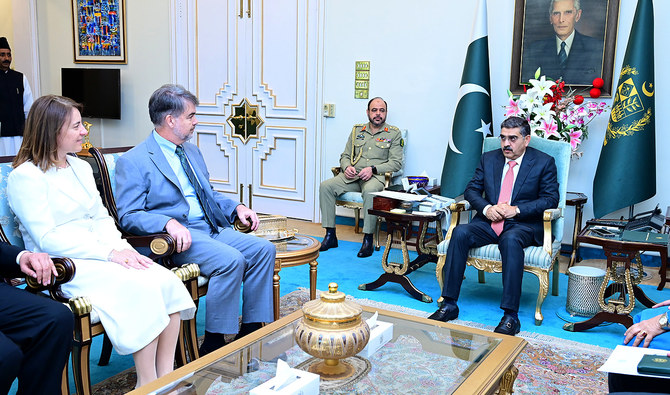
The development took place shortly after Prime Minister Anwaar-ul-Haq Kakar met IMF’s mission chief in Pakistan, Nathan Porter and the lender’s resident representative for the country, Esther Perez Tuiz. Kakar assured the IMF officials of Pakistan’s “enduring commitment” to reform agreements with the international lender, the Prime Minister’s Office (PMO) said.
“The IMF team has reached a staff-level agreement (SLA) with the Pakistani authorities on the first review of their stabilization program supported by the IMF’s $3 billion (SDR2,250 million) SBA,” Porter said in a statement.
“The agreement is subject to approval of the IMF’s Executive Board. Upon approval around $700 million (SDR 528 million) will become available bringing total disbursements under the program to almost $1.9 billion,” he added.
Porter said the “steadfast execution” of FY24 budget, continued adjustment of energy prices and renewed flows into the foreign exchange market, have lessened fiscal and external pressures on Pakistan’s economy.
“Inflation is expected to decline over the coming months amid receding supply constraints and modest demand,” the statement said. “However, Pakistan remains susceptible to significant external risks, including the intensification of geopolitical tensions, resurgent commodity prices, and the further tightening in global financial conditions.”
The IMF said Pakistan’s policy priorities included fiscal consolidation to reduce public debt while protecting development needs. It acknowledged Pakistan’s move to increase gas prices and adjust energy tariffs this year, saying that the painful measures were necessary.
“While these increases were substantial, they were necessary to avoid further arrears that threatened the viability of these sectors and the provision of critical energy supplies,” Porter said.
He said Pakistani authorities realize that the rupee must remain market-determined to sustainably alleviate external pressures and build reserves. “To support this, they plan to strengthen the transparency and efficiency of the FX market and to refrain from administrative actions to influence the rupee,” the statement said.
Porter said Islamabad was moving ahead with its policy to privatize select state-owned enterprises (SOEs). It said high governance and transparency standards will apply to the management of assets owned by the newly created Sovereign Wealth Fund (SWF) and managed by the Special Investment Facilitation Council (SIFC).
“To further strengthen governance, the authorities will ensure public access to asset declarations from Cabinet members and a task force, with participation from independent experts, will complete a comprehensive review of the anticorruption framework,” he said.
Porter said Pakistani authorities have accelerated engagement with multilateral and official bilateral partners. “Timely disbursement of committed external support remains critical to support the authorities’ policy and reform efforts,” he added.
The IMF approved the SBA for Pakistan last year at a time when the South Asian country was struggling to bridge an external financing gap to avert a sovereign debt default.
To ensure the review went smoothly, Pakistan’s interim administration has implemented a raft of tough financial measures in recent months to secure the IMF backing, including hikes in electricity and fuel prices as well as interest rates, which led to intense inflationary pressure on the economy.
With elections on the horizon for early next year, experts believe essential reforms are likely to be rolled out during the tenure of the caretaker government, as an elected administration may hesitate to impose stringent financial measures.


![]()

Pakistan reaches staff-level agreement with IMF on first review of bailout program
Short Url
https://arab.news/wj4n5
Pakistan reaches staff-level agreement with IMF on first review of bailout program
- Pakistan inches closer to receiving $700 million, the second tranche of a 9-month IMF program
- IMF says Pakistan recognizes rupee must remain market-determined, select SOEs must be privatized
Latest updates


© 2026 SAUDI RESEARCH & PUBLISHING COMPANY, All Rights Reserved And subject to Terms of Use Agreement.