UN agency confirms Pakistan has extended validity of Afghan refugee cards until year-end

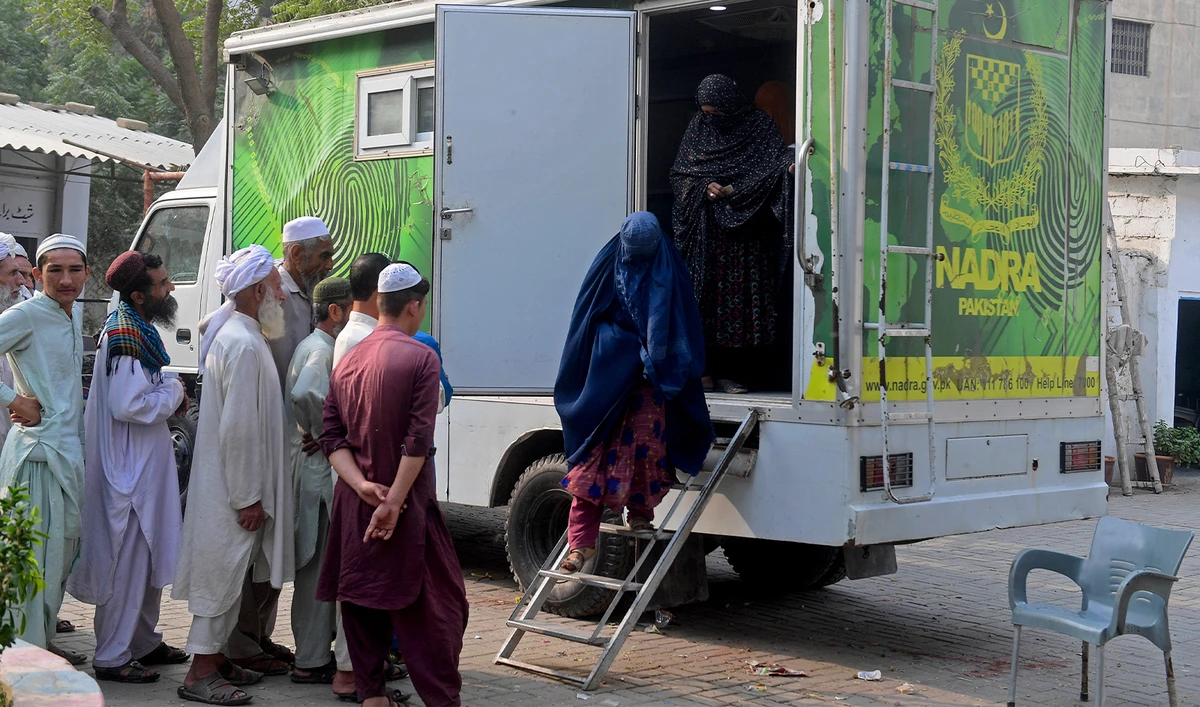
Afghan burqa-clad women refugees walk out of a National Database and Registration Authority (NADRA) van after their data verification, at a police station in Karachi on November 8, 2023. (AFP/File)
Short Url
Updated 15 November 2023
Follow

UN agency confirms Pakistan has extended validity of Afghan refugee cards until year-end

  • The announcement comes at a time when Pakistan has launched a deportation drive against unregistered foreigners
  • Pakistan has said it will also repatriate registered refugees to Afghanistan once undocumented foreigners are sent back

ISLAMABAD: The United Nations Refugee Agency (UNHCR) in Pakistan circulated a notification issued by the administration in Islamabad on Tuesday, saying the validity of the identity documents specifically designed for Afghan refugees had been extended until the end of the year.

The announcement comes at a time when Pakistan has launched a crackdown against unregistered foreigners, most of them Afghans, after giving them a brief deadline last month to voluntarily return to their countries.

The Pakistani authorities cited security reasons for its decision amid a fresh wave of suicide bombings in different parts of the country, saying that Afghan nationals carried out over a dozen of these attacks since the beginning of the year.

According to official estimates, there are nearly 1.7 million undocumented Afghan nationals in the country. However, the government’s deportation drive has also triggered uncertainty among registered refugees, many of whom have said that they have been harassed by the police in recent weeks.

According to the latest statistics compiled by the home department of northwestern Khyber Pakhtunkhwa province, 211,969 Afghan nationals had returned to their country by crossing Torkham border alone by November 14. 

Last week, Pakistani officials said they would initiate the process of returning these refugees once all the undocumented foreigners were sent back to their countries.

“Important announcement for Afghan @Refugees,” the UNHCR proclaimed from its official account on X. “Proof of Registration (PoR) cards are extended until 31 December 2023.”

It shared a relevant notification brought out by Pakistan’s Ministry of States & Frontier Region on November 10 with the post.

“In pursuance of the approval of the Federal Cabinet conveyed vide Cabinet Division’s Memorandum No. 941(S)/2023-Cab dated 10th November, 2023, Government of Pakistan is pleased to extend the validity of the Proof of Registration (PoR) Cards issued to the registered Afghan Refugees by NADRA, till 31st December, 2023,” the notification said.

The PoR cards entitle Afghan refugees to legally remain in the country. Issued by the National Database Registration Authority (NADRA), they are crucial for the social and economic integration of refugees, allowing them to move freely for work, education, and other personal reasons.

Pakistan started admitting large numbers of Afghan refugees after the beginning of the Soviet-Afghan war in 1979. According to the UNHCR, their number crossed more than four million by the end of 2001.

A recent exodus of Afghan nationals began after the Taliban swept back to power in Kabul, following the withdrawal of US-led international forces from the war-battered country in August 2021.
Opposition demands Imran Khan hospital transfer as government assures specialized examination

Updated 4 sec ago
Follow

Opposition demands Imran Khan hospital transfer as government assures specialized examination

  • Khan’s family says he spoke to his sons for 20 minutes, calls for urgent treatment under personal doctors
  • Former health minister warns ex-PM’s vision loss could be ‘irreversible’ without immediate intervention

ISLAMABAD: Pakistan’s opposition protest entered its second day on Saturday as its leaders demanded that jailed former prime minister Imran Khan be shifted to a private hospital for urgent eye treatment, amid the government’s assurance that his examination would be conducted at a specialized medical institution.

A group of leaders belonging to Tehreek-e-Tahafuz-e-Ayeen-e-Pakistan — or the Movement to Protect the Constitution of Pakistan — gathered outside Parliament House a day after its members started a sit-in, as police maintained a heavy security presence around the building and nearby roads.

Salman Akram Raja, the secretary general of Khan’s Pakistan Tehreek-e-Insaf (PTI) party, called for the former premier’s early transfer for treatment at Islamabad’s Shifa International Hospital.

“We have been told that there is consent to take him to Shifa International,” he said in a video message. “If that is the case, there should be no delay. We are also being told that one member of Khan’s family will be allowed to accompany him.”

Raja said Khan’s treatment should come first, followed by his release.

“Restoration of the Constitution and rule of law in this country has now become inevitable,” he added.

Separately, Mustafa Nawaz Khokhar, another politician, told a news conference at the National Press Club that the opposition’s only demand was that Khan be granted full access to the required medical facilities.

“He has already lost vision in one eye,” he told the media.

“His treatment should take place in the presence of his family,” he continued. “Until this demand is met, we will not step back.”

Dr. Zafar Mirza, a former health minister under Khan’s administration who accompanied Khokhar, said Khan was suffering from central retinal vein occlusion, a serious eye condition that can lead to permanent vision loss if not treated promptly.

“If intervention is not carried out even now, it is possible that he may never be able to see from one eye again,” he said, warning that the extent of the damage remained unclear and could be irreversible.

Earlier in the day, Khan’s legal team filed a petition in the Islamabad High Court seeking suspension of his 17-year prison term in a graft case and his release on medical grounds, citing what they described as his deteriorating health.

Khan’s sister, Aleema Khan, said in a post on X that the former premier had spoken to his sons for about 20 minutes following a direction from the chief justice of Pakistan and that the family was now awaiting urgent treatment at Shifa International Hospital under the supervision of his personal doctors.

“We cannot and will not tolerate any further delay,” she said.

Information Minister Attaullah Tarar said in a social media post that Khan’s further examination and treatment would be conducted at a “specialized medical institution” and that a detailed report would be submitted to the Supreme Court.

“Conjecture, speculation and efforts to turn this into political rhetoric and mileage for vested interests may please be avoided,” he added.

The opposition protest followed a report submitted to the Supreme Court this month by amicus curiae Barrister Salman Safdar, who visited Khan at Rawalpindi’s Adiala jail and recommended that the seriousness of his ocular condition be independently assessed without delay.

Medical documents cited in the filing mentioned drastically reduced vision in Khan’s right eye, which led prison authorities to take him to a government hospital where he underwent an intravitreal injection.

Khan’s party said his family and legal team were not informed about the development, which was first mentioned in a local media report.

The PTI has blamed the government for negligence leading to damage to Khan’s vision, though the allegation has been denied by federal ministers who say that the case is being monitored by the country’s top court while promising “best possible treatment.”

Support for Khan also came from former Pakistani cricketers who played under his captaincy during Pakistan’s 1992 World Cup victory.

Ramiz Raja said on X that seeing Khan “suffer and lose sight in one eye is an emotional meltdown,” while Wasim Akram wished him “strength, a speedy recovery, and a full return to good health.”

Waqar Younis urged that politics be put aside and called for Khan’s timely treatment.

Khan, 73, has been in custody since August 2023 in connection with multiple cases that he and his party say are politically motivated, an allegation the government denies.