QUETTA: Pakistan on Monday opened three new border crossings to expedite the deportation of Afghans living in the country illegally, officials said.
Nearly 300,000 Afghans have left Pakistan in recent weeks since authorities started arresting and deporting foreign nationals without papers after the Oct. 31 deadline for migrants without legal status to leave the country voluntarily.
The expulsions mostly affect Afghans, who make up the majority of foreigners in Pakistan. It has drawn criticism from the Taliban-led government in Afghanistan as well as human rights organizations.
The number of border crossings used to deport thousands of Afghans rose to five after the new facilities were opened in southwestern Baluchistan province, said Jan Achakzai, the caretaker provincial information minister.
Currently, about 15,000 Afghans have been crossing the border every day from Pakistan. Before the crackdown, around 300 people were crossing each day.
International aid agencies have documented chaotic and desperate scenes among Afghans who have returned from Pakistan.
Achakzai said police in Baluchistan in recent days had arrested more than 1,500 Afghans who had no valid documents.
A prominent Pakistani human rights lawyer, Moniza Kakar, said in the southern port city of Karachi that police had launched midnight raids on homes and detained Afghan families, including women and children.
The head of the Human Rights Commission of Pakistan, Hina Jilani, said Pakistan lacks a comprehensive mechanism to handle refugees, asylum-seekers and migrants without papers, despite hosting Afghans for 40 years.
Violence against Pakistani security forces and civilians has surged since the Taliban takeover of Afghanistan two years ago. Most attacks have been claimed by the Pakistani Taliban, the Tehreek-e-Taliban Pakistan, or TTP, a separate militant group but a close ally of the Afghan Taliban.
Pakistan often accuse the Taliban of harboring militants from groups like the TTP — allegations the Taliban deny — and said Afghans without permanent legal status are responsible for some of the attacks.
Pakistan has long hosted millions of Afghans, most of whom fled during the 1979-1989 Soviet occupation. More than half a million fled Afghanistan after the Taliban takeover.


Pakistan opens 3 new border crossings to deport Afghans in ongoing crackdown on migrants

https://arab.news/pkawv
Pakistan opens 3 new border crossings to deport Afghans in ongoing crackdown on migrants

- Nearly 300,000 Afghans have left Pakistan in recent weeks since Pakistan widened crackdown against illegal immigrants
- Number of border crossings used to deport Afghans have now risen to five, says Balochistan government official
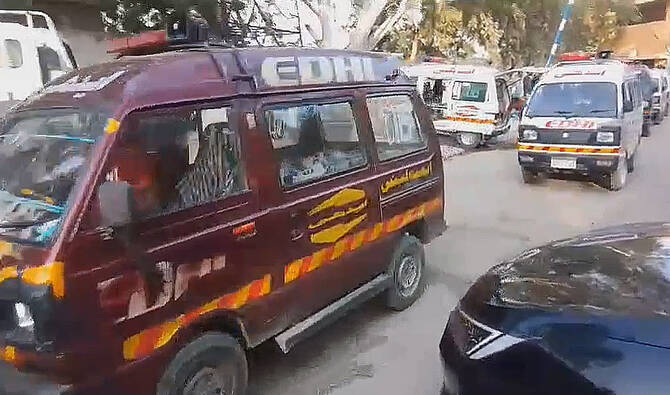
13 killed in motorway crash near Karachi, says provincial minister
- Rescue teams arrive at the site, move injured passengers to hospitals
- Zia-ul-Hasan Lanjar says traffic was restored after the incident
ISLAMABAD: At least 13 people were killed in a motorway accident on the outskirts of Karachi on Friday, according to a senior Sindh administration minister, with few details available about what caused the fatal road crash.
Sindh Home Minister Zia-ul-Hasan Lanjar expressed “deep sorrow and grief” over the incident and extended condolences to the families of the victims in a statement.
“The Senior Superintendent of Police (SSP) in Malir has confirmed that 13 people have been killed in the accident,” Lanjar said.
“I have directed that the injured be provided immediate and the best possible medical facilities, and instructed the relevant authorities to further expedite relief activities,” he added.
The statement said a heavy contingent of local police was present at the scene and the situation was under control.
The minister also noted that Rescue 1122 teams were present at the site and that injured passengers were shifted to nearby hospitals.
He said authorities had cleared the road and restored traffic flow.
Fatal road accidents are common in Pakistan, where traffic regulations are often poorly enforced and drivers frequently ignore speed limits.
Such crashes are particularly frequent in southern parts of the country, where single-carriage highways connect cities and towns.


